



3 Daily Habits That Shift Your Factory from Reactive Chaos to Proactive Control
You’ve been in the factory an hour, but you’re already on your third coffee and your second crisis. The phone rings. It’s your biggest customer, chasing that urgent order that was meant to ship yesterday. At the same time, your shop floor supervisor grabs you because Machine 3 is making that noise again, the one that usually precedes a very expensive silence. A key member of the assembly team has called in sick, and the materials for the next big job haven’t arrived.
Your day, which was supposed to be about planning for next quarter, is now a frantic game of whack-a-mole. You’re pulling people off jobs to fight fires, rejigging the schedule on the back of a scrap of paper, and making promises you’re not entirely sure you can keep. By the end of the day, you’re exhausted. You’ve worked incredibly hard, your team has performed heroics, and the big crisis was averted… just. But you know, deep down, that you’ll be doing it all again tomorrow.
This is the daily reality for so many leaders in small and medium-sized manufacturing businesses. It’s a state of constant, stressful, reactive chaos. We’re so busy dealing with the urgent that we never get a chance to tackle the important.
The core problem isn’t that you or your team aren’t working hard enough. I’d bet you’re all working flat out. The problem is the absence of a simple, daily rhythm. A rhythm that gives you visibility of what’s really happening, a clear set of priorities everyone understands, and a structured way to solve problems before they become full-blown emergencies.
What if I told you that you could fundamentally change this dynamic? That you could shift from firefighting to factory control, not with a massive, expensive six-month Lean transformation project, but with three small daily habits. Habits that take no more than 10 to 15 minutes each. Sounds too simple, right? Stick with me. Because these three routines, when done consistently, create an operating system for your shop floor that delivers proactive control, one day at a time.
The Two Worlds: Reactive Chaos vs. Proactive Control
Before we get into the habits, let’s quickly paint a picture of these two different worlds. I think you’ll recognise the first one.
The reactive factory runs on adrenaline and heroics. Surprises are the norm. The first you hear of a problem is when it’s already a crisis. The schedule is more of a hopeful suggestion than a plan. Information lives in people’s heads or on scattered spreadsheets, and communication happens in panicked phone calls or rushed conversations by the water cooler. The heroes are the people who can pull a rabbit out of a hat at the last minute, the master firefighters. The trouble is, when your factory needs heroes just to get through a normal Tuesday, your system is broken.
The proactive factory, on the other hand, feels different. It’s not silent or devoid of problems, that’s not realistic. But it is calmer. There’s a clear plan for the day that everyone understands. Issues are visible early, when they are small and manageable. Problems are discussed in a structured way, and there’s a disciplined follow-up to make sure they actually get solved. It feels less like a frantic scramble and more like a well-drilled team executing a game plan.
The crucial difference between these two worlds isn’t about multi-million-pound software systems or armies of consultants. I’ve seen huge companies with all the latest tech that are still utterly chaotic. And I’ve seen small, 30-person workshops that run like clockwork. The difference comes down to a few repeatable daily routines. A simple operating system that aligns your people, your information, and your decisions every single day.
These three habits are that operating system.
Habit 1: The 10-Minute Daily Stand-Up
When I say meeting, erase the image of stale biscuits, lukewarm coffee, and a rambling hour-long discussion that goes nowhere. This is not that.
A daily stand-up, sometimes called a huddle or a toolbox talk, is a short, sharp, focused communication burst at the start of the shift. It’s time-boxed, usually to no more than 10 or 15 minutes. And critically, everyone stands. Standing keeps the energy up and the conversation brief. Nobody gets comfortable.
The agenda is ruthlessly simple and always the same. It’s focused on three things: how we did yesterday, what the plan is for today, and what might get in our way. It is a pulse check for the factory, not a deep dive strategic review.
Why does this simple act work so well in a busy manufacturing environment?
For a start, it demolishes communication silos. The person from assembly hears directly from the fabrication team about a potential delay. The quality inspector can give a heads-up about a recurring issue before it affects the whole batch. It replaces the slow, unreliable grapevine with fast, direct, and accurate information. How many times has a problem festered for hours simply because the right people didn’t know about it? The stand-up kills that stone dead.
It also makes problems visible, early. It creates a safe, structured moment for people to raise their hand and say, “I think we’re going to have an issue with…” Spotting a problem at 8 AM when you still have the whole day to deal with it is infinitely better than discovering it at 4 PM when it’s too late. It’s the essence of proactivity.
Finally, it creates powerful alignment. When everyone hears the same plan and the same priorities from the same person at the same time, it focuses the entire team’s effort. There’s no ambiguity. Everyone leaves that 10-minute huddle knowing exactly what winning looks like for today.
This is a core tenet of Lean thinking. It’s all about making performance and problems visible, every single day, so you can continuously improve.
How to start tomorrow:
Don’t overthink it. Don’t spend weeks designing the perfect format. Just grab your key team members, find a space on the shop floor, and give it a go.
Here’s a simple script to get you started:
- Yesterday: “Morning everyone. Quick look back at yesterday. What went well? Where did we fall short of the plan? Any key learnings?” (2 minutes)
- Today: “Right, looking at today. What are the top 3 priority jobs? Are there any known bottlenecks or risks we need to manage?” (4 minutes)
- Blocks: “Okay, what could stop us from having a great day? Any issues with machines, materials, or people that we need to tackle? Who is going to own that fix?” (4 minutes)
That’s it. Ten minutes.
Hold it at the same time, in the same place every day to build the routine. Make sure you have one person facilitating to keep it on track and on time. And most importantly, write down the actions. Which brings us neatly to habit number two.
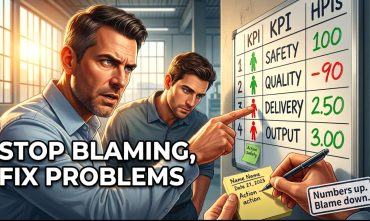
Habit 2: One Visual Board Everyone Can See
A conversation is temporary. It exists in the air for a few minutes and then it’s gone. Memories fade, interpretations differ. The single most powerful tool to support your daily stand-up is a visual management board.
What is it? It’s simply a “single version of the truth.” A physical whiteboard, or maybe a large screen, that lives on the shop floor where everyone can see it. It’s the anchor for your stand-up meeting. It’s the scoreboard for your day. It is not a nice-to-have display of corporate fluff; it’s a working tool.
Why is a visual board so much more effective than just talking, or using a spreadsheet hidden away on a manager’s laptop?
Our brains are wired to process visual information incredibly quickly. A red circle on a chart tells us there’s a problem instantly, without needing a single word of explanation. A simple graph showing output trending down is far more powerful than someone reading out a list of numbers. Visuals cut through the noise and make priorities and performance obvious at a glance, even to someone just walking past.
It also drives a powerful sense of accountability and shared ownership. When the plan, the performance metrics, and the problems are up there in black and white (and red, amber, and green) for all to see, it’s no longer “management’s data.” It’s the team’s data. It encourages people to engage, to ask questions, and to take ownership of the numbers. You can’t ignore a problem when it’s staring you in the face every morning.
How to build a simple version:
You don’t need fancy software. You need a whiteboard, some marker pens, and maybe some magnetic tape to create a grid. That’s it.
Here’s a basic layout that works for almost any small factory:
- Section 1: Today’s Plan. List the key jobs or work orders for the day. Include critical information like quantity and the due time or date.
- Section 2: Yesterday’s Performance. Track a few simple, vital metrics. Start with three at most. Things like Output vs Target, On-Time Delivery Percentage, and maybe a simple quality metric like First Time Pass Rate or Number of Defects.
- Section 3: Top Issues / Actions. Create a space to list the top 3 problems or blocks that were identified in the stand-up. For each issue, include an Owner (the name of the person responsible for the fix) and a Due Date.
Use colour coding to bring it to life. Green for on track, amber for at risk, red for off track or problem. The board becomes a living document, updated every single day during the stand-up. It’s the focal point of the conversation.
Habit 3: The “One Problem, One Action” Rule
So, you’re having a daily stand-up. You’ve got a visual board. Problems are being raised. This is fantastic progress. But now you have to avoid the most common trap of all.
I call it the “problem admiration society.” It’s where you get really good at identifying and talking about problems. The same issues come up in the meeting, day after day, week after week. Everyone nods sagely, agrees it’s a problem, and then… nothing happens. The conversation ends, and everyone goes back to firefighting the exact same issues that were caused by the problem you just admired.
The solution is to turn problem-solving into a daily micro habit. And the rule is beautifully simple: every stand-up meeting must end with at least one problem being assigned one concrete action, with one owner, to be completed that day.
The key is that it is a specific, tangible action, not a vague intention like “look into the problem.” It’s something that can be physically done and completed. By taking one small, proactive step to solve one problem every single day, you start to change the game. The cumulative effect of this is staggering. Five small problems solved this week is 20 problems solved this month. That’s 20 fewer fires you’ll have to fight next month.
Making progress visible:
Track it on your visual board. Your “Issues / Actions” section is where this lives. When a new action is agreed, it goes up on the board with its owner and a due date (usually “end of day”). The next morning, the first part of the stand-up is reviewing the open actions from yesterday.
When an action is complete and the problem is solved, you get the immense satisfaction of marking it as done. A big green tick. A line through it. Whatever works for you. This visual proof that you are not just talking about problems but actually closing them is huge for team morale. It shows people that their input matters and that things are getting better.
As a leader, make a point of celebrating these small wins. This positive reinforcement is what builds a proactive, problem-solving culture. It builds momentum.
Putting It All Together: Your Next 7 Days
Reading about this is one thing. Doing it is another. I know it can feel daunting to introduce new routines into a busy, high-pressure environment. So let’s make it easy.
Don’t try to roll this out across the entire factory at once. Pick one area. One production line, one assembly cell, one team. The one that’s causing you the most headaches is often a good place to start.
Then, set yourself a simple 7-day challenge.
- Monday: Hold your first, slightly awkward, 15-minute stand-up. Just use the simple script. Get a tatty old whiteboard and draw the three sections on it with a marker pen. It doesn’t need to be pretty. Identify just one problem and agree on one action.
- Tuesday: Do it again. This time, start by reviewing the action from yesterday. Update the board.
- Wednesday: By now, it should feel a little less strange. Keep the discipline. Keep it short. Keep it focused.
- Thursday: You might notice something interesting. People might actually start bringing issues to the meeting, instead of you having to drag them out of them.
- Friday: Hold your fifth stand-up. At the end of the day, get the team together for five minutes and look at the board. Look at the five actions you’ve completed. Ask them: Did this week feel any different? Were we more in control? Did we solve anything useful?
My bet is that the answer will be a resounding yes. You will have had a calmer, more controlled week. You’ll have had fewer nasty surprises. You will have solved a handful of annoying little problems that have been bugging you for months. You will have taken your first, decisive step out of reactive chaos.
What’s Next?
These three habits, the daily stand-up, the visual board, and the one problem one action rule, are not rocket science. They are simple, practical, and cost almost nothing to implement. But their combined effect is transformative. They create a daily rhythm of communication, clarity, and continuous improvement that puts you back in the driver’s seat.
This isn’t just theory. This is the basic blocking and tackling of operational excellence, and it works.
If you find you want help embedding these routines, training your team leaders to facilitate effectively, or linking your daily metrics to your overall business goals, that’s the next step. Our structured workshops or a hands-on coaching can help you lock in the gains and build a true, sustainable culture of proactive control. But it all starts with that first, 10-minute huddle. Why not try it tomorrow?
More Blog Posts

The True Price of a Late Shipment: Why Lead Time Reduction Protects Your Biggest Clients

Cost of Quality Failures: A Practical Guide for UK Manufacturers

The Hidden Costs of a Disconnected Team: How to Calculate the ROI of Better Collaboration
The Five Step Meeting Cadence That Stops Your Team Going in Circles

The Accountability Framework: How to Empower Your Team to Own Their Results (Without Micromanaging)

The Leader’s Guide to Diagnosing a “Stuck” Team: 7 Warning Signs and What to Do About Them







To leave me a message or book a return call at a time that suits you