


Why Lean Initiatives Fail After 6 Months (and How to Stop It)
Picture the scene. You’ve just wrapped up a massive improvement push. Maybe it was a sorting and setting in order blitz across the shop floor or a value stream mapping project promising to slash lead times. For the first few months, everything looks fantastic. Communication boards are clean and used, tools are perfectly placed in shadow boards, productivity is up, and your team seems genuinely engaged with the new way of working.
Fast forward six months.
You walk the floor and notice the daily management boards haven’t been updated since last week. Audit schedules are collecting dust in a corner. Firefighting is back in full swing, and your key performance indicators are quietly drifting back to where they started before you spent all that time, money, and effort.
It’s incredibly frustrating, and I’ve seen it happen more times than I care to count. I know exactly how deflating it feels to watch hard-won gains slip away.
The core claim I want to make here is simple: the problem isn’t the tools. The problem is treating these changes as short-term projects instead of a completely new way of running your factory.
In this post, we’ll unpack why these gains are so fragile and, more importantly, provide a practical playbook to sustain them in a busy UK manufacturing environment. You don’t have the time or budget to keep rolling out the same initiatives year after year. Let’s stop the rollback and start building a system that lasts.
The Six-Month Lean Slump: A Pattern, Not a One-Off
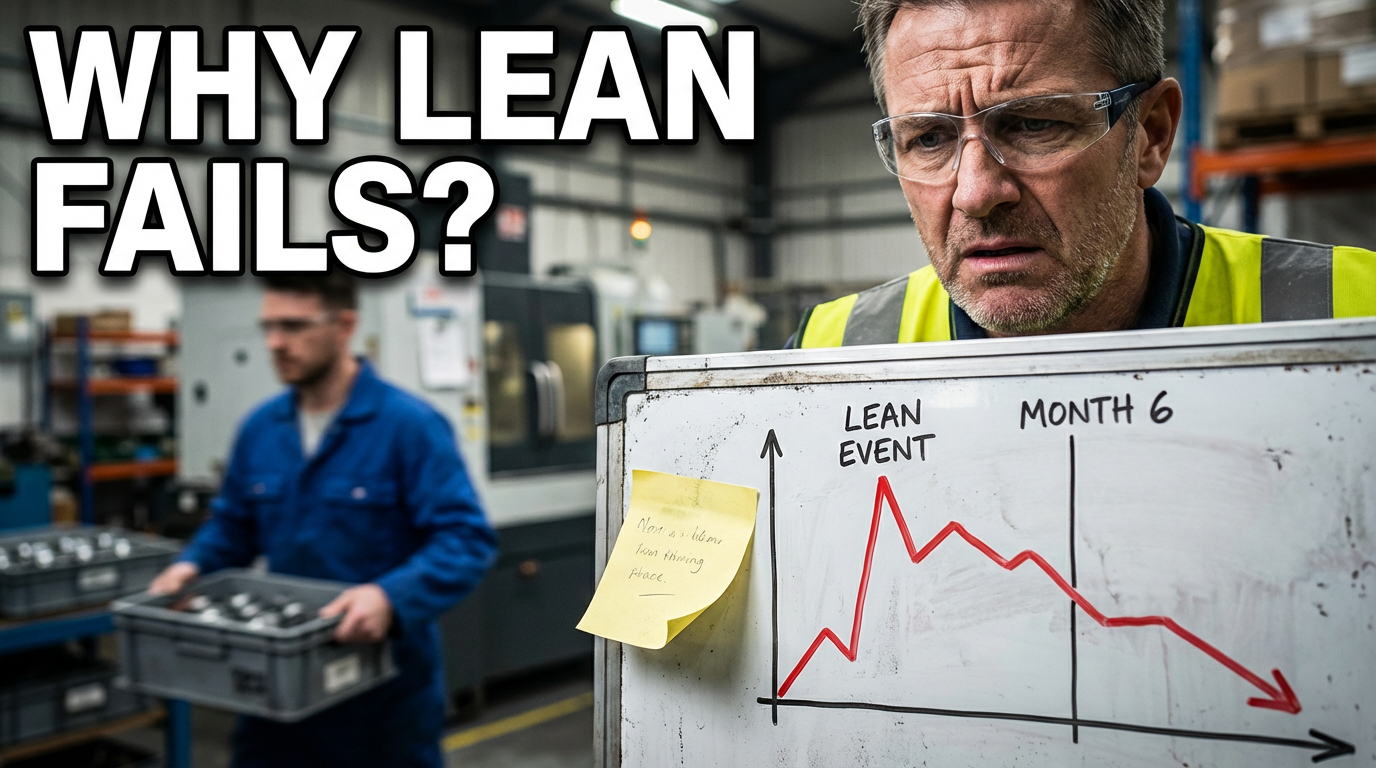
The six-month slump is a very specific, highly predictable pattern. You get the initial enthusiasm, quick results, a brief plateau, and then the inevitable regression back to the mean.
If this sounds painfully familiar, take comfort in the fact that you’re not alone. Across global manufacturing, and particularly here in the UK, failure to sustain continuous improvement is the rule rather than the exception. High rollback rates are common. Consultant-led programmes often don’t outlive the consultant. Once the external energy leaves the building, old habits creep back almost instantly.
It’s easy to blame the team. You might think your people just don’t care enough or that they’re resistant to change. But that’s rarely the case.
There are deep structural reasons why these initiatives are so fragile after those first few months. It’s not about a lack of willpower. It’s about how your business is fundamentally wired. This isn’t just a case of lazy operators. To fix the drop-off, you need to understand what’s really going wrong beneath the surface.
Why Lean Gains Are So Fragile
Lean Is a System, Not a Toolkit
The biggest trap we fall into is confusing a collection of tools with a comprehensive operating system. Doing some tools is not the same as changing your culture.
You can roll out visual boards, single-minute exchange of die, and kanban systems until you’re blue in the face. But if those tools aren’t backed by fundamental changes in leadership behaviour, company culture, and daily management, they will always be fragile.
Processes improve on paper, but if the way decisions are made stays the same, the old system reasserts itself. The reward systems and incentives haven’t changed. The daily habits of supervisors haven’t shifted. The tools become expensive window dressing on an unchanged operation.
The Time Bomb: Enthusiasm Versus Habits
There’s a massive difference between event energy and the slow, boring grind of building new habits.
During an improvement event, everyone is buzzing. You’re off the line, drinking lots of coffee, and fixing things that have annoyed you for years. But that three- to six-month window after the event is critical. The novelty wears off. The consultant packs up their laptop and goes home. The day-to-day pressures of getting product out the door ramp up again.
Without rigid routines and accountability, people naturally revert to the path of least resistance. It’s just human nature. If following the new standard takes slightly more mental effort than doing it the old way, and nobody is checking anyway, the old way wins every single time.
Why SMEs Feel It More
UK small and medium enterprises feel this pain particularly sharply.
In a typical smaller manufacturer, leaders are stretched incredibly thin. You have fewer support roles, less middle management, and a constant undercurrent of firefighting just to meet customer demands. When things get tight, the new initiative suddenly feels like extra work. It stops being the way we survive and grow, and it quickly becomes that thing we do when we have spare time. Which, let’s be honest, is never.
So it’s the first thing dropped in a crunch. This brings us right back to the core idea. The new methods must be part of how you run the business. They cannot be an overlay on top of an already overloaded operation.
Seven Common Reasons Lean Initiatives Collapse After Six Months
Let’s break down exactly what goes wrong. I’ve noticed seven common culprits, and you can probably spot a few of these in your own facility right now.
1. Lack of Visible Leadership Commitment
People on the shop floor have an incredible radar for what’s a passing fad and what’s a genuine priority. They can spot a hollow corporate initiative from a mile away.
The signs are always obvious. Leaders stop visiting the gemba. They stop asking about the new standards. They don’t follow up on the actions they promised to clear. In fact, they only really talk about continuous improvement when the consultant or the big boss is in the building.
The effect is immediate and devastating. Teams conclude that this whole thing will blow over soon. Instead of investing their energy in learning new ways of working, they just wait it out. And really, who can blame them?
2. Short-Term Focus and Initiative Fatigue
Then there’s the classic flavour-of-the-month mentality.
It’s one methodology this year. Maybe it’s something completely different next year. When you chase quick wins or immediate cost savings without a longer strategic intent, you just breed deep disillusionment.
People become highly sceptical. They roll their eyes in the canteen and say they’ve seen it all before. And they’re right. If there’s no long-term vision attached to the changes, it just feels like management is throwing mud at the wall to see what sticks.
3. Tool-Only Implementation (No Culture Change)
Have you ever walked into a factory where visual boards and laminated standards appeared overnight? It’s a very strange vibe. There’s usually very little explanation and absolutely zero involvement from the people actually doing the work.
The methodology becomes something done to operators, rather than something they own and control.
The symptoms are quite funny in a tragic sort of way. You see perfectly tidy toolboxes, but only when the auditor is walking around. You see beautifully laminated standard operating procedures that absolutely nobody reads. The boards look fantastic for visitors, but they don’t drive a single actual decision on the floor.
4. Weak Daily Management and Follow-Up
Improvement needs a rhythm. It requires daily huddles, clear metrics, regular reviews, and relentless problem-solving cycles.
When those rhythms are missing, performance simply drifts. Issues that you thought were fixed months ago suddenly recur. Those beautiful visual boards just become expensive wallpaper.
This is exactly why the six-month point is so dangerous. Once the initial push stops, if there’s no daily routine to catch the slip, the gains quietly evaporate while everyone is looking the other way.
5. Insufficient Training and Frontline Engagement
A shocking number of operators and supervisors never actually get the concepts explained to them in practical terms. They might get a one-hour presentation filled with Japanese words, but that’s about it.
When you lack proper training in problem-solving and standard work, your teams remain completely dependent on external experts or the one continuous improvement manager you hired.
This leads straight to theatre. People go through the motions. They fill out the forms because they were told to. But they don’t really understand or own the changes they are making.
6. Poor Communication and Misaligned Goals
How you frame the initiative matters immensely. If it’s framed purely as a cost-cutting exercise, it feels incredibly threatening. People naturally assume it means losing their jobs.
Contrast that with framing the work around quality, delivery, safety, reducing stress, and growing the business securely. That’s a message people can actually get behind.
But even with good messaging, misalignment will kill your progress. If the production manager is targeted entirely on volume, and the quality manager is targeted on defect reduction, they will clash. Conflicting targets completely undermine the collaborative behaviours you are trying to build.
7. Leadership Turnover and Competing Priorities
This one is incredibly common in the UK market right now. A new managing director, operations manager, or private equity owner comes in and decides to completely change direction.
Efforts stall immediately when leadership changes, especially if the new regime has different priorities or very little experience with continuous improvement.
It highlights exactly why you need a system that outlives individual leaders. If your entire culture of improvement rests on the shoulders of one enthusiastic plant manager, you are building your house on sand.
What Sustainable Lean Looks Like in a UK Factory
In mature sites, improvement is not a side project. It is the actual engine used to hit strategic objectives. Whether that’s reducing lead time, hitting on-time-in-full delivery targets, improving quality, freeing up capacity, or reducing working capital.
Improvement projects are chosen and resourced specifically because they move those big needles. They are not chosen just because doing a cleaning event seems like a nice idea this month. Everything connects back to the business plan.
Leaders in these successful factories behave very differently. They regularly go out to the gemba where the work happens. They ask curious questions about the standards. Most importantly, they actually help their teams solve problems instead of just demanding answers and pointing fingers.
They also use a beautifully simple daily management system. It is not overly complex or bureaucratic. There are key performance indicators, daily huddles, visual boards, and a very clear escalation process.
In a truly sustainable environment, small improvements are constant. They are just expected as part of the normal working day.
Operators are actively encouraged to spot waste, test out new ideas, and contribute to updating the standards. It is not a top-down mandate where management dictates every tiny move. Instead, it is a collaborative effort where everyone feels empowered to contribute to the continuous improvement journey.
Five Disciplines to Stop Your Lean Gains Slipping Away
- Make Lean a Strategic Choice, Not a Side Project
Align your metrics and improvement projects explicitly to overarching goals. Review progress with the same seriousness as financials. This alignment ensures that every effort contributes to the broader objectives of the organisation, making Lean an integral part of the business strategy rather than an isolated initiative. - Build a Simple Daily Management System
Choose a handful of meaningful metrics. Introduce short daily huddles and ensure visual boards are updated in real time. This system should be easy to understand and implement, allowing for quick adjustments and fostering a culture of transparency and accountability. - Standardise Before You Optimise
Good standard work is visual, simple, and co-created with operators. Regular checks ensure standards are followed and updated. By standardising processes first, you create a solid foundation upon which further improvements can be built, ensuring consistency and reliability in operations. - Invest in People—Training, Involvement, Recognition
Provide practical training in problem-solving. Involve people in designing new ways of working and recognise their contributions. Investing in your workforce not only enhances their skills but also boosts morale and engagement, leading to a more committed and innovative team. - Fix Leadership Habits
Leaders must schedule time for continuous improvement and hold themselves accountable for sustainment. Leadership commitment is crucial for maintaining momentum and ensuring that Lean principles are embedded in the organisational culture.
From Six-Month Project to Long-Term Advantage
Continuous improvement doesn’t fail because the tools are wrong. It fails when treated as a temporary campaign instead of a permanent operating system.
Run a self-check in one production area. Pick one discipline to strengthen over the next ninety days. If you’re tired of watching your hard work fade away, we can help. Reach out to discuss our on-site Lean Coaching and Mentoring Programme. Let’s stop the rollback together and start making real, lasting progress. By embedding Lean into the very fabric of your organisation, you can transform short-term gains into long-term advantages, ensuring sustained success and growth in an ever-competitive market.
More Blog Posts
Why Lean Initiatives Fail After 6 Months (and How to Stop It)

The Push vs Pull Debate: Why Volume and Variability Make the Call
The Anatomy of a Value Stream Map: How to Identify Non‑Value‑Added Time
From Firefighter to Coach: 5 Traits That Define True Lean Leadership

Takt Time vs. Cycle Time: Understanding the Heartbeat of Your Factory

The £50,000 Question Kevin Didn’t Ask: Why Your Lean Program is Failing in Silence







To leave me a message or book a return call at a time that suits you