


The Five Step Meeting Cadence That Stops Your Team Going in Circles
You know the meeting. It happens every Monday at nine, or maybe it’s Friday afternoon when everyone’s just watching the clock until they can get to the car park. Someone opens with “right, where are we with the delivery issue on line two” and forty minutes later you’re still talking about the same delivery issue. Same names come up. Same excuses get an airing. Someone says they’ll “look into it” and everyone nods like that means something. Then next week, you open with almost the exact same sentence.
If that sounds familiar, you’re not alone. And to be honest, it’s not really your team’s fault. Most weekly meetings in manufacturing weren’t built with any real structure to begin with. They grew out of habit. Someone, years ago, decided Monday morning was a sensible time to get everyone in a room, and the agenda has more or less stayed the same ever since, drifting between updates, gripes and the odd bit of finger pointing.
Here’s the thing though. You already know a method that would sort this out. You probably use it on the shop floor most days without giving it a second thought. Plan, Do, Check, Act. PDCA is stitched into how most UK manufacturers run their quality checks, their changeovers, their continuous improvement work. Nobody ever thought to apply that same discipline to the one meeting that’s supposed to hold the whole week together.
This post walks you through a five step meeting cadence built on that PDCA rhythm. It isn’t theory dressed up as advice. It’s a structure you can lift and use this week, with a sample agenda, the questions worth asking at each stage, and some fairly blunt thoughts on getting actions to actually happen, rather than just getting written down and quietly forgotten.
Stick with me on this one. It sounds almost too obvious to need writing down, and maybe that’s exactly why so few teams actually do it properly.
Why your weekly meeting keeps going nowhere
Worth diagnosing this properly first, because if you jump straight to a new agenda template without understanding why meetings drift in the first place, you’ll be back here in six months wondering why nothing’s changed.
Most circular meetings share a few habits, and I’d guess at least two of these sound familiar.
There’s no shared starting point. Everyone walks in with their own version of how the week went. Production thinks it went fine. Quality has a different story. Nobody’s looked at the same numbers before the meeting starts, so the first fifteen minutes gets eaten up just agreeing on what actually happened, before anyone’s even touched what to do about it.
Then there’s the tendency to ask “who” instead of “why”. A machine goes down twice in a fortnight and the conversation turns into who was on shift rather than what actually failed and why it keeps failing. That’s a completely natural instinct, by the way. Nobody enjoys sitting with an uncomfortable root cause. Blame is quicker and it feels like progress even when it changes nothing at all.
Actions get assigned to “the team” rather than a person. You’ve heard it. “We need to look at that.” Who’s we? By the time next week rolls around, everyone quietly assumed someone else picked it up.
And maybe the biggest one. Nobody actually checks last week’s actions before diving into this week’s problems. So the list just grows. It never gets reviewed, never gets properly closed off, and the same issues resurface because the loop never actually closes. That’s the circle, really. It isn’t that your team lacks ideas or effort. It’s that the meeting has no mechanism for finishing what it starts.
There’s a quieter version of this too, one that doesn’t get talked about much. Meetings that run long because they’ve become the only place certain people feel heard. Someone on the floor has been raising the same tooling problem for months and this is their one chance a week to say it out loud, so naturally they take it, even if it isn’t really on the agenda. That’s not a discipline problem exactly, it’s more a sign that other channels for raising issues aren’t working, and the weekly meeting has ended up carrying weight it was never designed for. Worth keeping in mind, because tightening the meeting won’t fix that on its own. You may need a separate, quicker way for people to flag things day to day so the weekly session doesn’t have to absorb everything.
Add in the pressure most UK manufacturers are under right now, energy costs that remain among the highest of any developed economy, wage costs climbing faster than most would like, margins getting squeezed from every direction, and you can see why a meeting that eats an hour and produces nothing concrete is such an expensive habit. Time on the shop floor and in the office is tight. A meeting cadence that actually works isn’t a nice to have anymore. It’s one of the cheaper productivity levers you have, and it costs nothing except discipline.
The five step cadence that actually closes the loop
PDCA isn’t a new idea, and you don’t need me explaining it to you like you’ve never seen a fishbone diagram. But most teams only apply it to the physical process, the actual making of things, and never think to turn it inward on how they run meetings. That’s a shame, I think, because the same logic that stops a defect recurring on the line works just as well at stopping the same conversation recurring in the meeting room.
Here’s how it breaks down into five practical steps, each one mapping back to that plan, do, check, act rhythm.
Step one: start with the scoreboard, not the chat
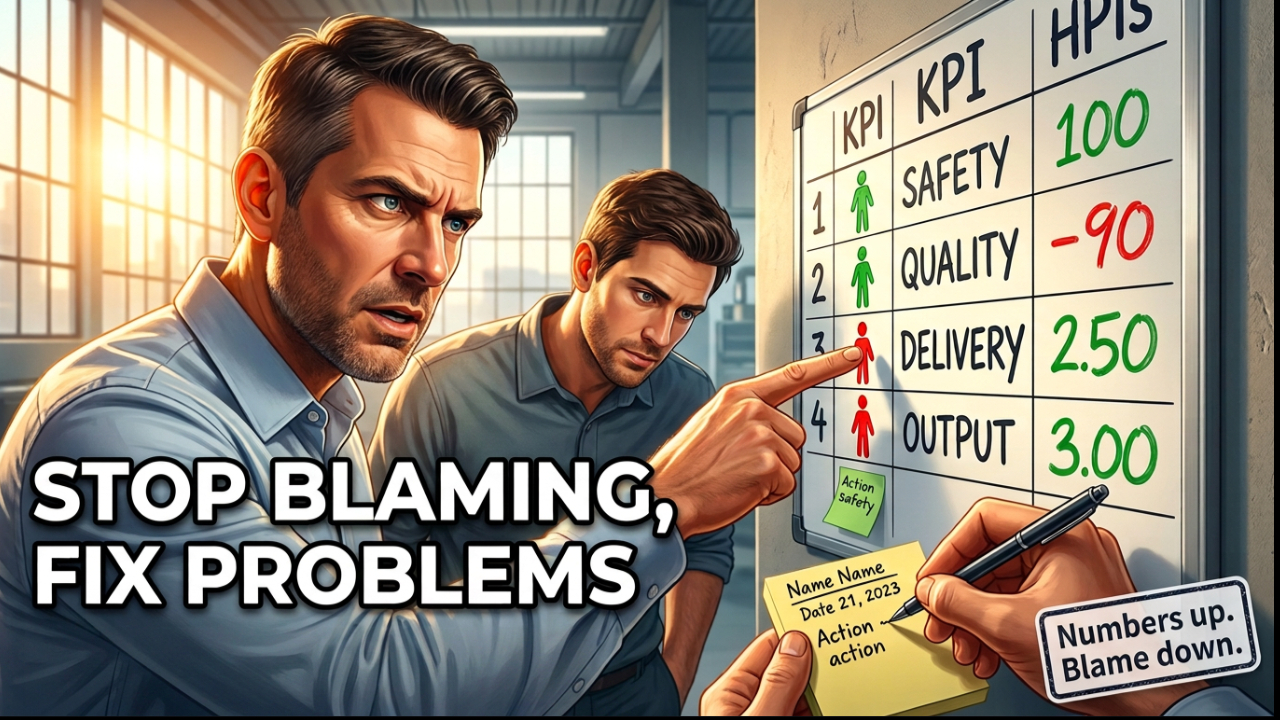
Before anyone speaks, put the numbers up. Whatever your version of a scoreboard is, safety incidents, quality rejects, delivery performance, output against target, get it on the wall or the screen before the meeting even opens. This is the check part of the cycle, and it needs to happen first, not as an afterthought halfway through when someone remembers to mention it.
The point here isn’t to read the numbers aloud like a weather report. It’s to give everyone the same starting picture so the conversation is about what the data means, not what the data even is. Ask something simple. What moved since last week, and what didn’t?
Step two: ask why, not who
Once you know what happened, dig into the misses. Not every miss deserves deep analysis, to be fair, some things really are just a one off. But the recurring ones, the second and third time something’s gone wrong, deserve five minutes of proper root cause thinking rather than a shrug.
Try asking why something happened three times before you accept the first answer. The first answer is nearly always a symptom. “The machine jammed” isn’t a root cause. Why did it jam? What changed? Has it happened before? This is where you separate a genuine one off from a pattern that’s quietly costing you every single week.
Take something as ordinary as a late delivery. First answer is usually “the supplier was late.” Fair enough, but why? Maybe the order went in later than it should have. Why was that? Maybe nobody flagged the stock level until it was already tight. Why not? Maybe the reorder point on that part hasn’t been reviewed since demand picked up. Suddenly you’re not looking at a supplier problem anymore, you’re looking at a stock threshold that needs updating, and that’s an action you can actually fix this week rather than a supplier you can’t control.
Step three: pick one or two priorities, not ten
This is the plan part, and it’s where a lot of meetings quietly fall apart. There’s a temptation, especially when the scoreboard’s had a rough week, to try to fix everything at once. Don’t. Pick the one or two issues that matter most this week and commit to them properly. Everything else either waits its turn or gets handled outside the meeting entirely.
I’ve sat in on meetings where the team left with eleven actions and, unsurprisingly, completed about two of them. Compare that with a team that commits to two focused actions and actually finishes both. Which week made more real progress? It isn’t close, if I’m honest.
Step four: assign actions like you mean it
This is where the do part starts to take shape, even though the actual doing happens after the meeting ends. An action needs three things to survive the week. A single named owner, not a department or a team. A clear definition of what done looks like. And an actual date, not “soon” or “when I get a chance.”
Write it down somewhere everyone can see it, whether that’s a physical board by the meeting room or a shared spreadsheet everyone actually opens. If it only lives in someone’s notebook, it doesn’t really exist.
Step five: close the loop before you close the meeting
Before anyone leaves the room, read the actions back out loud. Every single one, owner and date included. It sounds almost too simple to matter, but this thirty second habit catches more misunderstandings than you’d expect. Someone will occasionally say “wait, I thought Dave was doing that one” right there in the room, which is a far better place to catch that mistake than a week later when nothing’s happened.
Then confirm the next meeting time. That’s what turns this into a cadence rather than a one off event. Next week’s check phase depends entirely on this week’s plan being clear enough to actually check against.
A sample agenda you can steal for Monday morning
You don’t need anything fancy for this. A thirty to forty minute slot, the same time and place every week, and a bit of discipline about actually sticking to it. Here’s a version you could run more or less as is.
- Zero to five minutes: scoreboard review. Numbers go up before anyone talks. A quick read on what moved.
- Five to fifteen minutes: last week’s actions. Go through each one. Done, not done, or in progress. For anything not done, ask why, briefly, and decide whether it carries forward or gets dropped for a good reason.
- Fifteen to twenty five minutes: root cause the recurring issues. Pick the pattern that’s cost you the most this week and spend real time on why it keeps happening.
- Twenty five to thirty five minutes: agree this week’s one or two priorities and assign them properly, owner, definition of done, date.
- Thirty five to forty minutes: read the actions back, confirm everyone’s clear, and lock in next week’s meeting.
Notice what’s missing from that list. There’s no slot for general updates or a round the table where everyone shares what they’ve been up to lately. That’s on purpose. If people need to share updates that aren’t tied to an action or a metric, that’s what a quick message or a shorter, separate forum is for. This meeting has one job, which is closing the loop on what happened and opening a clear plan for what happens next.
Adjust the timings to suit your own team, obviously. A small tool room with four people might get through the whole thing in twenty minutes. A larger site with department heads from quality, production and logistics might genuinely need the full forty. What matters far more than the exact minutes is that every step happens, in order, every single week, without anyone skipping straight to problem solving before the scoreboard’s even gone up.
Getting actions to actually stick
Even with a decent cadence, actions still slip through the cracks if you’re not careful about how you write them. A few things worth getting right.
Write the action as an outcome, not a task. “Look into the packing line delay” is vague enough that almost anything counts as having done it. “Identify why pallets are queuing at the packing line and report back with one fix” gives you something you can actually check against next week.
One owner only. This one trips up more teams than you’d think, mostly because it feels a bit awkward to put someone on the spot in front of the group. But a shared action is nobody’s action. If a task genuinely needs two people, name a lead anyway. Someone has to be accountable for chasing it, even if others are helping along the way.
Keep actions small enough to finish in a week. If something’s clearly bigger than that, break it down. “Reduce scrap rate on line three” isn’t a week’s action, it’s a project. “Trial the revised setting on line three for two days and report the scrap rate” is.
Resist the urge to let actions roll over silently. If something didn’t get done, that’s information, not a failure to sweep under the rug. Maybe the priority genuinely shifted. Maybe the owner got pulled onto something urgent. Either way, say so out loud rather than letting it quietly vanish off the list. A meeting where actions can disappear without anyone noticing teaches everyone that deadlines are optional, and that lesson spreads fast, far faster than you’d like.
One more thing, and this comes from watching a fair few of these meetings over the years. The first few weeks will feel a bit stilted. People aren’t used to being asked “why” three times in a row, and they’re definitely not used to having their name next to a date on a board where everyone can see it. Stick with it anyway. I remember a small fabrication shop going from a Monday meeting that regularly ran past an hour with nothing much to show for it, to a twenty five minute session that actually cleared its action list most weeks. It took about six weeks of sticking to the format before people stopped treating it as a novelty and just started treating it as how things are done there.
Bringing it all together
None of this is complicated, and that’s rather the point. You don’t need new software, a consultant, or a training course to run a tighter weekly meeting. You need a scoreboard everyone looks at before they talk, a habit of asking why rather than who, a short list of priorities instead of a long wish list, actions with a name and a date attached to them, and thirty seconds at the end to read it all back.
Given what UK manufacturing is up against at the moment, tight margins, energy costs that show no sign of easing, a skills gap that means you genuinely can’t just throw more people at a problem, the time you waste in unproductive meetings is time you can’t really afford to lose. A tighter cadence is one of the few improvements that costs you nothing but the discipline to run it properly, and it tends to pay for itself within a month.
Give it five or six weeks before you judge it. The first meeting or two might feel a little awkward, and that’s fine, that’s normal, honestly. But once the habit sets in, you’ll notice the same conversation stops coming back week after week. Problems actually get closed instead of just discussed. And that Monday morning meeting stops being something people quietly dread and starts being the moment your week actually gets sorted out.
Start small if that feels safer. Pick just one team, one line, one meeting, and run the five steps properly for a month before you roll it out anywhere else. You’ll learn far more from getting it right in one room than from launching it everywhere at once and watching it fizzle out in three of the four. And if it does wobble in week two, which it might, that’s not proof it doesn’t work. That’s just the check phase doing exactly what it’s meant to do.
Want help making it stick
Reading about a better meeting cadence is one thing. Actually running it with a team that’s fallen into old habits, under real deadlines, with a hundred other things pulling at their attention, is another thing entirely. That’s exactly what our High Performing Teams Workshop was built for.
We work directly with your leadership team to build a cadence like the one above, tailored to your own scoreboard, your own priorities and your own people, so it survives well past that first slightly awkward week. You’ll leave with a cadence that’s already running on your shop floor, not just a good idea you meant to try someday.
If you’re ready to stop going in circles and start closing the loop for good, get in touch to find out more about the workshop and book your place.
More Blog Posts

The True Price of a Late Shipment: Why Lead Time Reduction Protects Your Biggest Clients

Cost of Quality Failures: A Practical Guide for UK Manufacturers

The Hidden Costs of a Disconnected Team: How to Calculate the ROI of Better Collaboration
The Five Step Meeting Cadence That Stops Your Team Going in Circles

The Accountability Framework: How to Empower Your Team to Own Their Results (Without Micromanaging)

The Leader’s Guide to Diagnosing a “Stuck” Team: 7 Warning Signs and What to Do About Them







To leave me a message or book a return call at a time that suits you