


The 30 Days After Lean Training: A Plan So It Doesn’t Fade
You know the feeling. Two days of training, a room that smelled faintly of flipchart pens, and by the end of it everyone was genuinely up for it. Someone from the shop floor who barely speaks in meetings suddenly had three ideas about the goods in bay. The trainer was good. The examples landed. You drove home thinking, right, this time it’s actually going to happen.
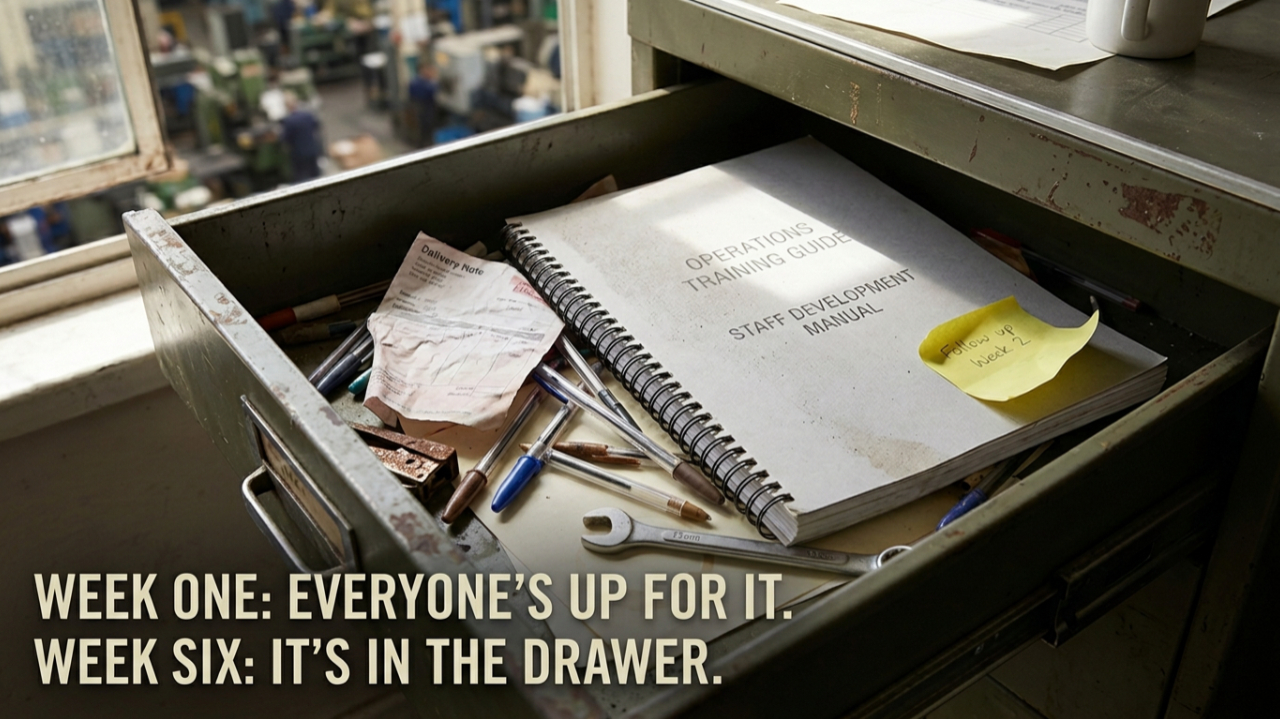
Then Monday happened. A machine went down, a customer moved a delivery date forward by a fortnight, and somebody left. By week three the workbook was in a drawer. By week six, if you’re honest, the only visible evidence of the training was a line in the accounts.
That’s not a failure of your team. It’s not even really a failure of the training. It’s what happens by default when nothing changes about the thirty days that follow. And it’s fixable, but only if you decide what those thirty days look like before you book the course, not after the energy has already drained out of the room.
So here’s the whole thing. The actual framework. Three projects in week one, a fifteen-minute huddle every day, a board on the wall that anyone can see, and a review on day thirty that you run in front of the team rather than in your office with a spreadsheet. That’s it. Four moving parts.
I’ll be upfront about something. Most training providers keep this bit slightly vague, because the follow-on coaching is where the money sits. I think that’s a bit backwards. If you can run this yourself, run it yourself. You’ll get more out of the training you’ve already paid for, and you’ll know exactly what you’re buying if you do decide to bring someone in later.
Why lean training fades, and why it isn’t your team’s fault
Start with the uncomfortable bit. Research on the forgetting curve suggests that without reinforcement, people lose roughly half of what they learned within an hour, about 70% within a day, and up to 90% within a week. That’s not a slight on anyone. That’s just how memory works when information isn’t used.
It gets worse when you look at application rather than recall. The Association for Talent Development puts the proportion of retained knowledge that actually gets applied on the job at somewhere around 10 to 20%. Stack those two numbers together and you can see why a two-day course, on its own, changes almost nothing. Not because the content was weak. Because a course is an event, and what you’re trying to change is a routine.
You’ll have seen the statistic that seventy, or eighty, or ninety percent of lean transformations fail. Those figures do circulate widely, with claims that around 70% of continuous improvement implementations fail and that 66 to 90% fail to sustain their improvements. To be honest, when you chase those numbers back through the citations, they get a bit thin, and I’d be wary of anyone who quotes them at you with too much confidence. What’s much better evidenced is the reason things stall. Transformations tend to unravel not because the tools were wrong but because leadership attention didn’t persist past the initial rollout, with momentum commonly lost within six to twelve months.
Read that again, because it’s the whole point. The thing that kills it isn’t resistance. It’s drift. Nobody says, “we’re stopping this.” It just stops being mentioned, and then one day you realise it’s been four months.
And the cost of that drift has gone up. UK employer training spend has fallen to around £1,700 per employee, down from £1,960 two years earlier and nearly 30% lower than 2011 in real terms. The average employee now gets 5.7 days of training a year, the lowest figure on record. You’re getting fewer shots at this than manufacturers did a decade ago. Which makes wasting one feel considerably more expensive than it used to.
Week one: three projects, and nothing else
The single most common mistake is enthusiasm. Everyone comes out of the training with eleven ideas and tries to start nine of them. Within a fortnight none of them are finished, which teaches the team something quite damaging: that this stuff gets started and never lands.
So week one, you pick three. Three is deliberate. It’s enough that the improvement isn’t one person’s pet project, and few enough that you can hold all three in your head while you’re also, you know, running a factory.
Pick them against four rules.
One: it has to be finishable inside thirty days. Not “substantially progressed.” Finished. If it needs capital approval, a new supplier or another site’s cooperation, it’s a good project but it’s the wrong project for this month.
Two: it has to be visible from where people actually work. Changeover time on a specific machine. The layout of one bench. How parts get from inspection to dispatch. If nobody can see the change by walking past it, it won’t reinforce anything.
Three: it needs one named owner. Not a team, not a department, one person with a name. Shared ownership sounds collaborative and behaves like nobody owning it.
Four: it needs a number. Minutes, metres walked, scrap pieces, days of stock, whatever fits. Pick the number before you start and write down what it is today. You’d be amazed how many improvement projects can’t prove anything afterwards because nobody recorded the starting point.
Write all three on one sheet of paper. Project, owner, measure, the number today, the number you’re aiming at, the date. Then stop. Don’t add a fourth because someone had a good idea on Wednesday. Put it on the ideas list for next month.
I’ve watched this go wrong the same way more than once. A firm comes out of training genuinely fired up and decides the first project will be “reorganise the whole production layout.” Which is, to be fair, probably the right thing to do eventually. But it needs a shutdown weekend, a forklift and about eleven conversations with people who weren’t in the training. Six weeks later nothing has moved, and the quiet conclusion in the canteen is that lean is a thing managers talk about. Meanwhile the boring project nobody chose, the one where you move the consumables trolley four metres and save an operator a hundred and twenty steps a shift, would have been done by Thursday and would have convinced more people than the layout ever could.
Small and finished beats big and pending. Every time, in that first month.
The daily fifteen minute huddle
This is the engine. If you only do one thing from this post, do this one.
Same time every day. Same place, which is on the floor in front of the board, not in an office. Standing up. Fifteen minutes with a timer, and when the timer goes you stop, even mid-sentence, because the reliability is more valuable than the extra five minutes of discussion.
The pattern that’s used across lean daily management systems is a short huddle of roughly ten to fifteen minutes, led by staff rather than managers, held directly in front of the visual board so the numbers get discussed and updated in the moment. That last detail matters more than it sounds. A huddle away from the board becomes a meeting. A huddle at the board stays a conversation about the work.
Keep the agenda to four things. What happened yesterday against the number. What’s in the way today. One update on each of the three projects, even if the update is “nothing moved.” And who is doing what, by when.
That’s it. No round the room updates. No “while we’re all here.” The moment it becomes a general meeting it grows to forty minutes and then people start finding reasons to miss it, and then it’s dead. I’ve seen a good huddle killed inside three weeks by exactly that, and the odd thing is nobody notices it happening, because each individual extra topic seemed reasonable at the time.
A few things worth deciding up front. Who runs it when the usual person is off, because they will be off. Whether it happens if you’re not there, and the answer should be yes, emphatically yes, otherwise it’s your meeting rather than the team’s. And what happens when a problem comes up that the group can’t solve. You need a simple escalation route, even if that route is just “it goes on the board with my name on it and I’ll come back tomorrow.”
Come back tomorrow, by the way. Actually come back. The fastest way to teach a team that raising problems is pointless is to ask them to raise problems and then not close the loop.
The board on the wall
Physical. On the floor. Where the work happens, not in a meeting room and definitely not only in a spreadsheet on your laptop.
I know digital boards are neater. I know the reporting is better. But in the first thirty days you’re not trying to build a reporting system, you’re trying to build a habit, and a whiteboard that fifteen people walk past forty times a day does something a dashboard cannot. Established guidance on visual boards makes the same points: keep it simple at the start, site it somewhere a stand-up huddle can physically happen and get team members to update items rather than doing it all yourself.
Keep it to three to five measures. Not twelve. Tracking a dozen or more metrics dilutes attention, and three to five well-chosen indicators hold focus far better. Whatever you pick, it should be something the team can influence today. Group order intake is interesting but nobody on the floor can move it this morning.
On the board: the three projects with owner and status, the measures with today’s number written by hand, a column for problems raised and who’s on them, and a space for ideas that aren’t being worked on yet. That last column is quietly important. It gives you somewhere to put the fourth good idea without derailing the three you committed to, and it stops people feeling ignored.
Handwritten, always. There’s something about a number written up in marker pen by the person who owns it that a printed sheet never quite achieves. Also, printouts get out of date and stay on the wall for weeks, which trains everyone to ignore the board.
Two failure modes to watch. The first is the beautiful board, laminated and perfect, that nobody dares write on. The second is the board in the wrong place, round a corner, past a fire door, somewhere you have to make a deliberate trip to see. If it takes a decision to look at the board, people will stop making that decision by about week two.
Day thirty: the review you run in front of the team
Put the date in the diary on day one. Tell everyone the date on day one too. That’s not a formality, it’s most of the mechanism.
Thirty days in, you stand in front of the board with the team, for about half an hour, and you go through five things. What you said you’d do. What actually happened, with the numbers. What you learned, including from whatever didn’t work. What you’re keeping permanently. And what the next three projects are.
Run it publicly. In front of everyone, not as a management summary that gets emailed round afterwards. A commitment made in front of the people doing the work behaves completely differently to one made in a leadership meeting, and the recognition lands differently too. When the operator who owned the changeover project stands up and says the number went from fifty-two minutes to thirty-one, that’s worth more to the next thirty days than anything you could say on their behalf.
Talk about the one that failed. Properly, not defensively. Usually one of the three won’t have landed, and how you handle that is the real test. If a missed project produces a telling off, you’ve just taught everyone to pick easy projects forever. If it produces a genuine conversation about what got in the way, you’ve taught them that the system is about learning, which is the whole idea.
If your trainer offers a follow up session, this is the day to use it. Not week one, when everyone still remembers everything. Day thirty, when you’ve hit real obstacles and have actual questions.
Then, on day thirty-one, you pick the next three and carry on. The huddle doesn’t stop. The board doesn’t come down. That’s the bit people get wrong: they treat day thirty as the finish line, when it’s closer to halfway. The UCL research on habit formation found it takes an average of 66 days for a new behaviour to feel automatic, with a range running from 18 days to as much as 254 depending on the behaviour. Thirty days gets you to the point where it stops feeling like an imposition. It doesn’t get you to the point where it survives you going on holiday.
One more thing from that research, and it’s genuinely reassuring. Missing a single day had no measurable effect on habit formation. So if the huddle doesn’t happen on the Tuesday everything went wrong, that’s fine. You haven’t broken it. Just don’t miss twice.
Bringing it together
None of this is complicated, which is sort of the problem with it. Three projects, one board, fifteen minutes a day, a review on day thirty in front of the people who did the work. There’s no clever methodology hiding in there and no software to buy. It’s just a decision about what happens in the four weeks after the training, made while you still have the energy to make it.
The reason it works isn’t that it’s clever. It’s that it replaces attention, which fades, with structure, which doesn’t. Improvement efforts overwhelmingly stall because leadership focus moves on rather than because the tools were wrong, and a fifteen minute huddle is basically a mechanism for making focus happen without anyone having to remember to focus.
It also costs nothing, which matters at the moment. With manufacturing forecast to grow under 1% this year and energy and employment costs still squeezing margins, the improvement you can make with a whiteboard and a quarter of an hour a day is a very different proposition to the one that needs capital.
So don’t try to do everything in this post. Pick the date of your day thirty review and tell someone. That’s genuinely the first move. The three projects and the board can be sorted in an afternoon once there’s a date that makes them necessary.
And yes, this is the part that most providers would rather sell you than publish. I’d rather you had it. If you run it yourself and it works, brilliant, that’s the training doing its job. If you get three weeks in and the huddle has turned into a status meeting, or the projects have stalled because they were too big, that’s when a bit of outside help earns its money, and at least you’ll know precisely what you’re asking for.
If you’d like someone to sit in on your first week and your day thirty review and help you choose three projects that will actually finish, get in touch and we’ll talk it through.
More Blog Posts

The 30 Days After Lean Training: A Plan So It Doesn’t Fade
Kanban on a Shoestring: Two Bin Replenishment Without Buying a New ERP

Why Your 5S Programme Died (And How to Make the Next One Stick)

The True Price of a Late Shipment: Why Lead Time Reduction Protects Your Biggest Clients

Cost of Quality Failures: A Practical Guide for UK Manufacturers

The Hidden Costs of a Disconnected Team: How to Calculate the ROI of Better Collaboration







To leave me a message or book a return call at a time that suits you