


Kanban on a Shoestring: Two Bin Replenishment Without Buying a New ERP
Somebody has sent you a quote for £60,000. Maybe it arrived on a Monday morning, about ten minutes after you found out that a line had been standing idle waiting for a box of M8 washers that cost less than the biscuits in the meeting room.
I’ve been in that room. Not the same one, obviously, but close enough. I’ve walked into more stores cages than I care to count where a perfectly capable team was losing hours every month to parts worth pennies, and where the proposed fix was a piece of software with a project plan, a data migration and a go live date that everybody quietly assumed would slip.
I want to be fair here. An ERP can be a very good thing. If you need proper bills of materials, job costing, traceability and one version of the truth across sales, purchasing and finance, it might be exactly what your business needs, and £60k isn’t a silly number for it. But that’s not the problem that landed on your desk this morning. The problem is that things run out. Cheap, boring, everyday things.
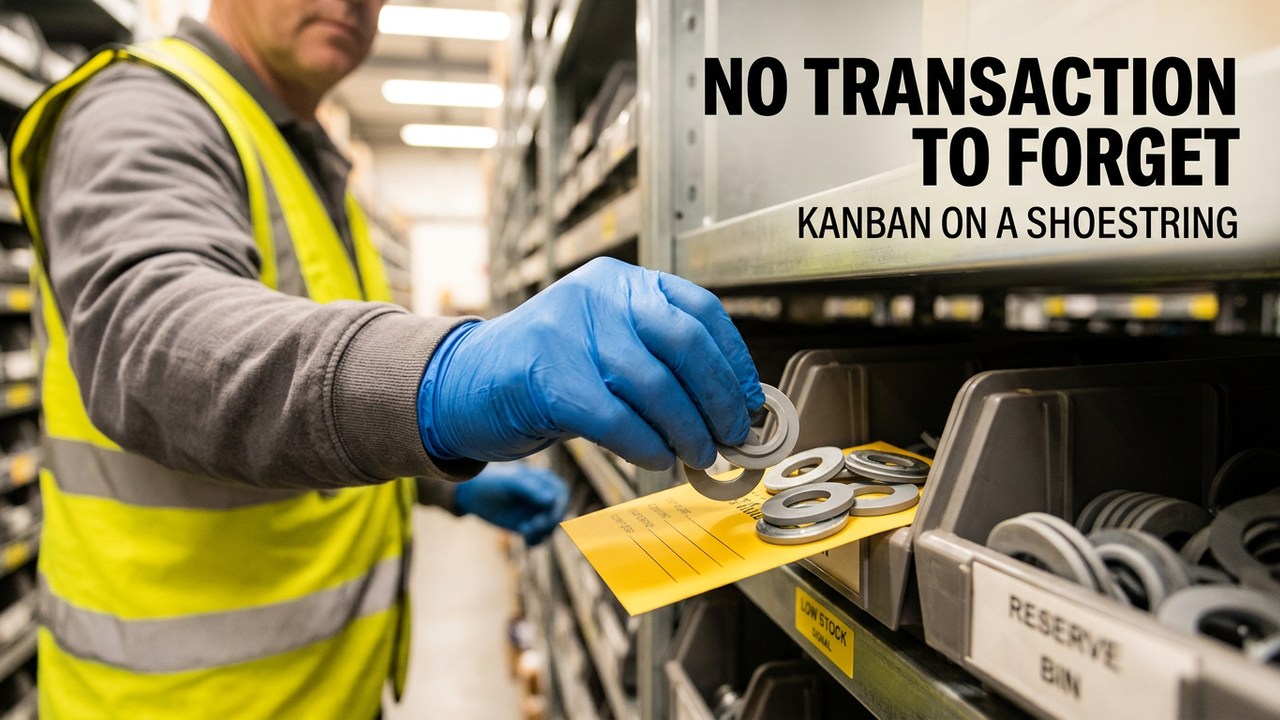
For that specific problem, there’s a method that’s older than most ERP vendors, needs no software and can be running on your shop floor by the end of next week. Two bins and a card.
This is a practical build guide. We’ll cover which items are worth putting on it, how to size the bins, where the card should live, and what to do in the first month when, and I’ll be honest with you, people will forget. They always do. It’s fine. It’s part of how you get there.
Why a £60k system might be answering a different question
Start with the money, because it matters. For a UK manufacturer with somewhere between ten and fifty people, one buyer’s guide puts a realistic first year budget at £20,000 to £100,000, depending on how complicated the operation is. So your quote isn’t outrageous. It’s just a lot of cash to spend on something that may not touch the actual problem. FactoryIQ
Then there’s the risk side. One 2026 analysis of discrete manufacturing projects (written by an ERP consultancy, so take it with a pinch of salt) reports that around 73 per cent fail to meet their objectives, with average cost overruns of 215 per cent. I wouldn’t tattoo those numbers on your arm. But I’ve seen enough go lives to know the direction of travel is about right.
Here’s what I’d want you to think about. Most stockouts on most shop floors don’t come from a shortage of software. They come from cheap consumables and small components that nobody has been asked to watch. Fasteners, gaskets, abrasives, sleeving, labels, cable ties, that sort of thing. And an ERP only knows what’s on the shelf if somebody books stock in and out. Picture how likely that is for a bag of washers at half past two on a Friday afternoon. Yes. Exactly.
That’s the quiet flaw in using a system to fix a discipline problem. The software’s reorder point is only as good as the stock count underneath it, and the stock count for low value parts is usually the least accurate number in the building. A two-bin system sidesteps the whole thing. There’s no transaction to forget, because the empty bin is the transaction.
None of this is new, either. Taiichi Ohno developed pull replenishment at Toyota, and the kanban card owes a good deal to the older two bin method, where emptying the first bin sends a card to purchasing. You may have heard the story about Ohno having a lightbulb moment in an American supermarket. Apparently, that’s a bit tidier than the truth. His 1956 trip was a business visit to study car plants and equipment suppliers, with the supermarket as a side trip. I quite like that, actually. The idea didn’t need a grand moment of inspiration. It just needed somebody to notice that an empty container is already a perfectly good message.
Which items qualify (and which really don’t)
You won’t put everything on this system, and you shouldn’t try. Not every part in your building deserves the same treatment.
The tidy way to think about it is ABC analysis. Rank your parts by annual spend, and you’ll usually find that the C items, the cheap ones, make up about half of your part numbers but only five to ten per cent of the value. Those are your candidates. They’re the parts that cause the most nuisance and tie up the least cash.
You don’t need a system to work this out. Export twelve months of purchase lines from Xero, Sage or whatever you use. Multiply unit price by quantity, sort from highest to lowest, and look at the bottom half. That’s an afternoon’s work at most, and I’d say it’s less if you’re comfortable with a spreadsheet.
But there’s a better filter than the spreadsheet, and it’s free. Ask your supervisors and your buyer one question: what did we run out of in the last six months? The list writes itself in about ten minutes. The best candidates are usually the parts people already swear about.
Then run each candidate through five quick tests.
- Steady demand. It gets used most weeks, in roughly similar amounts. If it’s used in a burst once a quarter, it’s not a two-bin part.
- Low value per unit. A spare bin of them shouldn’t make your finance director wince.
- Short, dependable lead time. Your supplier delivers in days, not weeks. Catalogue items from a wholesaler are ideal.
- Physically binnable. It fits in a tote, a box, a bag or a marked shelf space you can point at.
- Used in a known place. One or two locations, not scattered across three buildings.
And what doesn’t qualify? Anything engineered to order. Anything with a long or unpredictable lead time. Expensive components where holding a second bin is a real cash decision. Project driven parts that spike with a big job. And anything where you need batch traceability, because two bins won’t give you that. Those parts need proper records, and that might be where a future ERP genuinely earns its money. I’m not being dogmatic about it. Kanban isn’t a religion.
Now the bit people always want to skip. Don’t start with all four hundred C items. Pick a handful. Most guides suggest piloting on a small number of parts before rolling it out across the warehouse, and I agree completely. I’d say fifteen to twenty-five items is about right. Include a few of the ones that hurt most, so people see the benefit quickly, and a few boring ones that will work first time and build a bit of confidence. Those early wins matter more than you’d think.
Sizing the bins without needing a degree in statistics
The maths is gentler than people expect. The logic goes like this: when the front bin runs out, the reserve bin has to keep you going until fresh stock arrives. So the reserve needs to cover your daily usage multiplied by the time it takes to get replacement stock, plus a bit extra for when things go wrong. Most guides boil it down to daily usage times lead time, plus safety stock.
I’d tweak that in one small way. Lead time isn’t only your supplier’s delivery time. It’s everything between the bin emptying and new stock being on the shelf, and that includes the time the card spends sitting in a tray waiting for someone to notice it. So here’s the version I’d actually use:
Bin quantity = daily usage × (your own delay + supplier lead time in working days) + safety stock
Let’s make it real. Say you use stainless M8 bolts at about 60 a day. Your supplier delivers three working days after you order. Your own delay, the time between the bin emptying and the buyer placing the order, is about a day. That’s 60 × 4, which is 240. Add 25 per cent for safety, which is another 60, and you get 300. The supplier sells in boxes of 100, so that’s exactly three boxes per bin. Lovely. Rare, but lovely.
If it doesn’t divide that neatly, and it usually won’t, round up to the nearest whole pack. A bin that’s slightly oversized costs you pennies. A stockout costs you an hour of a line.
Now, where does the daily usage number come from? There are two routes. The careful one is to track real usage for at least two to four weeks before you fix any quantities. Count what goes out, or count empties, or ask the operators to tally on a bit of paper stuck to the shelf. The lazy but surprisingly decent one is to take your annual purchased quantity from the purchase ledger and divide it by the working days you actually run. For most UK sites that’s somewhere around 225 once you take out weekends, bank holidays and leave. It won’t be perfect, but it’ll be closer than a guess, and a lot closer than what most people put in an ERP’s reorder field.
For the safety margin, I’d go 25 per cent for reliable suppliers and up to 50 per cent for patchy ones. And in month one, lean towards too big rather than too small. You can trim later once you’ve got real evidence.
Then run one last sanity check. The time it takes to get through a bin has to be longer than the time it takes to reorder and receive replacements, otherwise the second bin could run dry before new stock arrives. In our example, 300 bolts at 60 a day lasts five days against a four-day replenishment loop. That gives you one day of breathing space. Good.
Two practical points that catch people out. First, check the bin can physically hold the quantity. I’ve seen beautifully calculated numbers that needed a bin the size of a wheelie bin. If it doesn’t fit, use a bag, a marked shelf, or a bigger container, or reconsider whether it belongs on the system at all. Second, watch out for minimum order quantities. If your supplier only sells 1,000 at a time, your bin size might need to be 1,000, and now it’s a different conversation about cash and space.
Sanity check the cash too. Three boxes of bolts at around 9p each is £27 of stock per bin, so £54 across the pair. For genuinely cheap C class parts, the total stock you’re holding is usually a small number. Do the sum for your own list. It’s a useful moment, to be honest, because it shows just how little money is tied up in the things that stop your line.
Where the card goes, and why it’s the whole system
The bins get all the attention. But the card is the actual system. The card is the message. If it goes missing, you’ve just got two boxes on a shelf and a false sense of security.
On the card itself, keep it plain. You want the part number and a description in the words your team actually uses, not the catalogue’s. Add the supplier and their product code, the bin quantity and pack size, the lead time, where the part lives, who orders it, and the date the size was last reviewed. Colour code it by supplier or by buyer if you can. Laminate it or slip it in a clear pocket, because shop floors are grubby places and paper doesn’t last a week without help.
Here’s the loop, and I’d suggest pinning it up where everybody can see it:
- The operator uses up the front bin.
- They pull the card and drop it in the collection point, then slide the reserve bin forward.
- The buyer collects cards at set times, orders one bin’s worth, and moves the card to an “on order” board with the date written on it.
- When the delivery arrives, goods in refills the empty bin and puts the card back on it.
- The refilled bin goes to the back of the shelf and becomes the reserve.
Now, where does the card physically sit? For small loose parts, my favourite is at the bottom of the front bin. It’s revealed the moment the last item is taken, so nobody has to remember anything. The empty bin practically announces itself. For bulkier items, where a card in the bottom would get buried, use a clear pocket on the shelf edge or the front face of the bin.
The collection point matters as much as the card. Put it somewhere people walk past anyway. A clear wall pocket at the end of the aisle, a small letter tray by the stores hatch, something like that. Not on the buyer’s desk in the office. Every step you add between the empty bin and the buyer is another place the card can quietly die.
The “on order” board is worth the ten minutes it takes to make. Two columns will do, “to order” and “on order”, with the date the order went in. When a card has sat under “on order” for longer than the lead time, it’s obvious. You’ll spot a late delivery before your operators do, which is a nice change.
Then think about your buyer’s rhythm. If cards get collected at nine and two every day, your own delay in the formula is roughly half a day to a day. If they get collected on Fridays, it’s a week, and every bin you sized needs to grow. This is the sort of detail that quietly wrecks a system that looked perfect on paper.
And here’s the honest weakness. A paper card can be dropped, borrowed or wiped, and an empty bin nobody actioned looks the same as a full one until the line starves. That’s true, and I’d rather you knew it now. The method is sound. The card carrying it is fragile. So build in one simple rule: a bin without a card is a red flag, and a card without a bin is a red flag. Then have the owner do a two-minute walk of the pilot area each day for the first few weeks, looking for exactly those two things.
The first month: what to do when people forget
People will forget. I say that with real affection. It isn’t laziness, it’s just that you’re asking a busy team to change a habit they’ve had for years, and habits are stubborn.
I remember helping a site where the cards kept vanishing. Somebody would find an empty bin, no card, and the buyer had no idea what to order. We spent a week suspecting sabotage, or at least a mild lack of enthusiasm. It turned out they were being taken home in overall pockets and going through the wash. We switched to cards fixed to the bin with a cable tie and the problem stopped inside a day. Nobody had done anything wrong. The system had just made it easy to walk off with the card.
That’s the mindset I’d encourage. When something goes wrong, don’t ask who forgot. Ask what the system made easy.
Before you start, give it an owner. A name, not a department. The advice from people who’ve done this is blunt: without a clear owner, the system collapses the first time somebody goes on holiday. Decide who checks the cards, who orders, and who covers when they’re away. Write it on the board.
Then here’s roughly how I’d shape the first four weeks.
Week one: sit with it. Walk the pilot area twice a day. Most problems show up on day two, and they’re usually small and slightly embarrassing. A bin in the wrong place. A card with a typo in the supplier code. A reserve bin that’s actually half empty because it was never filled properly at the start. Fix things on the spot and thank people for pointing them out.
Week two: resize. By now you’ll have a few real cycles of data. Some bins will be too small (you’ll know, because you nearly ran out) and some too big (because they haven’t moved in ten days). Adjust quantities and update the cards. This is the week that turns a guess into a system.
Week three: deal with the awkward bits. Holiday cover, night shift, agency staff who weren’t there for the briefing. This is also when the odd behaviours emerge, so watch for them. There are usually four.
Someone slides the reserve bin forward but leaves the card on it, so the buyer never sees it. Someone tops up the front bin from the reserve “to be helpful”, which quietly destroys the safety margin. Someone borrows a bin from another station and doesn’t bring it back. And the buyer, quite reasonably, batches cards until Friday because that’s when the orders go out anyway.
None of these is a disaster. Each one tells you where the design needs a small fix. Perhaps a sign on the shelf saying, “never top up from the reserve”, or a fixed collection time agreed with purchasing.
Week four: count and decide. Before you make any decision about expanding, gather three simple numbers. How many stockouts happened on the pilot items, compared with the month before? How many emergency or expedited orders did you place? And roughly how many minutes did your buyer spend chasing these parts? A tally sheet on the wall is plenty. You’re not building a dashboard. You’re just trying to have an honest conversation with some evidence in it.
If it’s worked, and in my experience, it usually does, add the next batch of items. If parts of it didn’t, you’ll know exactly which parts, and you’ll have spent a few hundred pounds finding out rather than sixty thousand.
Bringing it together
Two bins and a card won’t run your business. It won’t cost your jobs, schedule your machines or give you traceability on a critical component. It isn’t meant to.
What it will do is solve one specific, expensive, irritating problem, which is running out of cheap things. It works because the empty bin is the signal, so there’s no stock count to get wrong and no transaction to forget. You pick items that suit it, mainly steady, low value parts with short lead times. You size the bins using daily usage, a realistic lead time (including your own delay) and a sensible safety margin. You put the card where it can’t quietly disappear. And you give it a named owner and a month of patience while people find their feet.
If you still want an ERP after that, good. It’s a perfectly reasonable thing to want. But you’ll be buying it for the right reasons, to handle the complicated parts of the business, and you’ll have taken the daily nuisance of washers and cable ties off its plate. In fact, a well-run kanban loop for your C items can sit happily alongside a future system, doing the boring job it does best.
So here’s what I’d do this week. Ask your supervisors what you’ve run out of since March. Pick fifteen of the worst offenders. Do the sums on a single sheet of paper, buy a few dozen bins and a pack of card, and try it for a month. If it doesn’t work, you’ve lost very little. If it does, you might just find that the £60k conversation gets a lot shorter, and a lot more interesting.
Want a hand setting this up?
Reading a build guide is one thing. Putting it into practice on a busy shop floor, with real suppliers, real deadlines and a team who already have full-time jobs, is another. I know that.
If you’d like some support, we can do as much or as little as you need. We can walk your stores with you and choose the right pilot items, size the bins from your own purchase data, design the cards and the collection point, and stay involved through that awkward first month when people forget. There’s no software to buy and no six-month project plan to sign off. The aim is a working pilot on your shop floor within a couple of weeks.
If you’d like to talk it through, book a no obligation call with one of our team. Bring your list of things you keep running out of. That’s usually all we need to get started.
More Blog Posts
Kanban on a Shoestring: Two Bin Replenishment Without Buying a New ERP

Why Your 5S Programme Died (And How to Make the Next One Stick)

The True Price of a Late Shipment: Why Lead Time Reduction Protects Your Biggest Clients

Cost of Quality Failures: A Practical Guide for UK Manufacturers

The Hidden Costs of a Disconnected Team: How to Calculate the ROI of Better Collaboration
The Five Step Meeting Cadence That Stops Your Team Going in Circles







To leave me a message or book a return call at a time that suits you