


The Hidden Factory: The Second Plant You’re Paying For and Never See
Rework, reinspection, expediting and downtime don’t just cost you money. Together they run a whole second factory inside yours, using your people, your machines and your floor space.
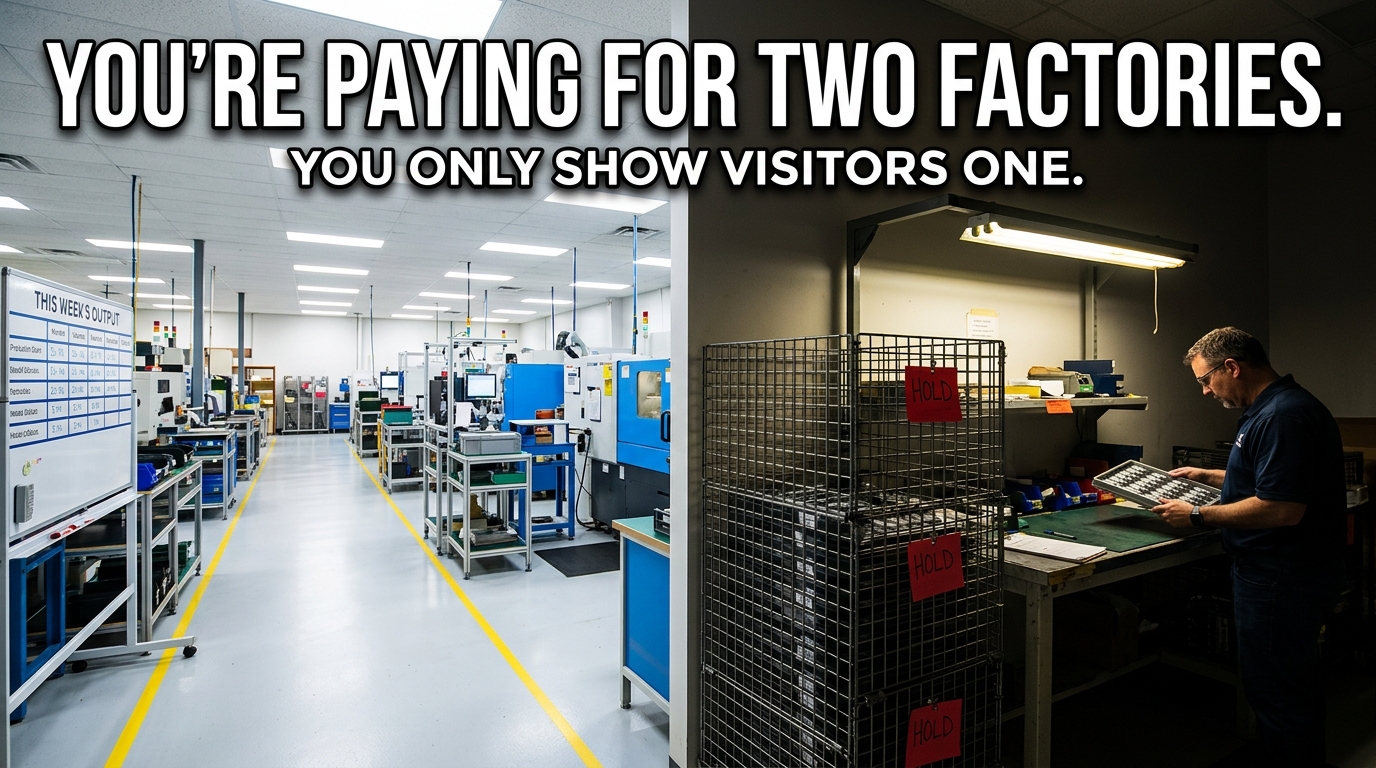
Picture the factory you show visitors. The tidy aisle, the machines running, the board with this week’s output on it. That’s the one on your org chart and in your budget.
Now picture the other one.
It’s the bench in the corner where two people spend most of the day fixing parts that were made wrong the first time. It’s the quarantine cage nobody quite owns, full of stock waiting for someone to decide what to do with it. It’s the inspector checking things a second time because the first check didn’t catch the problem. It’s the planner on the phone at four o’clock on a Friday, booking a dedicated van because an order’s going to be late again. It’s the machine that stops for a few minutes; a dozen times a shift and never makes it onto a downtime report.
That second factory has staff. It has a schedule, of sorts. It eats floor space, energy and overtime. It has a budget too, although you’ll never find it written down anywhere, because nobody ever approved it.
The quality pioneer Armand Feigenbaum called it the hidden factory. And here’s the uncomfortable bit. In a 1994 interview, he estimated that somewhere around 20% to 40% of the total capacity of many companies was tied up in it.
I’ll be honest, the first time I heard that number I thought it sounded like the sort of thing consultants say to sell consultancy. Then I started counting. I’ve walked round an awful lot of factories since my days as a Kaizen engineer, and I don’t think I’ve ever found one without a hidden factory. The only real question is how big it is, and whether anybody’s looking at it.
That question matters more right now than it has for a while. Make UK’s Q3 2026 Manufacturing Outlook showed the UK orders balance rising from +12% to +17%, while the employment balance fell from +15% to just +3%. More work coming in. Hardly anyone being hired to do it. So if you need more output, it’s got to come from somewhere.
My suggestion? Before you add a shift, buy a machine or chase another recruitment campaign, go and find your second plant. There’s a good chance the capacity you need is already on your payroll.
In this post I’ll walk you through what the hidden factory actually is, why your reports are almost designed not to show it, how its departments feed each other, how to measure it in a fortnight, and how to start closing it down without launching a huge programme.
What the hidden factory actually is
Feigenbaum had a lovely way of describing it. He said it was the part of the organisation that exists to do bad work. Then came the important bit: not because you want to do bad work, but because the way the process works pushes people into it.
I think that’s the key to the whole idea. Nobody sets out to build a hidden factory. It grows, one sensible looking workaround at a time.
When I go looking for it, I tend to find four departments. Every hidden factory I’ve seen has some version of all four.
Rework. Parts or assemblies that didn’t come out right and need fixing. Sometimes it’s a dedicated bench or cell. More often it’s spread around, a bit of fettling here, a bit of refinishing there, an operator quietly redoing something at their own station because it’s quicker than raising a report.
Reinspection. Checking things again because the first check couldn’t be trusted, or because there’s been a problem and now everything’s being sorted. One escaped defect and suddenly you’ve got a hundred per cent inspection on a product line for three months. Funny how those temporary checks never seem to get taken away.
Expediting. The hot list. The chasing, the reshuffling, the premium freight, the Saturday overtime, the batch that gets dragged out of the queue and rushed through because a customer’s shouting. Every expedited job pushes something else back, which then needs expediting too.
Downtime. Not just the big breakdowns everyone remembers, but the minor stops, the waiting for material, the waiting for a setter, the waiting for first off approval. The stuff operators just deal with because it’s part of the job.
Here’s a test I sometimes use. Ask yourself how many people in your business spend most of their day fixing, checking, chasing or waiting. Not doing their actual job. Doing the job the hidden factory gives them. If the answer makes you a bit uneasy, you’re in good company.
And what does it cost? The American Society for Quality’s long running rule of thumb puts quality related costs at 15% to 20% of sales for many manufacturers, rising as high as 40% of operations at the worst performers. To be fair, those figures are old, they’re American, and they get repeated a lot without much evidence behind them. Feigenbaum’s 20% to 40% capacity figure was an estimate too, not a measured dataset. I wouldn’t put either number in front of your bank manager.
But I’d treat them as a warning, not a forecast. Even if your hidden factory is half the size of the low end, that’s still a serious amount of capacity you’re paying for twice.
Why your reports don’t show it
If the hidden factory’s that big, you’d think someone would have spotted it. So why don’t they?
Mostly, it’s because the costs are spread so thinly across so many budgets that no single line ever looks alarming. Rework labour gets absorbed into production hours. Scrap disappears into material variance. Premium freight sits in the logistics budget. Overtime goes to payroll. The inspector checking things twice is just “quality.” Each one on its own looks like the normal cost of doing business.
It’s only when you add them up that you get a shock.
We looked at this in detail in Cost of Quality Failures: A Practical Guide for UK Manufacturers. The worked example in that post started with £5,000 of visible scrap and ended at £18,320 a month once rework, reinspection, machine time, rushed freight and lost capacity were counted. That’s more than three and a half times the number in the scrap bin. I’d say that’s fairly typical, if anything a bit on the kind side.
The second reason is how we measure yield. Lots of factories report final yield, which is the share of parts that eventually ship as good. That number can look brilliant. But it quietly includes everything that got reworked on the way.
Try this. Imagine a part that goes through five operations, and each one gets it right first time 95% of the time. Sounds decent, doesn’t it? Multiply it through, and only around 77% of parts get through all five without being touched again. That figure is called rolled throughput yield, and it’s the one that shows you the hidden factory. The gap between 77% and your shiny final yield figure is roughly the size of your rework department.
The third reason, I think, is the slightly awkward one. Hardly anyone measures it. Older ASQ research found that fewer than 35% of quality managers systematically tracked the cost of quality at all. Their 2025 benchmarking found only 31% of respondents felt they fully understood how quality costs affected their financial performance. If you don’t measure it, you can’t really be surprised when you don’t see it.
Downtime has the same problem. A 2022 study of a single turning machine found operators estimated around 319 hours a year of lost time from short stops, while the OEE system had recorded about 106 hours in the matching category. It was one machine, one plant and four people’s estimates, so I wouldn’t stretch it too far. But it rings true. Short stops get cleared by operators, not logged, and over a year they add up to whole shifts.
So your reports aren’t lying, exactly. They’re just answering a different question. They tell you what your visible factory produced. They don’t tell you what the hidden one consumed to get there.
How the four departments feed each other
This is the bit I find most interesting, and I think it’s the bit most businesses miss. The four departments of the hidden factory don’t just sit side by side. They feed each other.
Let me show you how it usually goes.
A machine goes down for an hour. Not a disaster. But the job on it is now late, so it goes on the hot list. To catch up, someone rushes the next changeover, skips a check or runs the machine a bit faster than it likes. A few parts come out wrong. Those need reworking, which takes a skilled person away from their normal work. Because there’s been a quality problem, the customer’s parts now get checked twice before they leave. The reinspection slows the line down, so the following orders late too. Now that one needs expediting. Overtime gets booked. Tired people make more mistakes.
And round it goes.
What strikes me every time is that each step felt reasonable at the time. Nobody did anything daft. They were just reacting to the last problem. But the cycle feeds on itself, and the hidden factory gets a little bigger each time round.
It also competes with your real factory for exactly the same resources. The rework bench uses floor space you could use for production. The reinspection uses people you could train on something else. The expedited jobs jump the queue on the same machines your planned work needs. Every hour the hidden factory takes is an hour your visible one doesn’t get.
Downtime is a good example of how big this can be. Siemens’ True Cost of Downtime 2024 report estimated unplanned downtime costs the world’s 500 biggest companies around 11% of their revenues, up from 8% in 2019. Those are huge global firms, not UK SMEs, so treat it with care. Closer to home, a 2017 UK study by Oneserve put the cost of downtime to British manufacturers at more than £180 billion a year, or about 49 hours and £31,000 per company. That’s an old figure and a vendor’s one, so again, a pinch of salt. But I’ve never met an operations director who thought their downtime was smaller than it looked.
Then there’s the customer. Customers don’t see your hidden factory directly. They see what it does to your delivery performance. In The True Price of a Late Shipment, we looked at how repeated late deliveries quietly push big clients to add a second supplier or send their next quote elsewhere, often without ever telling you why. A lot of those late shipments start life in the hidden factory. A breakdown here, a rework loop there, a batch stuck waiting for a second inspection.
So when you look at it properly, the hidden factory isn’t really a quality problem, a maintenance problem or a planning problem. It’s all three, chasing each other round in a circle.
Shining a light on it: how to measure yours in a fortnight
The good news is that you don’t need a big data project to find your hidden factory. You need your eyes, some tally sheets and a couple of weeks of honest counting.
Start with a walk. Go round the floor with one question in mind: where are we doing something twice, or waiting for something? Look for the signs. A rework bench or cell. Quarantine cages and “hold” areas. A whiteboard with a hot list on it. Parts stacked with a handwritten label. An inspector who seems to be checking everything. A pile of things nobody’s quite sure about. Operators who’ve built their own little fixes and jigs to get round a problem. Every one of those is a door into the hidden factory.
A small confession. On one of these walks, I asked a team leader what a corner full of part finished assemblies was. He looked at me as though I’d asked what the roof was for. “That’s the rework area,” he said. “It’s always been there.” That’s the thing. Once the hidden factory’s been around long enough, it stops looking hidden. It just looks normal.
Then count it for two weeks. Put a simple tally sheet at each spot you found. Keep it dead simple. Date, part, what happened, how long it took. Ask people to fill it in as they go. You’ll want four columns, one for each department: rework, reinspection, expediting and downtime. Include the short stops. If operators say a jam happens “a few times a shift,” ask them to tick each one.
Be really clear with people about why you’re doing it. You’re studying the process, not catching anybody out. The people doing the rework usually know exactly why it’s happening, and they’ve often been frustrated by it for years. If they think the tally sheet’s going to be used against them, you’ll get a beautifully clean set of numbers and learn absolutely nothing.
Put a pound sign on it. At the end of the fortnight, total up the hours in each department and multiply by a loaded labour rate or machine rate. Add any premium freight and overtime. Then do the bit most people skip and work out the lost capacity: the hours that could have been making saleable product, multiplied by the contribution you’d have earned on them. The method in our Cost of Quality Failures guide works well here. Just be careful not to count machine time and lost capacity for the same hours twice.
Turn it into one page. I like to call it the hidden factory P&L. Four lines, one for each department, with hours and pounds against each. Multiply by twenty-six to get a year. Put it in front of the leadership team.
I’ve watched that single page change the mood in a boardroom. People stop arguing about whether there’s a problem and start arguing about which bit to fix first. And to be honest, that’s a much better argument to be having.
Closing it down without a big programme
So you’ve found it, and you’ve put a number on it. What now?
My first bit of advice might sound odd. Don’t try to fix the whole thing at once. The hidden factory grew one workaround at a time, and you’ll probably close it down the same way, one department and one cause at a time.
Pick the biggest line first. Look at your hidden factory P&L and pick the department with the biggest number. Then, inside that department, find the handful of causes behind most of it. A simple Pareto chart will usually show you that a few part numbers, machines or failure types are behind the majority of the hours. Start there.
Fix causes, not symptoms. This is where most attempts go wrong. It’s very tempting to make the rework bench more efficient, or speed up the reinspection, or get a better deal on premium freight. That just makes the hidden factory run more smoothly. Ask why the rework happens and keep asking until you hit something you can actually change. A worn fixture. An unclear drawing. A setting nobody’s written down. Material arriving from a supplier who’s never been told what good looks like.
Prevent it at source. The fixes that last tend to be preventive ones. Mistake proofing, so a part can only fit one way. Clear standard work for the operations that keep going wrong. A proper first off check that’s planned in, so nobody’s waiting for quality to wander over. Preventive maintenance on the machines that keep causing short stops. None of that is glamorous. All of it works.
Break the expediting habit. Expediting is the hardest one to give up, because it feels like you’re helping the customer. But a factory that runs on the hot list is a factory where the plan’s become optional. Protect the schedule for the next few days and treat every expedite as a signal that something went wrong upstream. Then go and find out what it was.
Make it visible every day. If you’ve got a short daily meeting, add the hidden factory to the board. Rework hours yesterday. Jobs expedited. Minutes of short stops. Just a few numbers, looked at every morning. We wrote about how to keep that kind of meeting tight in The 15 Minute Daily Meeting That Keeps Lean Improvements From Fading. What gets looked at every day gets talked about, and what gets talked about tends to shrink.
Look after the people. One more thing, and it matters. The people who’ve been running your hidden factory are often some of your most capable. Your best fixers, your sharpest inspectors, the planner who can somehow conjure a van out of nowhere on a Friday. As the hidden factory shrinks, don’t let them feel they’re working themselves out of a job. Move them on to prevention. They already know where the bodies are buried, so to speak.
And then decide, on purpose, what to do with the capacity you get back. Maybe it’s more output against that improving order book. Maybe it’s shorter lead times for your biggest customers. Maybe it’s less overtime and a calmer Friday afternoon. All of those are good answers. The bad answer is not deciding at all, because then the hidden factory tends to quietly fill the space again.
Bringing it back to your second plant
Let’s pull it together.
Every factory I’ve ever walked into has had a hidden factory running inside it. Rework, reinspection, expediting and downtime, each one quietly staffed, each one using your machines, your floor space and your best people. Nobody approved it. Nobody budgets for it. And because its costs are spread so thinly across production, quality, logistics and payroll, your reports are almost guaranteed not to show it.
Feigenbaum reckoned it could tie up 20% to 40% of a company’s capacity. Maybe yours is smaller than that. Maybe it isn’t. Either way, the only way to find out is to look.
So walk the floor and find the doors into it. Count it honestly for a fortnight. Put a pound sign on it and turn it into one page. Then pick the biggest line, fix causes rather than symptoms, prevent problems at source, break the expediting habit and keep it visible every single day.
With orders improving across UK manufacturing and hiring still cautious, I’d go as far as saying your hidden factory might be the cheapest extra capacity you’ll ever find. You’re already paying for it. You might as well get some good parts out of it.
If you’d like a hand finding yours, this is exactly the kind of work we do at TCMUK. Our Lean Coaching and Mentoring Programme trains your own people in the tools that close down the hidden factory, things like root cause analysis, mistake proofing, standard work and daily management, and then coaches them through live projects on your shop floor. The gains belong to your team, and they keep coming long after we’ve gone.
Or if you’d rather just talk it through first, book a 15 minute call with Adam. Bring the department you suspect is the biggest. No pitch. Just a conversation about whether we can help.
Your second plant is already running. The only question is whether it keeps working for the problems or starts working for you.
More Blog Posts
The Hidden Factory: The Second Plant You’re Paying For and Never See

The 15-Minute Daily Meeting That Keeps Lean Improvements From Fading

The 30 Days After Lean Training: A Plan So It Doesn’t Fade
Kanban on a Shoestring: Two Bin Replenishment Without Buying a New ERP

Why Your 5S Programme Died (And How to Make the Next One Stick)

The True Price of a Late Shipment: Why Lead Time Reduction Protects Your Biggest Clients







To leave me a message or book a return call at a time that suits you