


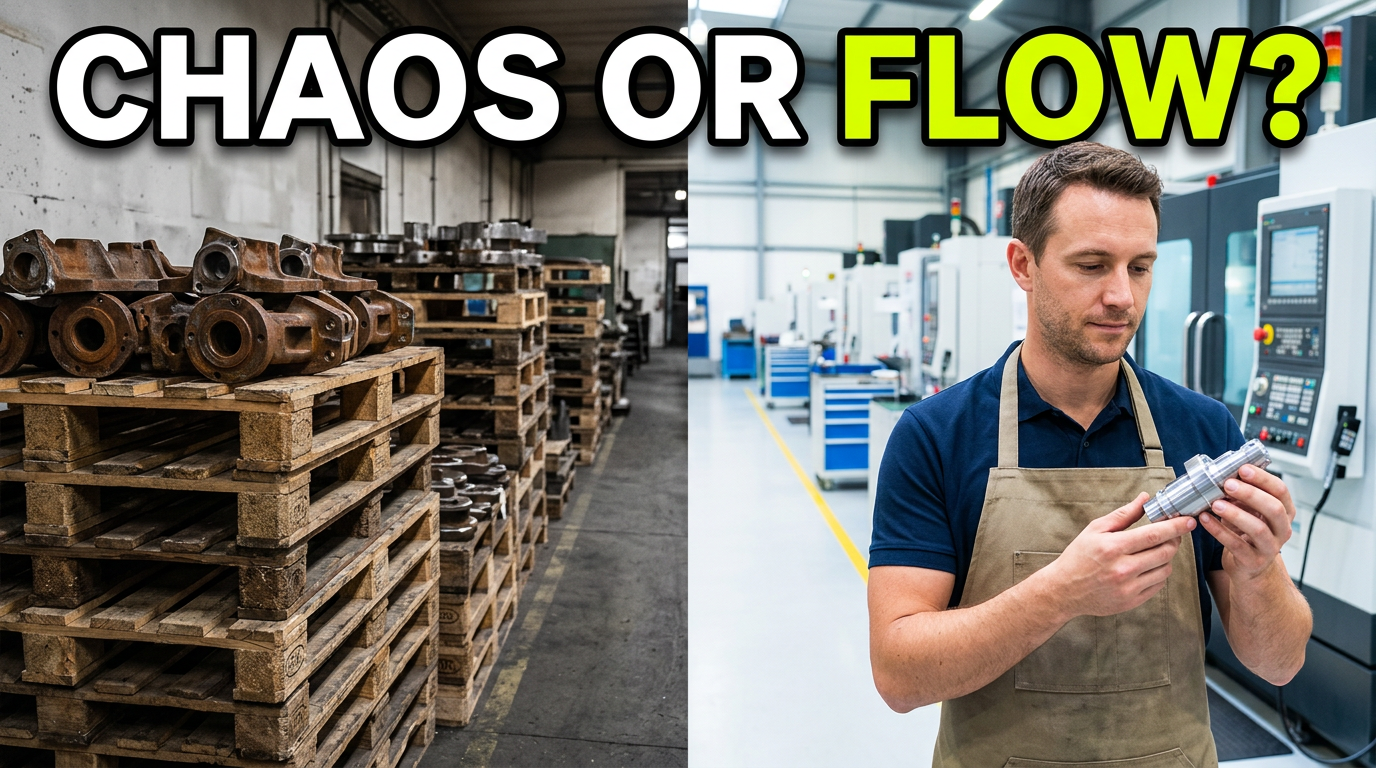
From Promising Delivery Dates to Consistently Hitting Them
How Lean tools reduce lead time variation and improve OTIF in technical businesses
Let us talk about the exact moment a delivery promise starts to wobble. You probably know the feeling well. The sales team wins a fantastic order from a key customer and confidently gives a delivery date. The customer is delighted. The sales director is pleased. But somewhere down the hall, your production manager is looking at the master schedule and quietly wondering how on earth that date is going to hold.
This is a classic dynamic. I have seen it many times in mid-sized UK manufacturing plants. You win an order, you look at the routing cards, you give a date, and then reality gets involved. The problem here is not just an operational headache. It is a trust problem. When delivery dates keep slipping, customers stop believing them. They start calling for updates constantly, which wastes time, or worse, they start looking for alternative suppliers who can actually do what they say they will do.
We often misdiagnose the core issue. We assume the problem is simply that our lead times are too long. But the real enemy is often lead time variation. It is the unpredictability that kills credibility. If you are consistently slow, customers can at least plan around you. But if you are unpredictable, you become a serious risk to their own production schedules.
Today we are going to look at how Lean methods help engineering and manufacturing factories become more predictable, reliable, and ultimately more customer-friendly.
Why delivery dates slip in technical businesses
If you run an established technical business with anywhere from twenty to two hundred employees, you probably already know how to make your product. Skill is rarely the issue. Your engineers are capable, and your machinists are experienced. The issue is usually flow.
Why do dates slip so consistently in engineering firms? Usually, it is a messy combination of systemic issues that have just become normal. Excess work in progress is often the biggest culprit. There is a deep psychological need in manufacturing to see everyone looking busy. If operators are standing still, middle managers get nervous. So what happens? Jobs get released to the shop floor too early just to keep the machines running. The system gets flooded. And suddenly your factory floor becomes a very expensive storage area for part-finished goods.
When you have too much work in progress, you create queues between process steps. A component might need only three hours of actual machining time, but it spends three weeks sitting on a pallet waiting for its turn on the milling machine.
Then you have to factor in changeover delays. If setting up a machine takes half a day, your team will naturally want to run larger batches to justify the setup time. Those bigger batches clog the system further. Add in the inevitable rework, a quality hold because someone missed a critical tolerance, or late engineering information from the design office, and the schedule starts to unravel.
And then there is the material shortage. You can have a complex assembly ninety-nine percent complete, but it cannot ship because one small fastening component is missing. All of these issues create variability on the shop floor. That variability makes planning difficult and turns delivery promises into guesses.
Why lead time variation matters more than average lead time
We need to talk about the difference between a process that is fast on average and one that is genuinely predictable. People often confuse the two.
Imagine you quote a four-week lead time to a customer. Sometimes you get lucky and deliver in three weeks. The customer is pleasantly surprised. But the next time they order, a machine goes down, a supplier is late, and the same product takes nine weeks to deliver. On average, your lead time might look acceptable. But averages are not much use to a customer who has their own assembly line waiting for your components. Predictability is far more valuable than intermittent speed.
When a manufacturing process is highly variable, planners are forced into a corner. They learn from being burned. They stop trusting the process and begin building buffers into everything. A routing that technically takes two weeks gets quoted as four weeks to be safe. Then sales adds another week just to manage expectations.
Suddenly you are quoting five weeks for two weeks of actual work. And the frustrating part is that you may still miss the date. Work expands to fill the time available for its completion, and buffers create more waiting, more work in progress, more confusion, and more firefighting.
We often end up celebrating firefighters. The expeditor who stays late to get a desperate order out of the door gets praised. The planner who quietly builds a boring, predictable schedule gets less attention. But consistency is what improves credibility with customers.
Lean tools that improve delivery reliability
Let us look at the Lean tools that actually fix these systemic issues. At its heart, Lean is about making work easier, smoother, and much more predictable.
Value Stream Mapping
You cannot fix a process you cannot see. Value stream mapping reveals exactly where time is lost across the full order-to-delivery flow. You map the journey from the moment the purchase order arrives to the moment the finished goods leave the loading bay.
It is usually quite eye-opening when leadership teams see this mapped out properly for the first time. It exposes waiting, clumsy handoffs between departments, hidden rework loops, and the real bottlenecks. You quickly realise that products spend far more time waiting than being worked on.
Pull systems and Kanban
This is about stopping the habit of pushing work onto the floor just because a machine happens to be empty. In a pull system, work only starts when the next step is ready to receive it.
Pull reduces overproduction and cuts excess work in progress. By controlling how much work is on the floor, you keep flow more stable, more visible, and far easier to manage.
SMED
Single Minute Exchange of Die is a methodology for faster changeovers. If your changeovers take hours, you are going to run bigger batches. If you can use SMED principles to bring setup time down sharply, you can afford to run smaller batches.
Smaller batches link directly to shorter queues and a more flexible production schedule. Jobs move through the factory rather than sitting in slow-moving clumps.
Heijunka
This is the practice of workload levelling. You do not want a massive spike of complex work hitting the floor on Monday morning followed by almost nothing on Thursday. Heijunka smooths the peaks and troughs of customer demand into a steadier, more manageable rhythm.
Smoother production means less stress on machines, less overtime for staff, and delivery dates that are much more dependable.
Standard work and visual management
If anyone can walk onto your shop floor and instantly see whether the plan is on track, you have good visual management. Standard work reduces the variation in how tasks are actually carried out by different operators.
Visual management helps teams spot problems before they become delivery problems. If a job is falling behind, a good visual board highlights it immediately.
How Lean improves OTIF
On time and in full, or OTIF, is the ultimate metric for customer satisfaction. Delivering ninety percent of an order on time is still a failure if the customer needs all of it. Delivering everything in full but three weeks late is equally unhelpful.
Lean directly attacks the root causes of poor OTIF. Better flow means components arrive at final assembly when they are actually needed. Fewer delays mean the schedule holds true. Fewer quality issues mean you are not scrambling to remake a part at the last minute.
When you improve both halves of the OTIF equation, you change how the market sees you. Customers talk. When you become the supplier who regularly delivers what was promised, when it was promised, you build genuine trust.
Example of a UK manufacturer reducing lead time
Imagine an established company in the Midlands making complex industrial valves. They have around a hundred and twenty employees, a turnover in the tens of millions, and a long engineering history.
Their promised delivery dates were too optimistic. The production floor was chaotic and unreliable. Work in progress was stacked everywhere. Supervisors were running around the factory trying to find the right subassemblies to finish urgent orders.
They started with value stream mapping and discovered their real bottleneck was testing and calibration. Everything piled up there because the upstream machines were producing more parts than testing could handle.
They reduced work in progress, removed excess pallets, implemented smaller batches, and tightened scheduling discipline. If a machine had no scheduled work, the operator was moved to support the bottleneck.
The result was significant. Lead times became shorter because jobs were not waiting in huge queues. OTIF improved because the factory was no longer promising what it could not reliably deliver.
How to start in your own business
Reading about Lean is easy. Implementing it is harder. So do not try to change your whole factory overnight.
Pick one product family or one value stream. Map that single flow from start to finish. Measure the actual lead time against the lead time you quote to customers. Identify exactly where the longest delays happen.
Start small with a pilot area. Introduce pull and visual management in that one flow. Prove it works. Then scale what works across the rest of the business.
Conclusion: from hoping to knowing
Customers do not value promises. They value dependable delivery. Lean helps technical businesses turn delivery from a stressful guessing game into a controlled system.
Consistency creates confidence. It gives your sales team confidence to quote accurately. It gives your production team confidence that the plan is realistic. And most importantly, it gives your customers confidence that you will do what you said you would do.
If your technical business is struggling with slipping dates, chaotic schedules, and frustrated customers, it is time to stop blaming the operators and start fixing the system. Step back, look at the flow objectively, and start building a factory that delivers what it promises, time after time. If you need support with this please do get in contact here.
More Blog Posts

The 30 Days After Lean Training: A Plan So It Doesn’t Fade
Kanban on a Shoestring: Two Bin Replenishment Without Buying a New ERP

Why Your 5S Programme Died (And How to Make the Next One Stick)

The True Price of a Late Shipment: Why Lead Time Reduction Protects Your Biggest Clients

Cost of Quality Failures: A Practical Guide for UK Manufacturers

The Hidden Costs of a Disconnected Team: How to Calculate the ROI of Better Collaboration







To leave me a message or book a return call at a time that suits you