


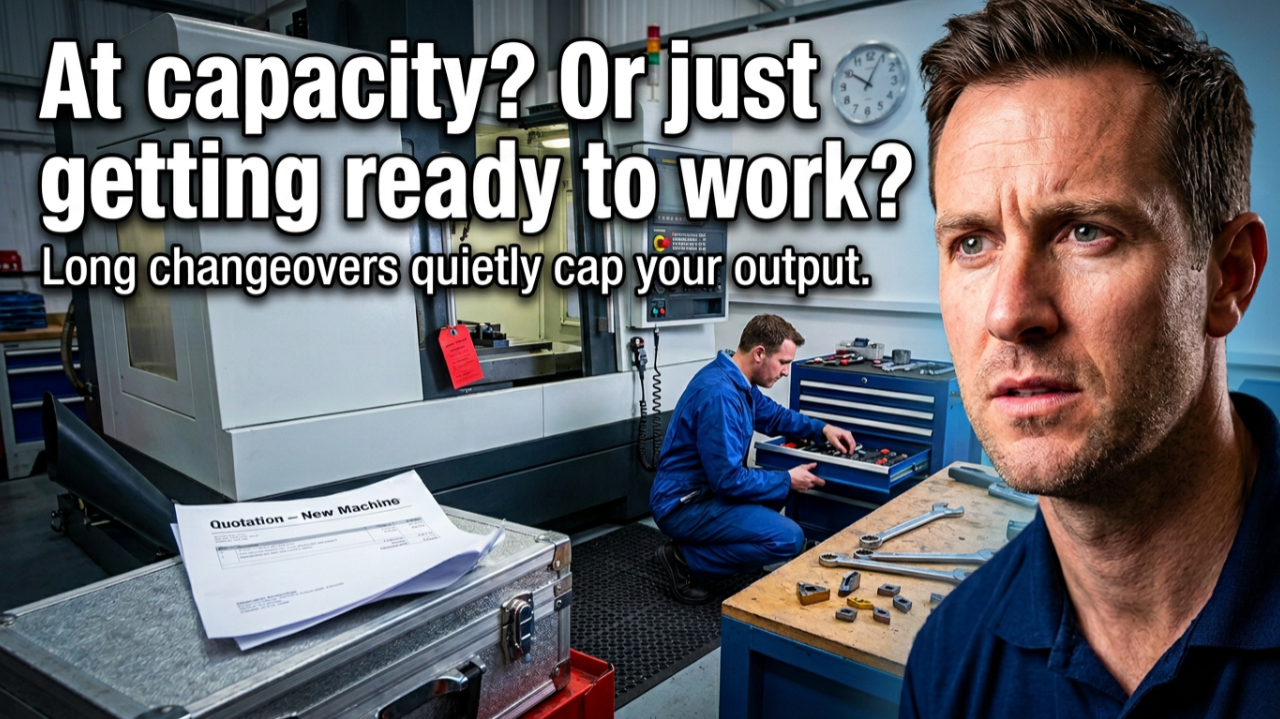
Get your Changeovers out of the Slow Lane
Why long set ups quietly cap your capacity, and how SMED gets the time back without buying another machine.
There’s a conversation I’ve heard in more factories than I can remember. A key machine is “at capacity.” A customer’s getting nervous. Somebody puts a quote for a second machine on the MD’s desk, and the talk turns to finance, floor space and who on earth is going to run it.
And nobody, at any point, asks how much of the week that first machine actually spends making parts.
Whether you run a high-volume business or a low volume one, changeovers are one of those things that can quietly drain the life out of your manufacturing process. Left alone, an unstructured approach to set ups has a habit of growing arms and legs. Then the arms and legs grow arms and legs. Nobody plans it. It just creeps.
I first saw this properly in the early nineties. I was a Kaizen engineer at a business making aerospace fasteners, and we were being trained in lean manufacturing by a Japanese sensei. He split us into three teams for a week of improvement events on three different machines: a centreless grinder, a thread roller and a header machine. My team got the header.
The first thing we did was film a real changeover, start to finish. Not a demonstration. The real thing, done the way it had always been done.
When we added it up, there were eight hours of it. A whole shift. For a production run that would last thirty minutes to an hour, depending on batch size, and we were talking batches in the thousands. The machine ran three shifts, so a big slice of its working life was spent getting ready to work.
And here’s the bit that still makes me smile. A major customer had flagged that machine as a high risk to their supply because of capacity. They were actively pushing us towards buying another one.
At the start of the week, we’d have been delighted with a 50% reduction. Honestly, that felt ambitious. Never in a million years did we think we’d get it under thirty minutes. But we did.
That week changed how I look at every factory I walk into. So this post is the longer version of what I learned, brought up to date for UK manufacturing in 2026. What long changeovers really cost you, why you should film one before you touch anything, how to split internal work from external work, and the three words that have stuck with me for over thirty years: eliminate, combine, simplify.
What a long changeover is really costing you
Most people think of a changeover as lost machine time. It is. But I think that’s the smallest part of the bill.
The bigger cost is what long changeovers force you to do to cope with them. If a set up takes half a shift, nobody wants to do it often. So you run bigger batches. Bigger batches mean more work in progress on the floor, more finished goods in the stores, more cash tied up in stock and more floor space lost to racking. You make things before anybody’s ordered them, which is overproduction, the waste that tends to feed all the others. Jobs wait in a queue behind the big run. Material gets moved, stacked, then moved again. Lead times stretch, so you quote longer, so customers order earlier and in bigger lumps, and round it goes.
In other words, a long changeover doesn’t just waste an hour. It sets your batch size. And your batch size quietly sets your stock, your lead times and a fair bit of your cash flow.
There’s a nice bit of history here. For most of the twentieth century, factories worked out batch sizes using the economic order quantity, a formula that treats set up time as a fixed cost you simply have to live with. Toyota’s big insight was to question the “fixed” part. If changeovers get short enough, the economic batch gets small, and suddenly you can make what customers actually want, when they want it.
That matters more for UK manufacturers now than it did when I was stood next to that header machine. A lot of your customers want smaller quantities, more variants and shorter lead times, and they don’t want to pay for you holding their stock. For plenty of UK firms, high mix, low volume isn’t a niche anymore. It’s just the work.
Then there’s capacity. Make UK’s Q3 2026 Manufacturing Outlook showed the UK orders balance rising from +12% to +17%, but manufacturers holding back on hiring because employment, energy and input costs are still biting. More orders. Same people. Same machines. So where’s the extra output meant to come from?
Before you sign off a second machine, or another shift you can’t staff, it’s worth asking a slightly awkward question. How much capacity is already sitting inside your changeovers, waiting to be found?
In my experience, it’s usually more than anyone guesses. Quite a lot more.
Film it before you fix it
If you take one thing from this post, make it this. Before anyone suggests a single improvement, film a real changeover.
Not a rehearsed one. Not the one your best setter does when he knows the MD’s watching. The normal one, on a normal day, from the last good part of the old job to the first good part of the new one. That’s the bit that counts, by the way. The changeover isn’t finished when the new tool’s in. It’s finished when you’re making good parts at the right rate.
Why video? Because memory is hopeless at this. Ask a setter how long a changeover takes and you’ll get an honest answer that’s often wildly out, because nobody notices the walking, the waiting and the searching. They just feel like part of the job.
When you play the footage back with the team, a few things almost always jump out.
Walking. One practitioner wrote about watching an operator go to the tool store fourteen times in forty-five minutes, collecting one tool at a time. I’ve seen versions of that more often than I’d like to admit.
Searching. For the right spanner, the right insert, the drawing, the program, the forklift, the person with the key to the cabinet.
Waiting. For the crane, for quality to sign off a first off, for material nobody brought up because nobody knew the job was next.
Adjusting. Run a part, measure it, tweak, run another, measure again.
That last one is the big one, and it surprises people. Shigeo Shingo, the Japanese engineer most closely associated with quick changeover, broke a typical set up into four chunks. Preparing and checking tools and materials took about 30% of the time. Centring, dimensioning and setting conditions took about 15%. Trial runs and adjustments took about 50%. And actually mounting and removing the tool? Around 5%.
Five percent. The bit everyone pictures when they think “changeover” is barely a rounding error. The rest is preparation and guesswork.
A quick word on how you film it, because it matters. Tell people why you’re doing it. Make it clear you’re studying the process, not the person. The setter on that footage is usually the one who knows exactly where the time goes and has been quietly frustrated by it for years. Put them in the room when you watch it back, and let them talk first. You’ll learn more in an hour than in a month of stopwatch studies.
Then map it. List every step, how long it took and who did it. A simple spaghetti diagram, which is just a sketch of the machine with a line drawn wherever the operator walked, is brilliant for this. If it looks like someone’s dropped a plate of spaghetti on the drawing, well, you’ve found some easy wins.
Internal and external: the split that changes everything
Once you’ve got the list of steps, there’s one question to ask of every single one.
Does the machine have to be stopped to do this?
If it does, it’s internal set up. Taking the old tool out. Fitting the new one. A few genuine settings. That work can only happen when the process is stood.
If it doesn’t, it’s external set up. Fetching the tools. Finding the drawing. Bringing the material to the machine. Preheating a mould or die. Presetting tools off the machine. Checking you’ve got the right fixings. All of that can happen while the last job is still running.
The principle is simple, and it was the backbone of everything we did on the header machine. Do as much of the work as you can while the machine’s still running. Keep internal work to the absolute minimum, ideally just fitting and removing the tool, die or material, and nothing else.
I’d almost guarantee you’ll find that a lot of what’s being done with the machine stopped didn’t need the machine stopped at all. It’s just always been done that way. The setter stops the machine, then goes to look for the tooling. Nobody ever decided that was the right order. It just became the order.
Shingo described the journey in roughly four stages. First, make sure anything external really is done while the machine runs. Second, separate internal from external properly, so everyone can see which is which. Third, convert as much internal work as you can into external work. Fourth, improve everything that’s left.
Toyota’s big press changeovers are the classic example, and I think they’re worth knowing because they show how much of this is about preparation rather than clever engineering. Their huge stamping dies were being positioned by eye and nudged with crowbars, with test pressings in between, and a change could take anywhere from twelve hours to nearly three days. The first improvement was simply to record the right measurements for each die and set to those rather than by eye. That alone took it down to about an hour and a half. Then came staging the next die and the crane before the old one came out, and keeping the right tools at the press. Eventually it got to under ten minutes per die.
That’s where the name comes from. SMED stands for single minute exchange of die, but “single minute” means a single digit, so under ten minutes, not literally sixty seconds. Shingo usually gets the credit, though to be fair the history’s a bit more tangled than that, and Toyota’s engineers had been chipping away at changeover times since the forties. Shingo also claimed his own data showed set up times falling, on average, to around 2.5% of where they started. Maybe take that with a pinch of salt. But even a fraction of it would change most factories I know.
You can start moving work external without spending much at all:
Changeover kits or carts. Everything the job needs, tools, fixings, gauges and paperwork, staged at the machine before it stops.
A visible schedule. If the setter doesn’t know what’s next, they can’t prepare for it. A simple board showing the next two jobs fixes more than you’d think.
Preheating and presetting. Warm the mould, preset the tools, load the program, all while the current job finishes.
First off checks planned in. Agree with quality in advance when they’ll be needed, rather than waiting for someone to wander over.
Eliminate, combine, simplify
The phrase that’s stuck in my head since those early events is three words. Eliminate, combine, simplify.
It comes from a framework Toyota borrowed from the American Training Within Industry programme of the Second World War, usually written as eliminate, combine, rearrange and simplify. I’ve always remembered it as three, and to be honest three’s easier to keep on a whiteboard anyway.
Take whatever internal work is left and run each step through those words, in order.
Eliminate first. Can you stop doing this step altogether? Shingo had a lovely observation about bolts: it’s only the last turn that actually tightens it. Everything before that is just movement. So if a clamp needs twelve turns of a bolt, that’s eleven turns of waste on every changeover. Quarter turn fasteners, cam clamps, keyhole slots and quick release fittings all attack that. And do you really need eight bolts holding something that four would hold safely?
Adjustments are the other big target. Every adjustment is a sign that something isn’t located in the right place. Locating pins, fixed stops, spacers cut to height and marked datum lines can turn “fiddle until it’s right” into “fit it and it’s right.”
Then combine. Can two steps happen at once? Two people working in parallel, one each side of the machine, can sometimes halve what’s left of the internal time. It needs a bit of choreography, and you’ve got to think hard about safety, but it’s often worth it on a bottleneck machine.
Then simplify. Make whatever’s left easy and hard to get wrong. Standardise tool heights so everything sits at the same shut height. Use the same size fixing everywhere so one spanner does the lot. Colour code. Put a photo of the finished set up on the machine. Shingo called this standardising function rather than shape. Your tools don’t all need to be identical. They just need to fit and locate the same way.
A word of warning, from experience. Don’t start with the engineering. Teams love designing a clever quick release fixture, and fair enough, it’s the fun bit. But the cheap stuff, the cart, the schedule, the staging and the checklist, usually gets you a big chunk of the gain for very little money. Get that in first. Then spend engineering time on what’s left, once you can see what really matters.
On the header machine, if I remember rightly, a lot of our first day’s gains came from nothing more sophisticated than a trolley, a marker pen and a bit of agreement about who fetched what. The clever bits came later in the week.
Making it stick, and spending the time wisely
Here’s the frustrating part. A great SMED week can quietly unravel within a couple of months if nothing holds it in place. New setter, mad week, the cart gets borrowed for something else, and before you know it the machine’s stood while someone goes looking for an insert again.
A few things help.
Write the new standard down. A one-page changeover standard, ideally with photos, kept at the machine. Who does what, in what order, and what “ready” looks like before the machine stops.
Put changeover time on the board. If you’ve got a daily production board, add changeover time to it. What gets looked at every morning gets talked about. What gets talked about tends to hold.
Check the kit, not just the clock. A quick audit of the changeover cart once a week catches the slow drift before it costs you.
Go round again. A common rule of thumb is that each serious pass through the process takes out somewhere around 45% of what’s left. So a two-hour changeover might need a few rounds before it gets anywhere near ten minutes. That’s normal. It’s a loop, not a project.
Then there’s a question most teams forget to ask until it’s too late. What are you going to do with the time you’ve saved?
It’s tempting to keep running the same big batches and pocket the extra hours as output. Sometimes that’s the right call, especially if the machine’s a genuine bottleneck and the order books full. But often the bigger prize is changing over more often, running smaller batches, and taking stock and lead time out of the whole business. The hours you win back on the machine can come back to you as cash in the bank, space on the floor and shorter quotes for your customers.
I’d decide that on purpose, as a leadership team, rather than letting it happen by default. Otherwise, you tend to end up with neither.
Bringing it back to the header machine
Let’s pull it together.
Long changeovers do more damage than the minutes on the clock suggest. They push you into big batches, and big batches drive work in progress, finished stock, overproduction, waiting and endless moving of material. And with orders improving across UK manufacturing while hiring stays cautious, the capacity hiding inside your changeovers might be the cheapest capacity you’ll ever find.
The method isn’t complicated. Film a real changeover and watch it with the people who do it. Split internal from external, and move everything you can to while the machine’s still running. Then take what’s left and eliminate, combine and simplify. Standardise it, measure it daily and go round again.
Think back to that customer pushing us to buy another header machine. We never needed it. The capacity was there all along. It was just spending a whole shift at a time getting ready to work.
So before you sign off on new kit, film your worst changeover. You might be surprised. I usually am, even now.
If you’d like a hand, this is exactly the kind of thing we do at TCMUK. Our Lean Coaching and Mentoring Programme trains your own people in tools like SMED and then coaches them through live projects on your shop floor, so the gains belong to your team and keep coming long after we’ve gone. You can read more about the Lean Coaching and Mentoring Programme, or book a 15 minute call with Adam to talk through the changeover that’s causing you the most grief. No pitch. Just a conversation about whether we can help. Your machines are probably far more capable than your changeovers are letting them be.
0330 311 2820
More Blog Posts

The 30 Days After Lean Training: A Plan So It Doesn’t Fade
Kanban on a Shoestring: Two Bin Replenishment Without Buying a New ERP

Why Your 5S Programme Died (And How to Make the Next One Stick)

The True Price of a Late Shipment: Why Lead Time Reduction Protects Your Biggest Clients

Cost of Quality Failures: A Practical Guide for UK Manufacturers

The Hidden Costs of a Disconnected Team: How to Calculate the ROI of Better Collaboration







To leave me a message or book a return call at a time that suits you