
Get your Changeovers out of the Slow Lane

Benefits of SMED  (Single minute exchange of dies)

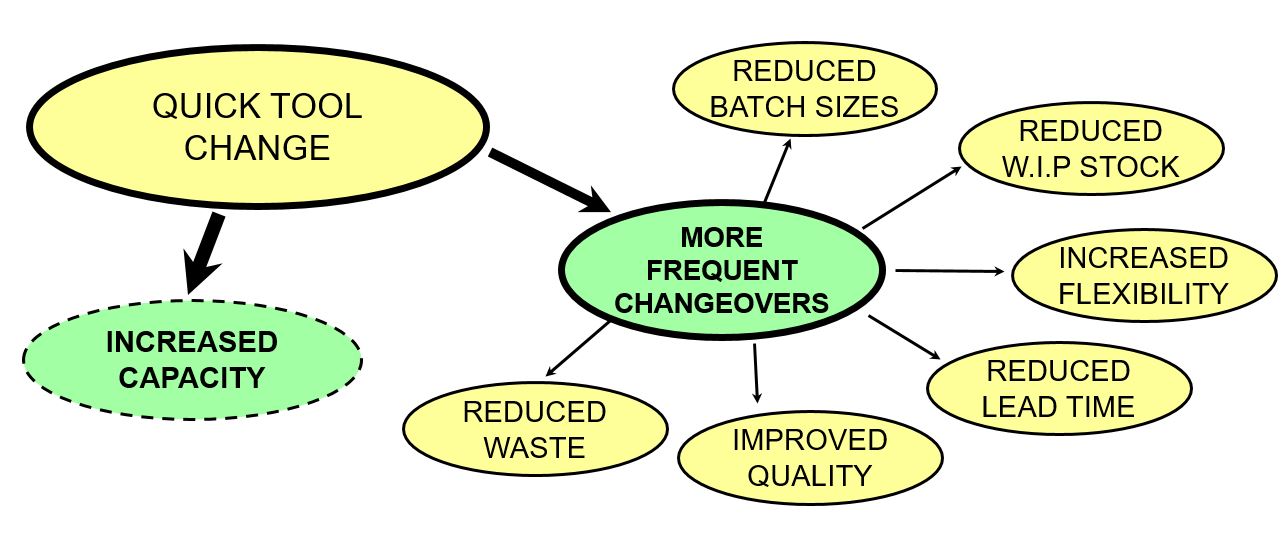
  • WIP and lot size reduction.
  • Finished goods inventory reduction.
  • Improved machine/resource utilisation.

Whether you are high volume or low volume business, changeovers is one of those things that can sap the living life out of your manufacturing process.

An unstructured/wasteful approach to changeovers (SMED, set-up, etc) has the uncanny ability to grow arms and legs, and those arms and legs can even grow arms and legs.

I first witnessed a set up reduction back in the early 90’s as a Kaizen Engineer manufacturing Aerospace Fasteners, we were being trained by a Japanese sensei in Lean Manufacturing, running three events on different machines; a centreless grinder; a header machine and thread roller.

Our team had the header machine, we videoed the actual set up so we could observe the waste within the process, much to our surprise there was 8 hours of it????? A WHOLE SHIFT WORTH OF CHANGEOVER for a production run that would probably last no more than 30/60mins depending on batch size, and batch size we were talking thousands. It was running three shifts.

Now bearing in mind, a major customer had flagged this as an high risk to their operation due to capacity and were forcing discussions on us purchasing another machine?????

At the start of the week, we we’re thinking a 50% reduction would be excellent, never in a million years did we think we’d get to sub 30mins, but we did!

Long Changeovers drive so much waste within your business, WIP, Overproduction, delays, waiting, transportation…..so they need to be focussed on.

The main benefits are as shown
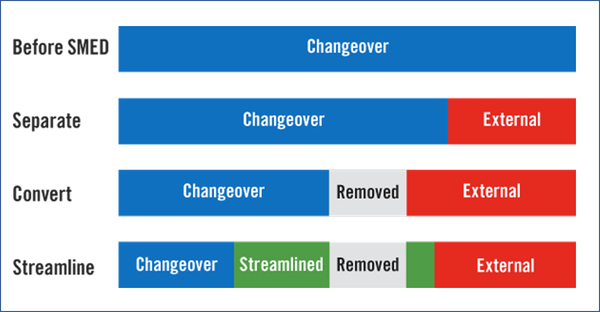
Key Principle of SMED

INTERNAL SET UP

Internal set up activities can only be performed when the process is stopped and must be kept to the absolute minimum in number and time taken to complete. Internal set-up activities should be limited to the actual fitting or removing of the Tool or Die or Material ONLY.

EXTERNAL SET UP

External set up activity can be performed with the process running and therefor does not affect the core changeover time.

As many changeover activities as possible should be external, leaving as few as possible as internal activities.

The statement that always sticks in my mind from my early SMED activities is ELIMINATE, COMBINE, SIMPLIFY.

0330 311 2820

Book a Return Call at a time that Best Suits You “HERE

The Productivity Puzzle and Lean

I’ve never been one to shout about Lean, Six Sigma or Theory of Constraints, to individuals to solve a solution. I personally have though, applied the tools and techniques to resolve a situation or gain an opportunity I have faced. Granted, it’s not just about the application of tools and techniques, it’s equally important to focus on People, Culture and Managing Change within today’s organisations and society. Every single person has touched or been a part of a Lean process, within our everyday life from grocery shopping to our work we will have been in contact with lean in motion.

The interesting thing I have noticed recently are the articles beginning to appear regarding “is Lean at a crossroads?” and “How Lean is perceived today” particularly in the UK (but perhaps globally). An article by Morpheus Group stated “Businesses are taking a much more pragmatic approach, using a blend of tools….with very few businesses labeling their Corporate Programmes as Lean”.

It does seem that Lean and other Japanese terms associated with it are perceived a risk to alienating the workforce. I wonder why? Are we that uncomfortable with something that is not invented by us?? Are we hiding behind the terms as an excuse not to change??? (There is no doubting it is hard to implement and sustain, but that should never be an excuse). When I personally think about these questions it’s never been about the wording (don’t get me wrong I do cringe with some of them) but it’s about the application, execution/implementation that is key and the right behaviours that drive it so that we can benefit from it.

Businesses are placing a lot of importance on Strategic Cost Saving and Quality. This is absolutely fundamental in “Change” for any business. Strategy and Performance Management, Policy Deployment, Hoshin Kanri, whatever you choose to call it, is the back bone of your business, it is how you do business.

I believe Business Improvement is more important today than it ever has been with the globalisation of markets. What is it that gives us the competitive edge? In particular UK Productivity remains below pre-recession levels. I have been in discussion groups where an estimated 40% of productivity is lost through non value added activities, an estimated £3 Billion cost. Something Lean, Six Sigma, TOC can certainly impact.

This debate will carry on and involves so much from skills, impact on society, etc., etc.

0330 311 2820

Book a Return Call at a time that Best Suits You “HERE