Leveraging Growth Mindset and Fact-Based Management in Manufacturing

The difference between stagnation and growth often lies in mindset and management approach. The case of an SME Manufacturer with an £8m turnover, which lost a monumental £1.5 million order to a competitor that did not even manufacture but merely outsourced, illustrates a vital lesson in resilience, mindset, and strategic focus.

The Importance of Managing by Facts

Today’s manufacturing landscape demands a shift from traditional, often emotionally-driven decision-making to a more robust, evidence-based approach known as ‘managing by fact.’ This paradigm underscores the necessity of grounding decisions in data, metrics, and factual evidence rather than intuition, gut feelings, or emotions. It’s a shift that aims to heighten efficiency, enhance productivity, and foster innovation by making informed decisions that are aligned with strategic objectives and market demands.

Understanding ‘Manage by Fact’

‘Manage by Fact’ is not just a catchphrase; it’s a comprehensive approach that encompasses:

  • Data-Driven Decision Making: Leveraging real-time data and analytics to guide strategic decisions, leading to more targeted and effective outcomes.
  • Performance Metrics: Establishing clear, measurable objectives that help in assessing performance against goals, thereby facilitating continuous improvement.
  • Objective Analysis: Encouraging a culture where decisions are made based on objective analysis rather than subjective opinion or hierarchical pressures.
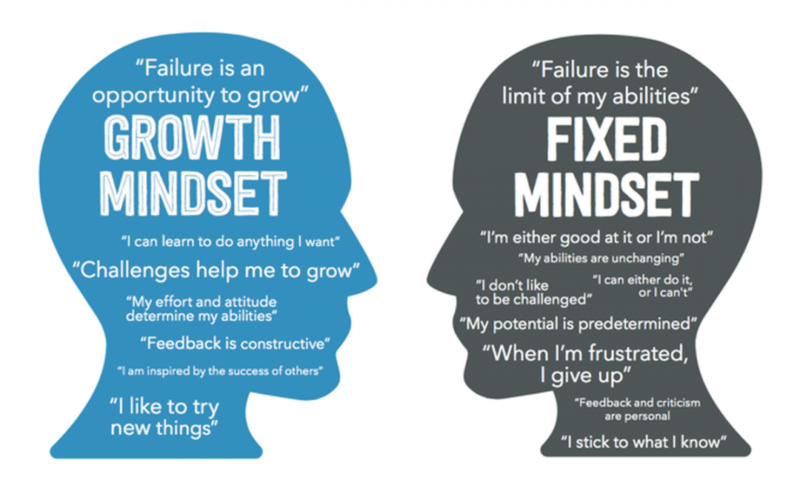
growth mindset

The Power of a Growth Mindset

At the heart of the SME Manufacturer’s story is the concept of a ‘growth mindset,’ a term coined by psychologist Carol Dweck. It denotes an underlying belief that talents can be developed through hard work, effective strategies, and input from others as opposed to a ‘fixed mindset’ which posits that talents and abilities are static and unchangeable.

A growth mindset in manufacturing signifies:

  • Embracing Challenges: Seeing failures, like losing a significant order, as opportunities to learn and evolve instead of insurmountable setbacks.
  • Persistent Effort: Understanding that mastery and improvement require time, effort, and perseverance.
  • Feedback and Critique: Welcoming constructive criticism as a resource for learning and development.
  • Learning from the Success of Others: Viewing peers and competitors as sources of knowledge and inspiration rather than threats.

Combining Fact-Based Management with a Growth Mindset

The synergy between managing by fact and fostering a growth mindset can become a formidable strategy in manufacturing. Here’s how:

  1. Data-Driven Insights for Continuous Learning: Utilising data not just for operational decisions but for learning and development, aligning employee growth with strategic business goals.
  2. Metrics for Performance and Growth: Performance metrics and KPIs can serve dual purposes—measuring current productivity and efficiency while identifying areas for skill development and innovation.
  3. Adaptability through Objective Analysis: An objective, fact-based approach empowers teams to adapt swiftly to market changes, technological advancements, and competitive dynamics, fostering a culture of continuous improvement and agility.

The Story of Resilience and Adaptation

Returning to the narrative of the SME Manufacturer, the loss of a £1.5 million order could have been a crippling blow. However, the management and team’s growth mindset, coupled with a strategic focus on facts and data, turned a potential disaster into a learning opportunity. It pushed the company to analyse what went wrong, to understand the market and competitors better, and to refine its value proposition and operations accordingly.

Their journey underscores several key takeaways for manufacturers:

  • Resilience is Key: The ability to bounce back from setbacks, powered by a belief in continuous improvement and the possibility of growth.
  • Embrace Change: Being open to change and willing to adapt strategies based on what the data shows can differentiate between stagnation and growth.
  • Collaborative Teamwork: A shared growth mindset within the team fosters collaboration, innovation, and shared ownership of both challenges and successes.

Conclusion: Forging Ahead with Facts and Growth

As the manufacturing sector continues to evolve amidst ever-changing market dynamics, the story of the SME Manufacturer serves as a compelling case study in the power of managing by facts not by emotion, and the transformative impact of a growth mindset.

Their experience illuminates a path forward for manufacturers seeking to navigate the complexities of modern-day business. It’s a dual approach where decisions are driven by data and insights, and where challenges and setbacks are seen not as endpoints but as stepping stones to greater achievements.

The manufacturers who will thrive are those who embrace the power of data, leverage the resilience of a growth mindset, and view every challenge as a new opportunity for growth and learning. Just as the SME Manufacturer demonstrated, the key lies in not just focusing on what to shrink but rather on what to grow. By striving to be better today than yesterday and planning to be better tomorrow than today, manufacturing businesses can ensure they remain competitive, innovative, and poised for success in an ever-evolving landscape.

0330 311 2820

Miss that moment – and you start to decline.

“There is at least one point in the history of any company when you have to change dramatically to rise to the next level of performance. Miss that moment – and you start to decline.” – Andy Gove

My personal view and experience is that it’s more than one point in time.

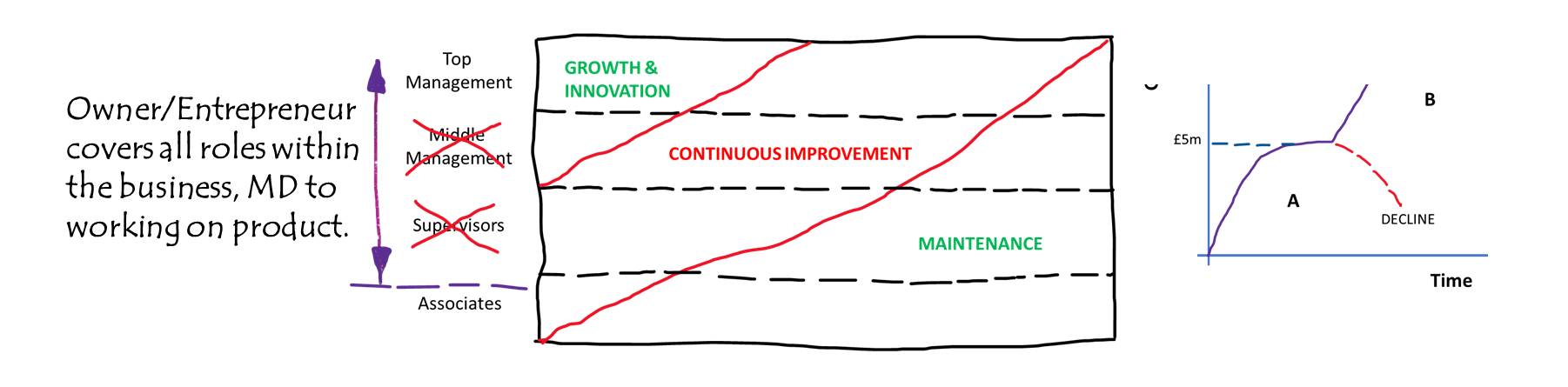
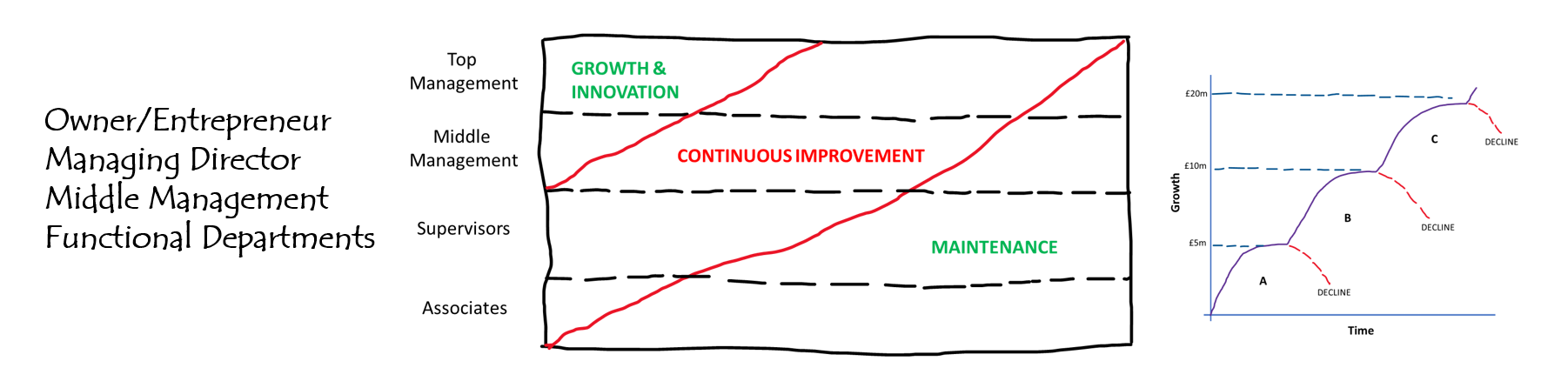
SMEs are characterised by their ability to adapt easily to market changes and their lean organisational structure (not as in Lean Manufacturing), which results in a more dynamic environment and a quicker decision making process. Although SME businesses vary widely in size and capacity for growth generally they will all follow a similar path: going from Owner/Entrepreneur with two or three employees to a business aiming for £10m or even £20m per year, and experiencing 20%/30% year on year growth and upwards along this journey. The sketch below illustrates an example of this, showing where most businesses may feel the pinch points of growth at key intersections.

SME Journey and Growth

Zero to £5m

The hard work really kicks in here. This part of the journey is often the one that is the most lonely, but often the most exciting. But it is here that most business owners feel the pains. Because it can be a lonely place, it is easy for owners to doubt themselves, they also don’t know what they don’t know which can be a limiting factor. And as an owner one of the main areas of responsibility is simply getting things done, which means you are working in your business as a manufacturer, and not working on it as a strategic leader.

In smaller SMES, management structures are also small with most owners being very hands-on. People are stretched across all functions all processes. Systems are not in place, IT is minimal or non-existent and there is a lack of standard processes. Utilising the Continuous Improvement and Management graph we can see that all levels are being worked with a very lean structure. Small customer projects, odd-job shop style of working.

SME Zero to £5m

As we get closer to a turnover of £5m, it becomes clear that things need to change. We are then moving from that odd-job, one off customer delivery to a mix of bigger projects, possible increased volumes and an increase in market share from your customers. As we start to scale-up from the initial start-up, decisions have to be made about the organisational structure, the company’s technology infrastructure, its business and marketing strategy, etc. With regard to organisational structure, you might now start to see the requirement for supervisory position(s) to take on more of the owners duties, the labour force growing, new machines, loans, investment, functional departments, Operations, Quality, Sales, Technical, Finance. This is where it can be rise or decline with those decisions. In scaling and growth and the opportunities it also brings its own set of problems, (albeit they are nice problems to have because its growth).

£5m to £10m

IT Systems and Planning may start to become an issue here, Microsoft Excel may no longer be good enough to manage your shop floor requirements (although I have seen £100m business still using excel but it was beginning to creak), and you are likely at this level to be considering MRP/ERP implementations. You may also look at outsourcing some functions, like Sales, Human Resources, Engineering Support, Quality, Quality Accreditation. All this requires a lot of investment in terms of time, money and energy. You need to do your homework to avoid costly mistakes, especially where IT is concerned, but it’s all opportunity.

And this stage, the business owner is now becoming more removed from the day to day operational tasks on the shop floor. This can be a very uncomfortable feeling in one or two ways. Firstly, the owner may want that hands-on role and not relinquish that part. It could be that the business is now at the stage where the owner is stopping it from growing, the entrepreneurial side is restricted as they are tied to the business. There a number of factors and variables in play, and having the right people is key, being a good leader is fundamental (at all stages).

SME £5m to £10m

£10m upwards

Financial Audits are required at this point (although some companies can be exempt if they satisfy certain criteria), so businesses need to be aware of the UK Audit requirements. Similar issues and opportunities still arise, but on a grander scale. Organisational structures are still fundamental, we might now start to see the need for Middle Management. We may also be looking to diversify into new markets, take on bigger orders, and higher volume. From £5m and up, some of your customers may not be the ones you want to deal with now, the one-off, low volume, job shop may not be your ideal customer. You might be seeing more of a need for Product Flow and Cells (Lean Manufacturing is a must from when you first start up), competition is high so you cannot stand still, even if your decision is to stay at a certain level. You will need to be driving for improvements to maintain the status quo, and your service has to be exceptional. Collaboration with a network of Manufacturers and or Partners, in my opinion, is key in this new world, and can bring some fantastic opportunities for growth. Again, IT infrastructure comes into play as the business is getting bigger: more employees, management leadership. The addition of new premises or additional buildings on the same industrial estate (this is where having a world class logistics operations pays dividends in not impacting your efficiency/productivity). The opportunities may now open up bringing the out-sourced services back in house, Sales and Human Resources, etc. At this level, you are likely to be making informed decisions based around data. Strategy alignment throughout the organisation is required, communicated and disseminated so everyone in the organisation knows the direction the company is going in and what the priorities are.

SME £10m upwards

Every business is different. One business’s pinch point may be at £3.5m another’s £7.5m but there will be very similar decisions to be made, but at this level the advantage is that businesses are likely to be able to make these decisions in a more informed way through data. Companies may not achieve sustained profitable growth unless they draft in the specialist skills required at the right time for the business. It’s the maxim that we don’t know what we don’t know. And the best advice is to seek advice from the experts in order to shift the dial in the right direction. This is something we can certainly help with, just contact the number below.

Ask yourself:

How much will it cost you not to resolve the issues that you are currently facing now or in the immediate future? How much will it cost you not to eliminate that pain? What are the lost opportunities on not taking your business to the next level or indeed keeping it at the level you want?

0330 311 2820

Book a Return Call at a time that Best Suits You “HERE

The saying goes “Culture eats Strategy for Breakfast” Drucker

The weekend of October 22nd I was watching the Austin Texas F1 Grand Prix, this is one programme that everyone knows in my house not to disturb me watching. This weekend Mercedes were all but clear of winning the constructors championship as long as Ferrari didn’t outscore them by 17 points, something in the end that Ferrari couldn’t do. Congratulations MercedesAMGF1!

Now what pricked my ears up was the interview with James Allison at the end of the race, a number of questions were asked around the differences between Ferrari and Mercedes, James (Ferrari man from 2000-2005 and returning 2013-2016 to Mercedes 2017) an absolute professional and held in high regard within F1 would not be drawn on the comparison, but what he did say regarding Mercedes summed it up in 28 seconds of video (click the image below for the interview).

If you look at Ferrari’s take on things in the past few races when things have been going wrong, their behaviour seems to be one of blame and bullet a few people, you would almost say “Manage by Fear”.

As James Allison put, by being Brave to Ultimately Prosper and the culture they have embedded at Mercedes to succeed clarifies the saying “Culture eats Strategy for Breakfast

Culture is hard to collate, classify, categorise and it’s certainly hard to measure, it also seems one of those things Businesses seem to shy away from, even borderline not accept. It’s the invisible glue that you can’t touch or feel, so we’ll ignore it.

BUT IGNORE IT AT YOUR OWN RISK THOUGH!

Quite often, businesses think culture is some flowery-fluffy stuff that doesn’t make any difference in the end, or even if they think it does matter, they have an excruciatingly hard time describing what theirs is.

This invisible glue that holds the organisation together is probably the most powerful entity you can tap into, it’s part of your businesses DNA, the same as how I describe Policy Deployment, it becomes part of your business DNA. The “How you get things done”

The “How you get things done” drives performance.

Culture is not what we say, but what we do without asking. A healthy culture allows us to produce something with each other, not in spite of each other. That is how a group of people generates something much bigger than the sum of the individuals involved.

So don’t underestimate “YOUR BUSINESSES CULTURE

0330 311 2820

Book a Return Call at a time that Best Suits You “HERE

Attention! – your Customers could be gone in 60 secs or less

Sales and Marketing

None of this is new and you probably heard it all before, but in my eyes that’s why it’s so important.

Sales and Marketing go hand in hand within any business, and every leader/owner should be working on their business (not in it) for a few hours a day.

But what do I mean working on your business.

Most businesses want to grow, so, you will have stated somewhere “I’m going to get from here to there by then”, now as an example this may be “Sales from £1m to £1.25m by end of 2018”.

So the working on your business (couple of hours/day), is all about the things you are going to do to get there. Now, you may have sales people, teams, etc.. this does not excuse you or absolve you of all responsibility in how, what, when, where, who and why in getting to that £1.25m.

Getting and Keeping Customers

This about your existing customers, new customers, finding new customers. (and attention is key, at 60 secs half your audience will have gone)

Examples may be:

  • Email campaigns, content, using the AIDA formula. (Attention, Interest, Desire, Action)
  • Sniper Marketing
  • New Products and Services
  • Reviewing your Social Media Impact (Google Adwords, facebook, twitter)

And don’t not underestimate the power of social media all because you are manufacturers, first port of call is having a website that is optimised and use friendly, something I’m currently sorting.

Sales Stats and Tips:

  • Over 60% of traffic is through mobile (phone/tablet). So, ensure optimised Mobile view first.
  • Over 50% of email is managed from mobile. Again, optimise for mobile viewing
  • At 60 secs half your audience will have gone (Attention is single most important word in marketing)
  • Your website load speed matters, big impact on ranking with Google.
  • Optimise your Linkedin profile, it’s not a CV, tell them where you add value.
  • 50 million Small Business on Facebook, 1.86bn active users, 66% log on every day. Search options are superb, but only 49% will support a brand liking, so how do we get in front of the others?
  • 56% of people would rather chat online than phone, you can now add chat boxes, Facebook messenger button, and more.
  • 67% will interact online with businesses.

But above all

DON’T FORGET TO ANSWER THE PHONE OR MAKE A CALL! (again remember attention, don’t answer in more than 5 rings and they’re probably gone.)

PS: It’s not the responsibility of your customers to keep you in mind, it’s your responsibility to keep you in their mind.

0330 311 2820

Book a Return Call at a time that Best Suits You “HERE

Do you have a Growth Mindset or a Fixed Mindset?

The past week or so I have come across the Growth Mindset in two different scenarios’, which made me think how this should be applied to business.

The first was with my son and his school, he was invited to an awards ceremony for “Achievement in Excellence”. This was a formal ceremony, smart dress, round tables, the lot. The school made a massive deal, and so they should.

What got me intrigued was the first presentation, “having a Growth Mindset”, the number one priority of the school was endeavouring to give all pupils a “growth mindset”, as opposed to a “fixed mindset”.

Now following on from that a few days later, I had a monthly magazine delivered and low and behold there is an article on the same subject, and the example given was regarding another school implementing the same principle.

Now, in the presentation and article they spoke about some of the behaviours that demonstrate a fixed mindset, for example “I can’t do that…”, “it’s alright for her, she does xxxx”, “you either got it or you haven’t”.

To be direct, when people with fixed mindsets come to an issue that requires more effort, more hard work, they conclude that they are no good at it. Does this sound familiar? It ultimately holds them back, not only in school but in BUSINESS!

I’ve come across this so much within businesses, “I can’t do that because”, “we’re different, it won’t work here”, “we can’t do that of x,y,z”.

A “Growth Mindset” works around those obstacles; learns from those obstacles; sees mistakes as interesting and grows from them; they have a genuine thirst for learning and developing.

One of the comments by the writer said “my dad always told me nothing worth having comes easy”. What we think about affects how we feel and how feel determines how we act and the actions we take.

Remember,
You have a choice of what to think about which ultimately determines your outcome.

For more on Growth Mindset click “Dr. Dweck’s discovery of fixed and growth mindsets have shaped our understanding of learning

0330 311 2820

Book a Return Call at a time that Best Suits You “HERE

Education and Industry, how do we get it so wrong?

Interesting discussion this week, especially regarding skills for industry.

On three occasions this week I’ve been in conversations where comments have been raised by business owners/leaders that the school curriculum is not aligned with what industry needs. How can this be?

But, when I think of my own experiences with my children, I’m not surprised.

My two kids go to different schools, the age gap between them is 2 years. If I take my eldest, he has just moved schools (based on his own fact based audit), his belief is that the new school gives him more options and a better chance of progression. This is his first year and if I use English as an example, his previous school never progressed him over 3 years, and at one point awarded him for his extra effort, he did extra lessons and again they awarded him but at the same time notified him he was moving down a set. This didn’t make sense to my son at all, nor to us. (We did question this, but that is another discussion).

The new school in less than half a term has progressed him up two grades, how can two schools be so different in approach and teaching????

Another example is science, he was in the top set at his previous school, but based on what information had been sent to his new school, he was placed in the lowest set? This was rectified after a few weeks as the teacher realised his potential and was even given and extra lesson.

The Education System is meant to be one of the most standardised/audited processes in the UK? How do we get it so wrong?

In one of the conversations we had 3 graduates (this was a round-table discussion for a future article by Stirling Media), these young adults were full of passion for engineering, manufacturing, the digital age but remarked on how little is taught on new technology or told about what future careers can be taken.

This too me is madness, particularly when we have stated as a country we need to bridge the skills gap.

When I was at Unipart my engineers use to link with a local girl school and we set tasks for them to do each year, as an example this could be a SMED project on a robot. The engineers would take them through the problem-solving roadmap and into implementation to see their results.

Not of all of them wanted to be engineers, but it certainly opened their eyes to what engineering and manufacturing can be as a career.

I know there are a lot of schemes regarding bringing Industry and schooling closer together, but how are we measuring their effectiveness? Because at the minute I don’t see it, and when I hear the comments from students like I have this week, I do begin to question.

I know this is crucial I just wish it was more of a policy, strategy within the government. Again, it may be, but a lot of us don’t see it.

Anybody else have any thoughts?

0330 311 2820

Book a Return Call at a time that Best Suits You “HERE

Teamwork – Wales & Leicester Prove the Point

I’ve never been one for football, but the two recent examples of how teamwork and purpose make an absolute difference comes in the form of Leicester City winning the Premier League and Wales currently in Euro 2016. You only have to see the camaraderie within both teams, the celebration in achievement with Wales, and seeing most of the players watching the result of the premier league pan out at Vardy’s house with the celebrations that entailed.

Now a common factor in this, is the role of the leader, both Chris Coleman (Wales) and Claudio Ranieri (Leicester) have set a purpose and belief within their teams which was unstoppable for Leicester and proving so for Wales. These leaders have set the tone for what they want from the team, the goal. They also have what most good leaders have which is ‘Charisma’, but these leaders offer much more than that. Noteworthy leaders also deliver some combination of expertise, commitment, dedication, motivation, focus and concern for others. These leaders are naturally goal orientated and understand the need and the best way to communicate the objective to the team.


The Five DYSFUNCTIONS of a Team


Absence of Trust

The failure to build trust is damaging because it sets the tone for the second dysfunction:

Fear of Conflict

A lack of healthy conflict is a problem because it ensures the third dysfunction of a team:

Lack of Commitment

Because of this lack of real commitment and buy-in, team members develop the fourth dysfunction:

Avoidance of Accountability

Failure to hold one another accountable creates an environment where the fifth dysfunction can thrive:

Inattention to Results

Team members put their individual needs or even the needs of their organisations above the collective goals of the team.


The above you could witness in England within the Euro’s, this is only my opinion, but for comparison look at the England RFU team and what Eddie Jones has achieved in a short time. Again a leader that builds purpose and teamwork, they haven’t lost yet under Jones and did something that has not been done since 1971, white wash Australia in Australia.

FOOD FOR THOUGHT!

0330 311 2820

Book a Return Call at a time that Best Suits You “HERE


Leadership Standard Work: Strengthening the Core of Manufacturing Management

Effective leadership is paramount in steering organisations toward success. Leadership Standard Work (LSW) represents a transformative approach that embeds discipline, visibility, and accountability into the daily routines of leaders at all levels. At its core, LSW is a systematic, documented set of behaviours and activities that are fundamental to driving performance improvement and organisational success. Let’s delve deeper into this concept and how it can be actualised in your manufacturing environment.

The Pillars of Leadership Standard Work

Leadership Standard Work revolves around several key behaviours that align with the fundamental lean principles of continuous improvement and respect for people. These include:

  1. Go and See (Gemba): Regular, scheduled visits to the place where work happens to observe processes and engage with frontline workers.
  2. Ask Why: Applying the five-whys technique to uncover the root cause of issues, thus fostering a culture of problem-solving.
  3. Show Respect: Creating an environment in which every team member feels valued and their input is considered critical for continuous improvement.

Standard Work vs. Leadership Standard Work

Standard Work and Leadership Standard Work are twin pillars in high-functioning manufacturing environments, but they cater to different yet complementary aspects of operational excellence. To understand the distinction and the interplay between the two, let’s expand and explore.

Standard Work: The Bedrock of Consistent Quality

Standard Work is a detailed outline of the optimal current method for performing a particular task or process. It encompasses the best practices identified through continuous improvement efforts and is designed for workers at the operational level to ensure consistency and efficiency. Essentially, it’s the “what” and “how” of the daily tasks:

  • Documented Processes: Clear, concise instructions for performing a task that anyone in the role can follow for consistency.
  • Time Elements: Standard time taken for each task helps in scheduling and balancing workloads in a lean manufacturing system.
  • Sequence of Operations: An optimised sequence for carrying out tasks to reduce waste and ensure efficiency.
  • Quality Checkpoints: Built-in quality inspection points within the workflow to ensure defects are caught and corrected early.
  • Tools and Materials: Identifying and arranging necessary tools and materials to minimise movement and waiting times.

Standard Work is the baseline framework from which continuous improvements are identified and applied. It creates an environment where output quality becomes predictable, and processes become more transparent and efficient. As changes are made through kaizen (continuous improvement) activities, Standard Work documents are updated to reflect the new best practices.

Leadership Standard Work: Enhancing Management Effectiveness

In contrast, Leadership Standard Work turns the spotlight onto the roles of leaders and managers within an organisation. It pertains to the “who,” “when,” and “why” – focusing on leadership behaviours and activities that ensure the Standard Work and all other processes are effective, sustainable, and continuously improving.

  • Routine for Leaders: It includes scheduled checks and observations, regular meetings, and audits ensuring that operations are running according to the documented Standard Work.
  • Performance Monitoring: Involves reviewing key performance indicators (KPIs) to ensure that targets are met, and progress is made toward strategic goals.
  • Problem Escalation: Leaders address issues that frontline employees cannot resolve on their own, bringing a systemic approach to solving workflow interruptions.
  • Mentorship and Development: LSW emphasises developing staff; leaders schedule time to coach and mentor employees, reinforcing a culture of learning and improvement.
  • Change Management: Leaders are tasked with managing and guiding change within the organisation, ensuring that new practices are smoothly integrated and accepted.

LSW provides a blueprint for leaders to follow that ensures they are supporting the Standard Work done at all levels. By managing their time around core leadership tasks and creating a routine aligned with operational processes and goals, leaders ensure that they are not only providing direction but are also supporting and enabling their teams.

Symbiosis and Synergy

Both Standard Work and Leadership Standard Work are vital to sustaining lean manufacturing methodologies. While Standard Work prescribes “the way work is done,” LSW ensures “the way work is led.” In practice, one cannot be successful without the other. Standard Work without supportive Leadership Standard Work may lead to drifts in practice and gradual decline in outcomes as frontline employees may not feel supported or held accountable to maintain improvements. Conversely, Leadership Standard Work without solid Standard Work lacks the baseline consistency required for meaningful leadership activities, leading to disorganised efforts and suboptimal resource allocation.

The synergy between the two establishes a robust system where process efficiency is maintained and continuously improved upon, and where organisational goals are met with consistency through engaged leadership. Leaders reinforce the Standard Work by verifying its application and encouraging continuous improvement, while frontline workers carry out the carefully designed Standard Work, knowing that their efforts are supported and that there’s a framework for escalating and resolving issues. This creates a dynamic loop of performance and productivity that underpins a culture of excellence.

Implementing Leadership Standard Work

To effectively implement LSW, leaders must first understand their roles and establish a set of activities that align with organisational goals. For example:

  • For a Team Leader or Supervisor:
    • Starting the shift with a brief team huddle to discuss the agenda, safety topics, and performance metrics.
    • Routine checks for adherence to 5S standards and progress on action items.
    • Direct, on-the-floor coaching, and problem-solving sessions with team members.
  • For a Senior Manager or General Manager:
    • Weekly or bi-weekly Gemba walks to maintain firsthand knowledge of operations and employee concerns.
    • Participation in cross-departmental meetings to ensure alignment on strategic objectives.
    • Reviewing KPIs and ensuring that audit protocols are being followed to maintain high standards of quality and safety.

Each level of leadership standard work varies in scope and frequency, but the underlying principles remain the same.

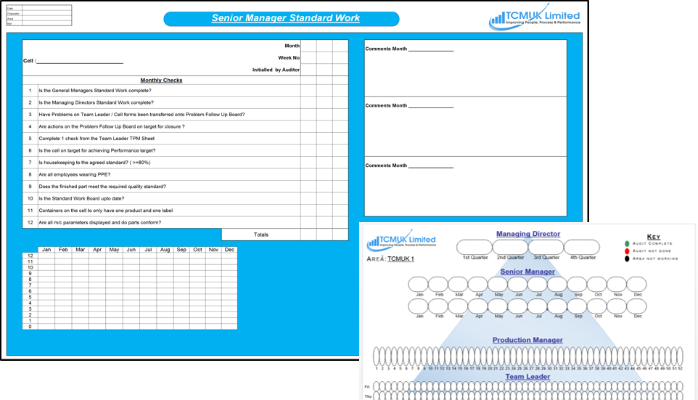
Leadership Standard Work Audit

The Impacts of Effective Leadership Standard Work

By embracing LSW, manufacturing organisations can expect several key benefits:

  • Problem-Solving: Frontline associates, empowered to raise issues, drive a culture of immediate problem-solving rather than reactive fire-fighting.
  • Continuous Improvement: Regular practice of LSW ensures that improvement becomes habitual, not just a one-off event.
  • Developing Leaders: Provides a framework for nurturing future leaders by exposing them to strategic thinking and decision-making processes.
  • Performance Gains: Continuous focus on goals and metrics tends to accelerate performance improvements.
  • Team Culture: Promotes a sense of ownership at all levels, leading to stronger team bonding and collaboration.

Case Studies and Evidence

The practice of LSW isn’t theoretical; it has been successfully integrated into numerous organisations. As we implemented and embedded this within Unipart in the late 90’s early 20’s it highlighted its effectiveness. LSW was introduced across the organisational hierarchy, from team leaders to the managing director, driving substantive improvements and embedding a proactive and positive culture. Just one of the many implementations we have done throughout the years since.

The Leadership Pyramid

Visualising LSW through a leadership pyramid can provide clarity on the distribution of responsibilities and activities at all levels. It emphasises the importance of foundation work by team leaders, the managerial oversight, and strategic vision at the upper tiers of the pyramid.

Key-Takeaway

Leadership Standard Work is the engine that propels the continuous improvement vehicle forward. It provides predictability, structure, and a means by which leaders can methodically contribute to the organisation’s overall well-being while developing their teams. In embracing LSW, manufacturing organisations are not merely investing in a set of tasks; they are nurturing a culture of excellence, responsibility, and innovation that echoes through every layer of the company’s fabric.

For manufacturing leaders seeking sustainable improvement and cohesive teams, leadership standard work isn’t a choice—it’s an essential strategy in the modern manufacturing playbook.

If you need support or want to know more about Leadership Standard Work please do contact us

 0330 311 2820

World Class Traits

Committed LEADERSHIP is essential to success

Maintaining a strong CUSTOMER FOCUS assures we’re fixing the right things and going in the right direction

Effective PROCESS MANAGEMENT accelerates improvement & helps us keep ahead of our competitors

Drive improvement goals through the enterprise using effective STRATEGY DEVELOPMENT & REVIEW

Careful attention to ORGANISATIONAL DEVELOPMENT builds important foundations for continued success

Carefully chosen METRICS help us monitor our rate of improvement & make course corrections when needed

Rigorous & Structured USE OF CI TOOLS is the engine that propels improvement

0330 311 2820

Book a Return Call at a time that Best Suits You “HERE

Beyond the Tools: 5 Leadership Strategies to Build a True Culture of Continuous Improvement

Let’s be honest for a second. You’ve probably rolled out Lean tools before. You bought the shadow boards, ran the 5S workshops, maybe even put tape on the floor. It looked good for a while. Then real life happened. A major customer expedited an order, a machine went down, and suddenly everyone was back to firefighting.

That’s the reality in a lot of established manufacturing and engineering businesses, especially those with 40 to 200 people. Performance is often held together by experience, effort, and a handful of heroic individuals. It isn’t always held together by a repeatable system. Lean tools like Kanban, SMED, or visual management are genuinely useful. They can create big improvements when they’re applied well. But they are not self-sustaining.

The truth is that most continuous improvement failures are not technical. They are human. People stop surfacing problems early because they do not want the grief. Supervisors fix things themselves instead of coaching their teams. Production meetings become data-readouts with no action. Incentives sometimes reward output at all costs, which means the real issues stay hidden.

A continuous improvement culture is not something you install like new software. It is built. It is built through daily leadership behaviours, shared routines, and the kind of consistency that eventually becomes “how we do things here.”

These five strategies are designed for directors who want actual results now, without creating a bloated Lean department or pausing production for a giant transformation programme. They are practical, people-focused, and realistic for the pressures manufacturing leaders face every day.

What Culture Really Means

We throw the word culture around a lot. Maybe too much. But on the shop floor, it has a very practical meaning.

A continuous improvement culture is a place where problems are visible, discussed without blame, and solved through small, steady experiments. Improvement is part of the work, not something squeezed into a Friday afternoon if time allows. Leaders coach thinking rather than just giving answers. Barriers get removed. Learning gets shared. And the gains hold because the routines hold.

That is the difference between tools and culture. Tools can create a quick uplift. You reorganise a cell, and productivity improves. You run a workshop, and people leave energised. But culture creates repeatable capability. Tools may give you a cleaner workspace this month. Culture makes sure it stays that way next month, and improves again the month after.

That matters because the businesses that win long term are not always the ones with the most impressive Lean launch. They are the ones that build the discipline to keep improving after the launch has faded.

Strategy 1: Lead With Problems First

This is a hard shift for many operational leaders. Most management teams are wired to lead with targets, output, and performance review. But if you want a true continuous improvement culture, you have to start leading with gaps, obstacles, and abnormalities.

Why? Because improvement cannot happen if people are hiding the truth. If leaders punish bad news, bad news disappears. It goes underground. That is expensive. Hidden scrap becomes rework. Hidden downtime becomes lost capacity. Hidden quality escapes become customer pain. Hidden staffing problems become overtime, burnout, and missed delivery.

The first step is to define what an abnormality actually is. That may sound basic, but it is rarely clear enough in practice. An abnormality is anything outside the standard. It can be a safety risk, a quality escape, a late delivery, a missing part, a prolonged changeover, a rework loop, or a machine stop that keeps repeating.

Then leaders have to change the questions they ask. Instead of “Why did you miss the target?” ask “What stopped us today?” Instead of “Who is responsible?” ask “What in the process allowed this to happen?” Instead of leading every conversation with the score, lead it with the obstacle.

Visual systems help here. Use an hour-by-hour board to compare plan versus actual. Display a downtime Pareto so the top causes are visible. Track first pass yield by product family. Keep a top-three constraints board live and current. These do not need to be complicated. In fact, the more straightforward they are, the better they work.

I once saw a bottleneck cell that always hit its numbers on paper. The metrics looked brilliant. But the team was quietly reworking parts after hours to make the figures look good. Once leadership started tracking first pass yield properly and discussing it without blame, the real constraint surfaced immediately. Nothing had changed technically. The behaviour changed because the problem became visible and safe to discuss.

That is the point. Directors do not need more tools. They need a daily management system that tells the truth early.

Strategy 2: Build Psychological Safety and Accountability

People must feel safe to speak up. But standards still need to be non-negotiable. That balance is where a lot of leadership teams get stuck.

On one side, some teams create a fear-driven culture where people stay quiet because they do not want grief. Problems get buried, learning stops, and the same issues keep coming back. On the other side, some teams swing too far the other way. No blame becomes no accountability. Standards slip, quality weakens, and nobody owns the outcome.

The answer is to separate people problems from process problems. Start every issue review by assuming a process weakness until proven otherwise. In most cases, that is where the truth lies. If the process made it easy for the issue to happen, the process is the problem that needs solving.

A consistent response helps. First, contain the issue and protect the customer. Second, investigate the process. Third, improve and standardise. Fourth, share the learning across the site so the same issue does not keep reappearing in a different department.

Keep the problem-solving method simple and disciplined. Use 5 Whys, but only with evidence. Use a Fishbone when an issue has multiple possible causes. Use an A3 for cross-functional problems that involve production, quality, maintenance, engineering, and supply chain all at once.

There are also some anti-patterns to watch for. If root cause is written as “operator error” every time, you have probably stopped too soon. That is not a root cause. It is usually a sign that the process, training, interface, or standard was weak. Avoid overcomplicated templates that make people dread problem-solving meetings. And do not confuse sorting the mess with fixing the cause. Containment matters, but containment is not prevention.

Imagine the wrong drawing revision gets used on the shop floor. A weak leader blames the operator for picking up the wrong paper. A stronger leader asks why the wrong revision was even available at point of use, why the document control system allowed it, and why the handover process did not catch it. That is the difference between blame and learning.

Psychological safety accelerates learning. Accountability ensures that learning becomes a standard.

Strategy 3: Install Daily Management Routines

If improvement only happens during formal workshops, it will never outpace daily firefighting. That is why a continuous improvement culture needs a heartbeat.

For most mid-sized manufacturing businesses, a daily management system is the most practical way to create that heartbeat. It gives the business a rhythm for surfacing issues, solving them quickly, and escalating the ones that cannot be fixed at the first level.

Start with tiered meetings. Keep them short. Tier 1 should happen at the line or cell level and last 10 to 15 minutes. The focus is simple: what happened yesterday, what is the plan today, what problems exist, and what support is needed. Tier 2 brings together area managers to handle resource conflicts, quality trends, and maintenance coordination. Tier 3 is the site-level review where systemic barriers, priorities, and cross-functional issues get resolved.

Then introduce leader standard work. This is where many businesses fall down. Leaders are often busy, reactive, and pulled in ten directions. If the improvement routines are not built into their week, they are the first thing to disappear when pressure rises. Schedule gemba walks. Review top abnormalities. Check whether actions are closing on time. Coach one improvement conversation a day or one per shift.

You also need clear escalation rules. What can the team solve in the moment? What needs same-day escalation? What becomes a formal improvement project? Without this clarity, issues just drift. They get discussed but not solved.

Good daily management feels calm. The meetings are short. The actions are clear. Problems do not linger for weeks waiting for the monthly operations meeting. People stop relying on memory and start relying on routine.

Think about the classic production-and-maintenance blame cycle. Production says maintenance is too slow. Maintenance says production keeps breaking things. Daily management breaks that loop because it puts both teams in the same rhythm. The data is reviewed together. The causes are examined together. And the ownership becomes shared.

When leaders show up consistently, continuous improvement stops being a poster on the wall and becomes the operating system.

Strategy 4: Develop People Through Coaching

In many technical SMEs, leadership promotion is based on technical brilliance. The best setter gets promoted. The most reliable engineer becomes the supervisor. The strongest problem solver becomes the manager. That is understandable, but it creates a trap.

Very often, the people who are best at solving problems are the ones who keep solving everything themselves. They become the hero in the middle of the system. The trouble is, hero culture does not scale. You cannot continuously improve an entire factory with a handful of experts constantly firefighting for everyone else.

A real kaizen culture needs leaders who teach problem-solving, not leaders who simply hand out answers. That is a different skill. It requires patience, discipline, and a willingness to let people think.

A coaching routine can help. Kata-style questions are a good place to start. Ask what the target condition is. Ask what the actual condition is. Ask what is stopping progress. Ask what experiment will be tried next. Ask what learning is expected. That kind of questioning builds capability over time.

The key is to keep improvement small and frequent. Do not wait for the perfect answer. Do not wait until the whole system is redesigned. Encourage the next step. Then the next one. Small experiments create momentum, and momentum creates confidence.

You also need to protect time for coaching. Put it in leader standard work. If coaching is optional, it will get squeezed out. Start with one pilot area if you need to. Measure the behaviours that show learning is happening: action closure, recurrence rates, problem-solving participation, and whether supervisors are coaching more than they are fixing.

There are some common mistakes here too. Leaders give answers too quickly because they want speed. That feels efficient, but it robs the team of learning. Others try to coach without removing barriers, which just creates frustration. You cannot ask a team to improve if they do not have the tools, time, data, or authority to act. And improvement should never be delegated away to the CI person or the engineer alone.

I once saw a supervisor who stopped fixing every tricky changeover himself. Instead, he coached the team to build a repeatable setup standard. Over time, changeovers stabilised, training became easier, and the team became more capable. That is what coaching does. It turns dependence into capability.

The culture shift happens when teams learn how to think, not when they are told what to do.

Strategy 5: Align Measures and Recognition

Whatever you measure, whatever you tolerate, and whatever you reward will override the values poster in reception every single time. Culture follows the scoreboard.

This is where many mid-sized companies accidentally undermine their own improvement efforts. If bonuses are tied only to output, people will hide downtime or ignore minor defects to hit the numbers. If the loudest praise goes to firefighting, then firefighting becomes the hero behaviour. If improvement work is invisible, it gets pushed down the list. Not because people do not care, but because the system tells them what matters.

You need leading indicators that reflect improvement behaviours, not just end results. Track the number of abnormalities raised. That number may rise at first, and that is a good sign. It means people are finally surfacing issues instead of hiding them. Track action closure rates so people see that problems are being dealt with. Track recurrence rates for the top issues. Look at skills matrix progress. Audit compliance on critical standards.

Recognition needs to be just as intentional. Celebrate prevention, not only recovery. Highlight cross-functional wins where production, maintenance, quality, and engineering worked together instead of operating in silos. Praise the team that removed a recurring issue permanently, not only the person who stayed late to patch over the symptoms.

You also need to make trade-offs visible. Under pressure, output and improvement will sometimes conflict. That is normal. What matters is that leaders show how decisions are made. If improvement is always the thing that gets dropped when the week gets busy, the whole culture will tell people that Lean is optional.

I once saw a site heavily praise a person who stayed late to rework a huge batch of faulty parts. He was the hero of the week. But the better leadership move would have been to praise the team that eliminated the rework loop, so nobody had to stay late at all. That is the real shift. Stop rewarding the cost of failure. Start rewarding the removal of the cause.

If the scoreboard rewards hiding problems and doing heroics, you will get more of both.

A Practical 90-Day Start

You may be thinking this all sounds right, but where do you actually begin without overwhelming the business? Keep it simple. Start small. Focus on one area first.

In the first 30 days, define your abnormalities clearly. Set up a basic visual board in one pilot area. Start a short Tier 1 daily meeting. Agree the no-blame, high-standard response to issues so people know what to expect.

Between days 31 and 60, add Tier 2 and Tier 3 escalation routines. Introduce leader standard work for supervisors and managers. Start the coaching habit. Aim for just two coached problems per week per leader. Keep it manageable enough that it actually sticks.

From days 61 to 90, begin aligning measures and recognition. Expand daily management into a second area. Run one cross-functional A3 on a recurring systemic issue. Use that learning to refine the approach before rolling it wider.

This kind of rollout does not require a restructure. It does not require a huge capital spend. And it does not require a Lean department full of specialists. It requires leadership discipline and consistent behaviour.

Culture Is Built Together

There is a reason culture change often fails when one enthusiastic manager goes on a training course and comes back full of ideas. The rest of the leadership team is still doing things the old way. The enthusiasm gets crushed by the existing system.

What actually sticks is shared practice. The same language. The same routines. The same response to problems. The same expectations across departments and shifts. That is why group learning works so well in manufacturing. It creates consistency in leadership behaviour, which is what culture really depends on.

This matters even more in multi-shift environments, where communication can be messy and misunderstandings build quickly. When day-shift and night-shift managers are trained together, they stop working against each other and start fighting the process issues together.

A continuous improvement culture is not the result of one champion. It is the result of many leaders behaving consistently.

The Next Step

Building a true culture of continuous improvement comes down to a few core things. You need problems-first visibility, so nothing stays hidden. You need psychological safety combined with strict accountability. You need daily management routines to keep the heartbeat going. You need coaching capability to turn firefighters into multipliers. And you need measures and recognition aligned to the behaviour you actually want.

Lean tools alone will never get you there. But these five leadership strategies absolutely can.

If you are ready to stop fighting the same fires every week, the next step is not a bigger toolkit. It is a more consistent leadership system. That is where continuous improvement stops being a project and starts becoming part of how the business performs. Please do check out our Lean Coaching Programme.