Why Smart People Still Fail: The Hidden Architecture of High-Performing Teams

We’ve all been in that meeting. The one where you look around the table and realise that despite having a room full of smart, capable people, something is fundamentally stuck. Maybe a key project is slipping, again. Or the tension between your team and another department is so thick you could cut it with a laser. Everyone is working hard, everyone is busy, but the wheels are just spinning in the mud. It’s a frustrating place to be, and if you’re in manufacturing, that frustration doesn’t just stay in the meeting room. It shows up as delays on the factory floor, as quality issues, as missed shipment dates.

Over the years, I’ve seen this pattern play out time and again. And I’ve also been lucky enough to see what it looks like on the other side. I’ve seen teams that just… click. They move with a shared understanding, they solve problems almost before they become problems, and they consistently deliver, not through luck or brute force, but through a kind of quiet, confident competence.

What’s the secret? It’s not about finding a team of superstars. It’s not about some magical project management software or the latest management fad. I think it comes down to something much more fundamental. High-performing teams are built, not found. They are engineered, intentionally, around five core pillars that support each other. When these pillars are explicitly defined, aligned, and practiced every single day, they create a resilient system for sustained performance.

This month, we’ve touched on these ideas in different ways, but today I want to pull it all together. Let’s break down the anatomy of a truly high-performing team.

Pillar 1: Purpose (The ‘Why’ That Drives the ‘What’)

First up is Purpose. Now, I know what you might be thinking. “Purpose? That sounds a bit fluffy. We make widgets, our purpose is to hit our production target.” And you’re not wrong, but you’re not entirely right either.

A team’s purpose is its reason for existing, articulated in a way that connects the daily grind to a bigger picture. It’s the answer to the question: why does this team matter to our customers and to the wider business? It’s the compass that keeps everyone pointing in the same direction, especially when the map gets confusing.

I once worked with an engineering team at a components manufacturer. They were brilliant, technically excellent, but they were burning out. They were constantly being pulled in a dozen different directions by requests from sales, operations, and R&D. They felt like a glorified help desk. Their purpose, as far as they could tell, was to react to whoever shouted the loudest.

We spent some time together, not writing a fancy mission statement, but getting to the core of their value. They didn’t just “fix engineering problems.” They were the team that “ensured our components could be manufactured reliably, at scale, and to the highest quality standard, so our customers could trust them in critical applications.” Suddenly, their work wasn’t just about closing tickets. It was about enabling trust and reliability down the entire supply chain.

This clear purpose became their filter. A new request came in. Did it help them deliver on reliability, scalability, or quality? If yes, it was a priority. If no, it was questioned. Scope creep reduced because they had a clear mandate to protect. Motivation went up because their work had a clear, valuable meaning.

In practice, this means:

  • Co-creating a shared mission statement. Not one handed down from on high, but one the team and its key stakeholders build together.
  • Starting your weekly planning meetings by reminding everyone of the ‘why’. “Okay team, our purpose is X. How does this week’s plan get us closer to that?”
  • Tying every major task back to a customer outcome. This isn’t just about finishing a project; it’s about making a customer’s life easier or their business more successful.

A couple of questions to ask your team:

  • Do we all agree on the top two or three customer problems we are here to solve this quarter?
  • Can we draw a straight line from every task on our board back to delivering on that purpose?

Without a clear purpose, you’re just a group of people doing tasks. With one, you’re a team on a mission.

Pillar 2: Stakeholders (The People Who Matter)

No team is an island, especially not in manufacturing. Your work is a critical link in a long chain that includes suppliers, logistics partners, internal departments like procurement and sales, and of course, the end customer. The second pillar is about consciously managing this ecosystem. It’s about knowing who matters, what they need from you, and how you’re going to engage with them.

Ignoring this is, to put it mildly, a recipe for disaster. It leads to rework when the design team’s specs don’t account for the capabilities of the production line. It leads to conflict when the sales team promises a delivery date your team can’t possibly hit. It’s the source of so much wasted energy and political friction.

Stakeholder alignment isn’t just about getting approvals. It’s about building a shared understanding of reality. It’s about proactive communication, not reactive damage control.

In practice, this means:

  • Creating a stakeholder map. Physically writing down who your key stakeholders are, what they care about, how much influence they have, and the right way to communicate with them is a game changer. Who needs a weekly email update? Who needs a fortnightly deep dive? Who just needs to be kept informed?
  • Using a decision rights framework. Something like a RACI chart (Responsible, Accountable, Consulted, Informed) can work wonders. It clarifies who gets the final say on what. No more endless debate or decisions being revisited because the right person wasn’t in the loop.
  • Holding regular stakeholder reviews. Needs change. Priorities shift. A quick, regular check-in can surface these changes before they become major problems.

A couple of questions for your team:

  • Who are the top five people whose sign-off we need to deliver our work this month? Are they clear on what we need from them and by when?
  • Are we consistently meeting our key stakeholders’ expectations? How do we know? What feedback have we received lately?

Getting this right turns stakeholders from potential roadblocks into powerful allies. They become partners in co-creating value, not just hurdles to be overcome.

Pillar 3: Delivery (The Rhythm of Getting Things Done)

Purpose gives you direction and stakeholder alignment clears the path. But you still have to actually move forward. The Delivery pillar is all about how your team gets work done. It’s your operating rhythm, your processes, your shared habits that turn good intentions into reliable, predictable output.

In manufacturing, we understand process. We have standard operating procedures, we use principles of lean to eliminate waste, we value consistency. The same thinking needs to be applied to how the team itself operates. A chaotic, unpredictable internal process creates stress and burns trust with everyone who depends on you. A smooth, predictable rhythm builds confidence and frees up mental energy to focus on improvement, not just firefighting.

This isn’t about heavy, bureaucratic project management. To be honest, it’s the opposite. It’s about creating a lightweight system that makes work visible, keeps things moving, and surfaces blockers quickly.

In practice, this means:

  • A simple planning cadence. Whether it’s weekly sprints or a two-week cycle, having a regular rhythm of planning the work, doing the work, and then reviewing the work creates predictability. The goal is to set clear, achievable goals for each cycle.
  • Visual management. A physical board on the shop floor or a simple digital tool showing what’s in progress, what’s stuck, and what’s done is incredibly powerful. It makes progress tangible and blockers impossible to ignore.
  • Clear handoffs and escalation paths. Everyone on the team should know what happens when their part of the work is done, and who it goes to next. They should also know exactly what to do and who to talk to the moment they get stuck.

A couple of questions for your team:

  • What is the smallest, most valuable thing we can deliver in our next work cycle?
  • What are the top three blockers preventing us from making progress right now, and who is responsible for helping us remove them?

Great delivery isn’t about being the fastest team. It’s about being the most consistent and reliable. It’s the drumbeat that lets the rest of the organisation count on you.

Pillar 4: Capability (The Skills to Win)

You can have the best purpose, the most aligned stakeholders, and the smoothest process in the world, but if your team doesn’t have the skills and knowledge to actually do the work, you’re going nowhere. The Capability pillar is the engine of your team. It’s about having the right people with the right skills in the right roles, and critically, a plan for keeping those skills sharp and filling any gaps.

In today’s world, especially in UK manufacturing, this is more important than ever. Technology is changing. New materials and processes are emerging. Seasoned experts are retiring, taking decades of knowledge with them. A team that isn’t actively learning is a team that is falling behind.

Capability isn’t just a line item for the HR department’s training budget. It’s a core responsibility of the team itself. It’s about creating a culture of continuous learning and development that’s woven into the fabric of your daily work.

In practice, this means:

  • Mapping your skills. What capabilities are absolutely critical for you to deliver on your purpose? Who on the team has them? Where are the gaps? Where are your single points of failure, where only one person knows how to do something critical? Once you see it, you can build a plan.
  • Cross-training and structured onboarding. Giving team members opportunities to learn each other’s roles builds resilience. If someone is off sick or leaves, the work doesn’t grind to a halt. And having a proper process for bringing new members up to speed is vital for maintaining performance.
  • Building in learning rituals. This could be a weekly ‘toolbox talk’ on a new safety procedure, an after-action review following a project, or a ‘learn and apply’ session where someone teaches a new skill they’ve picked up.

A couple of questions for your team:

  • Looking at our next big milestone, what are the critical skills we need? Do we have them covered?
  • What piece of coaching or training would do the most to reduce risk or improve the quality of our work right now?

Investing in capability is investing in your team’s ability to adapt and thrive in the face of change. It’s what turns a good team into a great one over the long haul.

Pillar 5: Relationships (The Glue That Holds It All Together)

This last pillar is, I think, the most important and often the most overlooked. It’s about the quality of the human connections within the team. It’s about trust, open communication, and psychological safety. It’s the invisible glue.

You can have all the other pillars in place, but if team members don’t trust each other, if they’re afraid to speak up, if they’d rather work around a problem than have a difficult conversation, your performance will always have a ceiling. And when the pressure is on, that ceiling gets very low, very fast.

Strong relationships are what allow a team to have healthy conflict, to challenge ideas without making it personal. They enable rapid problem solving because people feel safe to say “I made a mistake” or “I don’t know how to do this” early, when it’s still easy to fix.

On a factory floor, psychological safety has a very real meaning. Does an operator feel safe enough to hit the stop button on a multi-million-pound production line because they’ve spotted a potential quality issue, without fear of being blamed for the downtime? If the answer is yes, you have a high-performing culture. If the answer is no, you have a culture that hides problems until they become catastrophes.

In practice, this means:

  • Making it safe to speak up. Leaders have to model this by admitting their own mistakes and actively asking for dissenting opinions. It means treating failures as learning opportunities, not as something to be punished.
  • Building in structured feedback loops. Creating regular opportunities for peer-to-peer feedback, self-reflection, and leader feedback helps normalise these conversations and makes them less scary.
  • Using team rituals to build cohesion. Running effective retrospectives where the team honestly discusses what went well and what didn’t is crucial. Celebrating successes and recognising individual contributions builds morale and a sense of shared identity.

A couple of questions for your team:

  • On a scale of 1 to 10, how safe do people feel to voice a concern or a dissenting opinion? What would it take to move that number up one point?
  • How could we improve the way we collaborate to shorten our feedback cycles and catch problems earlier?

Relationships are the foundation. When they are strong, they can bear the weight of immense pressure. When they are weak, even the smallest crack can bring the whole structure down.

From Pillars to a Living System

The real power of this model isn’t in looking at each pillar in isolation. It’s in understanding how they all connect and reinforce one another.

A clear Purpose makes it obvious who your key Stakeholders are. Knowing your Stakeholders’ needs shapes your Delivery process. The challenges you face in Delivery reveal your Capability gaps. Investing in Capability strengthens the Relationships and trust within the team. And those strong Relationships are what allow a team to stay connected to their Purpose when things get tough. It’s a virtuous cycle.

The quickest way to turn this model from a nice idea into your Monday morning reality is to work on it together, as a team, using your real challenges. This is precisely what our High-Performing Teams Workshop is designed to do. It’s a practical, one-day session where you build each pillar around your actual work, not generic theory. You’ll leave with a co-created purpose statement, a clear stakeholder plan, a simple delivery rhythm, a focused capability plan, and a set of shared rules for building trust and psychological safety.

To make this tangible, you can even track your progress with a simple scorecard. On a scale of 1 to 5, how would you rate your team’s clarity of purpose? Your stakeholder alignment? For delivery, you can track your on-time completion rate. For capability, skills coverage. For relationships, a simple psychological safety poll. Collecting this data from quick surveys and retrospectives helps you see trends and focus your improvement efforts where they’ll have the biggest impact.

Ultimately, building a high-performing team isn’t magic. It’s a process. It requires the same discipline, focus, and commitment to continuous improvement that you already apply to your manufacturing processes. By focusing on these five pillars, you’re not just managing a team; you’re building a resilient, adaptable, and powerful engine for performance.

Stop Wasting Time in Meetings: The 2-Minute Fix That Actually Gets Things Done

Right, picture the scene. You’re at the end of the daily production meeting. Everyone’s had their say. The quality manager talked about a recurring issue with component alignment on Line 3. The maintenance lead mentioned that a key piece of machinery is due for a service. You’ve all nodded sagely, looked at the charts on the wall, and finished your lukewarm tea. The meeting leader says, “Okay, good chat everyone. Let’s get back to it.”

And then… what happens?

Everyone shuffles out. Some head back to the shop floor, others to their desks. But a nagging feeling hangs in the air. Did we actually decide to do anything about that alignment issue? Who is responsible for booking that service, and when are they going to do it? More often than not, everyone leaves with a slightly different version of the meeting’s outcome in their head. The result is that the same problems reappear in tomorrow’s meeting, and the one after that. It’s a cycle of talk without traction, and frankly, it’s a colossal waste of time and energy.

I’ve seen it happen in countless manufacturing businesses across the UK, from small workshops to massive plants. It’s the quiet productivity killer. But what if I told you there’s a simple, two minute habit that can completely transform this dynamic? A habit so straightforward it feels almost too easy, yet it’s the single most effective way to turn your meetings from vague discussions into engines for real, measurable action. Stick with me, because this is one of those small changes that delivers massive results.

The Forgotten Half of the Improvement Cycle

If you’ve been in manufacturing for more than a week, you’ve probably heard of the PDCA cycle. Plan, Do, Check, Act. It’s the bedrock of continuous improvement, the lean methodology mantra we all know and love. We’re usually pretty good at the first two parts.

Plan: We love to plan. We create detailed project outlines, we map out workflows, we hold meetings to discuss potential solutions to a problem. This is the exciting, blue sky thinking part. “Let’s trial a new jig to fix that alignment issue.” Great plan.

Do: We’re manufacturers, we’re people of action. We excel at doing. We’ll go out and build the jig, we’ll implement the new process, we’ll run the trial. We get our hands dirty and make things happen.

But then, something funny happens. We get so caught up in the next fire, the next urgent order, the next big plan, that we often stumble on the last two, most crucial steps.

Check: This is where we’re meant to pause and measure. Did the new jig actually improve the alignment? By how much? Did we hit the targets we set out in the planning phase? This step requires data, honesty, and a moment of reflection.

Act: Based on what we learned in the ‘Check’ phase, we act. If the jig worked brilliantly, we standardise its use across all relevant lines (Act). If it only half worked, we go back and refine it (which is really starting a new PDCA cycle). If it was a total failure, we learn from it and scrap the idea, preventing us from wasting more resources.

The Check and Act phases are where learning and genuine improvement happen. Without them, Plan and Do are just a shot in the dark. It’s like designing and building a new car engine but never actually testing it on a dynamometer or putting it in a car to see if it works. You’ve done the busy work, but you have no idea if you’ve actually created any value.

And this is exactly what happens in our meetings. The meeting itself is the ‘Plan’ phase, and sometimes a bit of the ‘Do’. But when we walk out without clear conclusions and actions, we completely skip ‘Check’ and ‘Act’. We leave the engine of improvement sitting on the factory floor, unassembled.

The Simple Habit: Two Closing Questions

So, how do we fix this? How do we bolt the Check and Act phases onto the end of every single meeting? It comes down to creating a non negotiable routine. A habit. For the final two minutes of every single gathering, before anyone is allowed to stand up or close their laptop, the meeting leader, or a designated person, must ask two simple questions.

Question 1: “To be clear, what did we decide here today?”

This question is pure gold. It’s a forcing function for clarity. It cuts through waffle, assumptions, and politeness. Someone needs to articulate, out loud, the concrete decisions that were made. Not the things we discussed, not the ideas we floated, but the actual decisions.

For example, instead of a vague feeling that something should be done about the alignment issue, the answer to this question should be sharp and specific: “We decided that the current jig is not fit for purpose and we are going to trial a new, 3D printed prototype.”

This acts as the ‘Check’ phase for the meeting itself. It confirms that everyone is on the same page. You’d be amazed how often you ask this question and get three different answers from three different people. That’s a meeting that was destined for failure, and you just saved it in 30 seconds. It forces the group to get to a single, shared understanding before they scatter. No more, “Oh, I thought we were just going to monitor it for another week.” No, we decided to act. It’s there, in the open.

Question 2: “Brilliant. So, who is doing what by when?”

If the first question is the ‘Check’, this one is the ‘Act’. It’s the accountability engine. A decision without an owner and a deadline is just a nice idea. It’s a wish. This question transforms that wish into a commitment.

It’s not enough to say “we” will do it. “We” is nobody. This question demands a name. Who, specifically, is on the hook for this?

  • Who: “Sarah from engineering.”
  • What: “Is going to design and print the prototype jig.”
  • By when: “And have it ready for trial by next Tuesday’s pre shift briefing.”

Look at the power of that statement. It’s unambiguous. Sarah knows her task. The team knows Sarah is doing it. Everyone knows the deadline. Now, there is a clear action that can be followed up on. In the next meeting, you don’t have to ask, “So, any movement on that alignment thing?” You can ask, “Sarah, how did you get on with that prototype jig for today’s briefing?” It completely changes the conversation from reactive to proactive.

These two questions, asked consistently, are the most powerful system you can introduce to make your meetings productive. They take maybe 120 seconds, but they save countless hours of confusion and rework down the line.

Making It Stick: Practical Implementation

Knowing the questions is one thing; building them into the fabric of your daily work is another. A new habit needs a system to support it, especially when everyone is busy and defaults to old patterns. Here are a few ways I’ve seen teams successfully integrate this two-minute drill.

First, assign a specific role. Don’t just leave it to the meeting leader, who might be flustered or forget. Create a rotating role called the ‘Action Champion’ or the ‘Closer’. Their only job in the meeting is to listen for decisions and, at the two minute warning, to be the one who pipes up and asks the two questions. By rotating the role, everyone becomes familiar with the process and takes collective ownership of the habit.

Second, make it visual. We work in visual environments. We have shadow boards for tools and visual controls on our machines. Apply the same logic to your meetings. Have a dedicated space on a whiteboard or flip chart labelled ‘Decisions’ and ‘Actions (Who, What, When)’. As the answers to the two questions are given, write them down for all to see. This physical act cements the commitment. If you’re in a conference room, use the last slide of your presentation as a dedicated action capture template. When people see it written down, it becomes real.

Third, capture it digitally. The whiteboard is great for the moment, but you need a persistent record. Immediately after the meeting, the Action Champion or meeting leader should transfer those actions into a shared system. This doesn’t need to be a complex project management suite, though those are great. It could be a simple shared document, a Microsoft Planner board, a Trello board, or even just a follow up email summarising the actions. The key is that there is a single source of truth that everyone can refer back to. This closes the loop and creates a seamless trail of accountability from one meeting to the next.

The Real-World Impact: From Grumbling to Gaining Ground

Let me tell you about a client we worked with, a mid-sized engineering firm in the Midlands. Their morning production meetings were, to put it mildly, a bit of a grumble fest. The same issues with tooling, material shortages, and information gaps would come up day after day. There was a lot of talk, a lot of shrugging, and a palpable sense of frustration. The team was busy, but they were stuck in a reactive loop, constantly firefighting the same problems.

We introduced the two-minute, two question habit. To be honest, it was awkward at first. People weren’t used to being put on the spot with a name and a deadline. But the shift lead, a brilliant guy named Dave, was relentless. He made it non-negotiable.

Week one was clunky. By week two, people started coming to the meeting more prepared, already thinking about solutions because they knew they’d be asked to commit. By week four, the transformation was incredible.

The list of recurring problems started to shrink. For the first time, they were actually solving the root causes of issues instead of just patching them for the day. For example, a persistent problem with a supplier delivering incorrect parts was finally resolved because someone, let’s call him Mike, was tasked with “calling the supplier’s quality manager and agreeing on a new sign off process by Friday.” It got done. The problem vanished.

The team’s engagement shot up. They felt heard because their discussions were leading to tangible outcomes. They started taking more ownership, suggesting improvements proactively. Within three months, they had reduced minor line stoppages by over 15% and, more importantly, the general mood on the shop floor had lifted. It wasn’t a place of frustration anymore; it was a place where problems were identified and systematically crushed. All from a simple two-minute habit.

Building a Culture of Continuous Improvement

This is where the magic really happens. This two-minute habit is more than just a meeting tactic. When you practice it relentlessly, you are embedding the entire PDCA cycle into your team’s DNA. You are moving from a culture of ad hoc reaction to a repeatable system for results.

Every meeting becomes a micro cycle of improvement.

  • You Plan by discussing the issue.
  • You Do by getting to a decision.
  • You Check by asking, “What did we decide?” to ensure clarity.
  • You Act by asking, “Who is doing what by when?” to drive accountability.

This rhythm, once established, creates unstoppable forward momentum. It builds trust, because people see that commitments are made and kept. It fosters a high-performance environment where everyone understands that the goal isn’t just to talk, but to achieve. It turns continuous improvement from a theoretical concept on a poster into the practical, everyday way your team operates.

It’s the difference between a team that is constantly busy and a team that is consistently effective. And it all starts with having the discipline to save the last two minutes of every meeting for the only two questions that truly matter.

Ready to Build Your High-Performance Team?

If this idea of embedding simple, powerful habits to drive real results resonates with you, then you’re ready to take the next step. Transforming a team’s culture doesn’t happen by accident; it happens by design.

I invite you to join our upcoming High-Performing Teams Workshop, created specifically for leaders in the UK manufacturing sector. This isn’t a theoretical lecture; it’s a hands-on session where we’ll equip you and your team with the practical tools and routines needed to foster a culture of accountability and continuous improvement.

In the workshop, you will gain:

  • A toolkit of practical habits, like the 2-minute meeting closer, to drive clarity and action.
  • Proven team routines for problem solving, communication, and performance tracking.
  • Customised coaching to help you embed these new systems and make them stick within your unique operational environment.

Stop letting your meetings be a black hole for time and energy. Start building a system that guarantees forward momentum.

To learn more or to reserve your spot, please visit High-Performing Teams Workshop or call us directly at 0330 311 2820. Let’s build something great together.

The Secret Engine of Strategy: Why Coaching Your Leaders is the Only Part That Truly Matters

You’ve probably got a strategy document somewhere. Maybe it’s a beautifully designed PowerPoint deck, or a detailed plan sitting in a shared drive, the result of weeks of offsite meetings and intense debate. It’s full of smart goals, clear objectives, and ambitious targets. Everyone nodded along in the kick-off meeting. There was a real buzz in the air.

And then… what happened?

For a lot of businesses, especially in the demanding world of UK manufacturing, that initial energy just sort of… dissipates. The day-to-day reality of production targets, supply chain headaches, and machine maintenance takes over. The grand strategy gets relegated to a line item in a monthly management meeting, a nagging feeling that you’re not quite on track, but you’re too busy putting out fires to figure out why.

I’ve seen this play out more times than I can count. And I can tell you the reason your strategy might be stalling has almost nothing to do with how good the plan is. It’s not about the software you use or potentially the framework you follow. It’s about people. More specifically, it’s about the capability of the leaders on the ground, your supervisors, team leaders, and department managers, to turn that plan into reality. This is about why coaching those leaders isn’t just a nice to have, it’s the absolute linchpin of successful strategy deployment.

The Seductive Trap of Tools and Processes

When we want to improve something in manufacturing, our instinct is to reach for a tool or a process. It’s in our DNA. We think in terms of systems. Got a quality problem? Implement a Six Sigma project. Need to improve efficiency? Let’s go all in on Lean principles and value stream mapping. Falling behind the competition? It must be time for a full-scale digital transformation, complete with new ERP systems and shiny dashboards.

These are all powerful tools. I’m a big believer in them. But they are, at the end of the day, just tools. And a tool is only as good as the person using it.

Think about it. You can hand a team the most sophisticated process map in the world, but if their line manager can’t explain why it matters or can’t handle the pushback and questions that inevitably come with change, that map is just a laminated piece of paper. You can install a state of the art data analytics platform, but if your production supervisor doesn’t have the confidence to use that data to have a tough conversation about performance, the investment is wasted.

This is where so many strategies under deliver. They focus entirely on the ‘what’ (the new process, the target) and the ‘how’ (the steps to follow) but completely neglect the ‘who’. The people tasked with implementing the change are often given the playbook but no actual training on how to lead the team through the game. They are expected to just get it. This lack of focus on leadership capability creates a huge gap. A gap between the boardroom’s intention and the shop floor’s reality. It’s a gap filled with confusion, disengagement, and a quiet, creeping return to the old way of doing things. Because the old way, for all its faults, is comfortable. It doesn’t require a leader to be a great communicator or a resilient coach. It just requires them to keep things ticking over.

So, What Actually Makes a Leader Effective When It Counts?

If it’s not about just understanding the process, what is it? What separates a manager who can execute a strategy from one who just presides over its slow decline?

It boils down to a handful of core human competencies. Not technical skills, but leadership behaviours.

First, there’s clear communication. This isn’t about sending a well written email. It’s the ability to stand in front of your team, look them in the eye, and translate a high-level business objective like “Increase operational efficiency by 15%” into something that makes sense for them. It means explaining what it means for their daily work, why it’s important for the company’s future (and their job security), and being able to answer the tough, cynical questions that come up.

Next is team motivation. A great leader in strategy deployment is a master of buy in. They don’t just issue directives. They connect the work to a bigger purpose. They understand that people aren’t motivated by spreadsheets; they’re motivated by feeling that their contribution matters, that they are part of a team that’s succeeding, and that their efforts are recognised.

Then comes real accountability. This is a big one, and it’s so often misunderstood. Accountability isn’t about blame. It’s not about shouting when a target is missed. True accountability is about creating a culture where everyone feels a sense of ownership. An effective leader builds a system where it’s safe to talk about what’s going wrong, to analyse failures without fear, and to collectively agree on how to get back on track. It’s a supportive, not a punitive, process.

And of course, there’s adaptive problem solving. No strategy survives first contact with reality. A key supplier will be late. A critical machine will break down. A new regulation will come into force. A leader who can execute strategy doesn’t panic or get derailed. They see these moments not as roadblocks, but as problems to be solved. They empower their team to find solutions, make decisions, and adapt the plan without having to run up the chain of command for every little thing.

The leader’s unique role is to be the translator and the shock absorber. They take the pressure and complexity from above and turn it into clear, manageable, and motivating actions for their team. Without that, the strategy remains an abstract concept, completely disconnected from the daily grind.

Coaching: The Bridge Between Knowing and Doing

Okay, so we know what good leadership looks like. But you can’t just send your managers on a two day “leadership skills” course and expect them to come back transformed. I’ve seen companies spend thousands on generic training, only to see everyone revert to their old behaviours within a month.

Why? Because leadership isn’t a theoretical subject you can learn from a textbook. It’s a practice. It’s a set of behaviours that need to be developed, honed, and supported over time. And that is where coaching comes in.

Coaching is not training. Training is about transferring knowledge. Coaching is about changing behaviour. It’s an active, ongoing process. It involves tailored, one on one guidance, structured feedback, and a real focus on helping leaders overcome their specific, real-world challenges.

A good coach doesn’t give the answers. They ask the right questions. Instead of saying, “Here’s what you should have done,” a coach asks, “That was a difficult conversation. How did you feel it went? What would you do differently next time? What support do you need to handle that situation better?”

This approach builds self-awareness and problem-solving muscles. It helps a technically brilliant but perhaps poor communicator learn how to connect with their team. It helps a conflict avoidant supervisor learn how to have firm but fair conversations about performance. It’s deeply personal and intensely practical.

The research on this is pretty conclusive. You’ve probably heard of Google’s famous Project Oxygen, where they crunched years of data to figure out what made their best managers so effective. The number one behaviour? Being a good coach. They found that teams led by managers who were effective coaches weren’t just happier; they were more innovative, more productive, and more likely to stay with the company. If it’s true for a global tech giant, you can be sure it’s true for a busy manufacturing firm in the UK.

The Ripple Effect: Real Stories and Tangible Impact

When you start consistently coaching your leaders, something remarkable happens. The impact isn’t just on the individual leader. It ripples out across their teams and, eventually, across the entire organisation.

I remember working with a mid-sized engineering firm in the Midlands. Their strategy was solid: diversify their product line to enter a new market. But the execution was a mess. The production floor was chaotic, blame was rampant, and the new product line was plagued with delays and quality issues. The supervisors were skilled engineers, but they were terrible leaders. They managed by shouting.

We didn’t change their strategy. We didn’t bring in a new system. We just started coaching the supervisors. We worked with them every week, helping them plan their team communications, role playing difficult conversations, and guiding them on how to empower their teams to solve problems instead of just escalating them.

The change was slow at first, then all at once. The supervisors started holding short, effective daily meetings instead of just walking the floor and pointing out mistakes. They started asking their teams for ideas on how to solve production bottlenecks. They started celebrating small wins.

Within six months, the entire atmosphere on the shop floor had changed. Engagement went up, yes, but more tangible things happened. Staff turnover in that department dropped by nearly a third. The defect rate on the new product line was cut in half. The supervisors weren’t just managers anymore; they were leaders who took genuine ownership of the strategy. They made it theirs.

This is the culture shift that coaching creates. When leaders are trusted and effective, they build psychological safety. That’s a term that means people feel safe enough to speak up, to admit a mistake, to challenge the status quo, or to suggest a new idea without fear of being humiliated. In a manufacturing environment, that is gold dust. It’s the difference between an operator quietly ignoring a potential safety issue and one who feels empowered to stop the line and get it fixed. It’s the difference between a team that just does what it’s told and a team that actively looks for ways to improve.

Why Making This a Priority is Non-Negotiable

At this point, you might be thinking this all sounds good, but it also sounds like a lot of time and effort. And you’re right, it is. But the alternative is far more costly.

The alternative is a failed strategy.

Think of all the resources you invest in creating your strategic plan: the time from your senior team, the money spent on market research, the investment in new equipment or technology. Without capable leaders to execute that plan, all of it is at risk. It’s like building a high-performance racing car and then handing the keys to someone who has never driven before. The car is perfect, but it’s going straight into a wall.

Coaching your leaders is the single most powerful lever you have to close the strategy execution gap. It’s the transmission that connects the power of your strategic engine to the wheels on the ground. It amplifies the value of every other investment you make. A well coached leader will get more out of your Lean programme. They will ensure your new digital tools are actually used effectively. They will build the resilient, accountable teams that can weather any storm.

Without strong, coached leaders, your strategy is just a wish. It’s a document in a drawer. With them, it becomes a living, breathing reality, embedded in the daily actions and decisions of every single person in your organisation.

From Good Intentions to Outstanding Execution

So, to bring it all back. The success of your next big plan won’t be determined in the boardroom. It will be determined on the factory floor, in the warehouse, and in the quality lab. It will live or die based on the strength, confidence, and capability of the leaders you have in those crucial positions.

The tools, the processes, the playbooks… they are all important. But they are secondary. Strategy deployment succeeds or fails on the strength of its leaders. Investing in a new system without investing in the people who will run it is a recipe for disappointment. But when you commit to building your leaders’ capabilities through dedicated, practical coaching, you are not just investing in them. You are investing in the certainty of your own success.

Ready to close your strategy execution gap? If you’re tired of seeing great plans fall short, it’s time to focus on the one thing that will make all the difference. Discover how our Strategy Deployment Programme embeds leadership coaching and capability building at its heart to ensure your next plan delivers real results.

Contact us now to book a consultation and move from good intentions to outstanding execution.

From Friction to Flawless Execution: Unifying Your Teams with the X Matrix

Have you ever seen it? The classic standoff. The sales director, beaming, walks back into the office having just landed a massive, company-changing order. High fives all around. Then they walk over to the production manager to share the good news, and the beaming smile is met with a stone-cold stare. The production manager’s first question isn’t “How much revenue is that?” but “When do they need it by? Do you have any idea what this does to our current schedule?”

In a flash, the celebration is over. It’s not one team winning; it’s two departments bracing for a fight.

This, right here, is the quiet killer in so many manufacturing businesses. We call them departmental silos. They’re the invisible walls that spring up between sales, production, engineering, finance, and quality control. Everyone is working hard, everyone is trying to hit their numbers, but they’re not working together. It leads to friction, wasted effort, missed deadlines, and a general feeling of us versus them. To be honest, it’s exhausting for everyone involved.

The problem isn’t usually the people. It’s the system. Or rather, the lack of one. The root of the issue is that each department is playing its own game with its own scoreboard. What if, instead, everyone in the company could see the same game plan, understood their specific role in it, and shared the same scoreboard? That’s what we’re going to talk about. We’ll explore how creating visible, shared objectives, using a powerful but practical framework like the X Matrix, can dismantle those silos and turn competing teams into a single, unstoppable execution force.

The Real Cost of Departmental Silos

Let’s be real for a moment. What do silos actually look like on a Tuesday afternoon in a busy manufacturing plant? It’s not just a theoretical concept; it’s a series of small, frustrating moments that add up to a big problem.

It’s the engineering team spending months perfecting a new product design, only to find out from production that it’s a nightmare to manufacture efficiently, requiring costly new tooling that wasn’t budgeted for.

It’s the finance department chasing the sales team for forecasts, while the sales team is chasing production for lead times, and production is blaming procurement for material delays. It’s a circular firing squad of emails and excuses.

I remember visiting a factory a few years back where the quality team had implemented a new, rigorous inspection process. They were proud of it, and their metrics for ‘defects caught’ went through the roof. The problem? It created a massive bottleneck at the end of the production line. On-time delivery numbers plummeted, and the production team was furious. The quality team hit their goal, but the company, as a whole, failed the customer. Both teams were doing their jobs as they understood them, but they were working at cross purposes.

This isn’t just inefficient; it’s corrosive to your company culture. It breeds a “not my job” mentality. People stop thinking about what’s best for the business and start thinking about how to protect their own patch. Morale takes a nosedive because nobody enjoys coming to work feeling like they’re in a constant battle with their own colleagues. Good people, the ones who want to collaborate and solve problems, eventually get fed up and leave.

So where does this all come from? It’s rarely intentional. It’s the natural result of a few common things:

  1. Isolated Goals: Sales is bonused on revenue. Production is measured on cost per unit and efficiency. Finance is focused on cash flow. When these goals aren’t explicitly linked, they will inevitably conflict.
  2. Unclear Company Vision: If the leadership hasn’t clearly and repeatedly communicated the top 3 to 5 priorities for the entire year, departments are left to invent their own. And they will, based on what seems most important from their limited perspective.
  3. Limited Communication: There’s no regular, structured forum for different team leaders to get together, review progress against a shared plan, and solve cross-functional problems. The weekly production meeting doesn’t count if sales and engineering aren’t there.

Silos aren’t a sign of bad people. They’re a sign of a disconnected strategy. The cost isn’t just in lost efficiency; it’s in lost potential, lost morale, and ultimately, lost customers.

The Case for Shared Objectives

So, what’s the alternative to this siloed chaos? It’s deceptively simple in concept: get everyone aiming at the same target. Think of your business as a rowing team. If the person in the front is rowing towards the left bank, and the person in the back is rowing towards the right, you’re just going to spin in circles and get very tired. The only way to move forward, fast, is for everyone to row in the same direction, in perfect sync.

Shared objectives are your common direction. They create a clear line of sight from the highest-level strategic goals of the company right down to the daily tasks of an individual on the shop floor.

This is where so many businesses stumble. The owner or managing director has a brilliant three-year plan in their head—maybe it’s to expand into a new market, increase profitability by 20%, or become the number one supplier in a specific niche. But that vision stays in the boardroom. It never gets translated into meaningful, tangible goals for the people who actually make, sell, and ship the product.

A truly aligned organisation makes that connection explicit. The process looks something like this:

  • Company Strategic Goal: Increase market share in the North of England by 15% in three years.
  • Annual Company Objective: Launch Product X, which is tailored for the northern market, and secure 10 flagship clients this year.
  • Sales Department KPI: Secure £500,000 in sales for Product X from the target region.
  • Production Department KPI: Achieve a 98% on-time, in-full delivery rate for Product X and maintain a specific cost per unit.
  • Engineering Department KPI: Finalise the Product X design and support production to resolve any manufacturing issues within 24 hours.

Do you see the difference? Suddenly, the goals aren’t in conflict. For the company to win, Sales, Production, and Engineering all have to succeed, and their success is now visibly interconnected. The sales team knows that promising unrealistic delivery dates will hurt production’s ability to hit their target, which ultimately hurts everyone. Production understands that keeping costs down on Product X helps sales be more competitive, which helps everyone.

When objectives are shared and visible, the conversation changes. It shifts from “That’s your problem” to “How can we solve this together?” It clarifies priorities. When a new request comes in, you can ask a simple question: “Does this help us achieve our shared objective of launching Product X successfully?” If the answer is no, it becomes much easier to say no, or to at least question its urgency. It gives your teams a framework for making smart decisions without needing constant supervision.

X Matrix: A Practical Tool for Breaking Down Silos

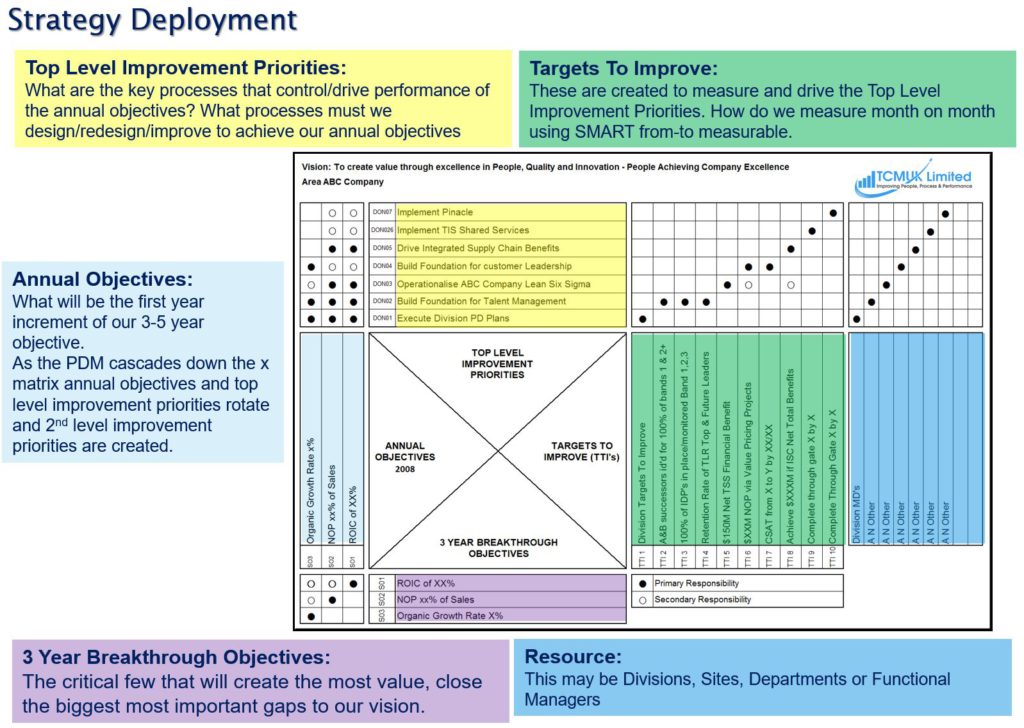
Okay, so the idea of shared goals is great. But how do you actually manage it without creating a mountain of spreadsheets and confusing documents? This is where a tool like the Hoshin Kanri X Matrix comes in.

Now, don’t let the name intimidate you. It sounds complex, but at its heart, the X Matrix is just a powerful one-page plan that shows the connections between your long-term vision, your annual goals, your key projects, and the metrics you use to measure success. It’s a visual map that everyone in the business can understand.

Imagine a large square divided into four quadrants, with a space in the middle:

  • South Quadrant (Bottom): Long-Term Objectives. This is your “True North.” Where do you want the business to be in 3 to 5 years? These are the big, strategic ambitions. For example: “Become the UK’s most trusted supplier of high tolerance components” or “Achieve carbon-neutral operations.”
  • West Quadrant (Left): Annual Objectives. What do we need to accomplish this year to make progress towards our long-term vision? These are more specific and time-bound. Things like: “Reduce overall waste by 10%,” “Increase on-time delivery from 92% to 97%,” or “Launch our new e-commerce platform.”
  • North Quadrant (Top): Top Improvement Priorities. These are the key projects or initiatives you will execute this year to achieve your annual objectives. Think of them as the “how.” For example: “Implement 5S across the factory floor,” “Renegotiate contracts with top 3 suppliers,” or “Train sales team on new CRM software.”
  • East Quadrant (Right): Metrics to Measure. How will you know if you are winning? These are the key performance indicators (KPIs) that track your progress. Things like “Customer satisfaction score,” “Scrap rate,” “Sales conversion rate,” or “Employee turnover.”
  • Far East (Far Right): Ownership. This is crucial. For every top priority and every key metric, you assign a name. Who is responsible for driving this forward? Accountability becomes crystal clear.

The real power of the X Matrix is in the corners and the centre. This is where you use dots or check marks to show the relationships. You can see exactly which Top Priorities (North) support which Annual Objectives (West). You can see which Annual Objectives link to which Long-Term Goals (South). You can see which Metrics (East) are measuring the success of your priorities.

It forces the critical conversations that break down silos. When you build the matrix as a leadership team, the sales director can see that the “Implement 5S” project isn’t just a tidy-up exercise for production; it’s a critical enabler for reducing lead times, which directly impacts the “Increase on-time delivery” objective that the sales team cares so much about. Everything is connected, and for the first time, everyone can see those connections on a single sheet of paper.

Building Cross-Functional Collaboration

Having a beautiful X Matrix on the wall is a great start, but it’s just a tool. It’s like having a detailed map but never actually starting the journey. The tool only works if you build the right behaviours and rhythms of communication around it. This is about bringing the plan to life.

Here are a few essential enablers for making this work in the real world:

  1. Regular Cross-Team Reviews: The plan is not static. You need a regular heartbeat of accountability. This often takes the form of a monthly or quarterly business review. The key is that this isn’t a series of separate departmental updates. It’s one meeting where leaders from every department review the same plan—the X Matrix. You go through the key metrics. Are they green, amber, or red? If a metric is red, the conversation isn’t about whose fault it is. It’s about which cross-functional priorities are behind schedule and what help is needed to get them back on track.
  2. Transparent Communication Channels: Everyone should be able to see the score. Modern manufacturers use simple digital dashboards—they can be built in Excel, Google Sheets, or more advanced tools like Power BI. These dashboards display the key metrics from the X Matrix in real time, or close to it. When the on-time delivery metric is visible on a screen on the shop floor and on the sales director’s laptop, it becomes a shared reality. There’s no hiding from the data.
  3. Collaborative Training: Don’t just train your teams in their functional skills. Invest in training that brings different departments together. A workshop on Lean principles or problem-solving that includes people from sales, finance, and production can be revolutionary. They start to understand each other’s challenges and learn a common language for improvement. They build personal relationships that make it much easier to pick up the phone and solve a problem later on.
  4. Leadership That Models the Way: This might be the most important piece of the puzzle. If the department heads and senior leaders are seen to be collaborating, challenging each other respectfully, and focusing on the shared objectives, the rest of the organisation will follow. But if they leave the strategy meeting and go back to protecting their own turf, the entire effort will fail. Leaders must consistently use the X Matrix to frame their decisions and communications. They must walk the talk, every single day.

Real World Impact: From Friction to Flow

Let me tell you about a fictional but very typical company: Midlands Precision Engineering. They were a 50-person firm, good at what they did, but stuck. Growth had stalled. Their biggest problem was internal friction. Sales would promise custom jobs with short lead times to win business, which would throw the production schedule into chaos. Production would then cut corners to catch up, leading to quality escapes. The quality team would then clamp down, slowing everything down again. It was a vicious cycle.

They decided to try a new approach. The leadership team spent two days building their first X Matrix. For the first time, they had a heated but productive debate about what truly mattered for the business over the next three years. They agreed on three long-term goals: being the number one choice for quality, achieving 99% on-time delivery, and growing the business by 50%.

From there, they defined their annual objectives and the key projects to get there. One of the top priorities was to create a formal “Sales, Inventory, and Operations Planning” (SIOP) process. This project was co-owned by the heads of Sales and Operations.

What happened? The monthly SIOP meeting became the place where they made promises together. Sales brought their forecast. Production brought their capacity plan. They looked at the data together and agreed on a plan for the next three months. Sales now understood the real constraints of the factory, and production got a much earlier view of demand, allowing them to plan materials and labour more effectively.

Within a year, their on-time delivery had jumped from 85% to 97%. Quality issues dropped because the frantic, last-minute rush jobs became the exception, not the rule. And because they were now a more reliable supplier, they started winning more profitable, long-term contracts. Morale improved dramatically because people were no longer fighting fires; they were working together towards a clear, common goal. The X Matrix didn’t magically solve their problems, but it gave them the map and the compass they needed to solve them together.

Your Next Move

We’ve covered a lot of ground, but the core message is simple. Departmental silos are the default setting in most growing businesses, but they don’t have to be your reality. The antidote is to make your strategy visible, make your objectives shared, and make your teams interconnected. You stop managing departments and start leading a single, unified business.

Frameworks like the X Matrix provide a practical, proven way to do this. They move your strategic plan from a document gathering dust on a shelf to a living, breathing tool that guides daily decisions and fosters genuine collaboration. It’s not about adding more management layers or bureaucracy. It’s about creating clarity, alignment, and accountability. It’s about getting all your best people rowing in the same direction.

If this sounds like the kind of clarity and alignment you’ve been looking for to unlock your business’s true potential, then it might be time to take the next step. To see how these principles can be applied directly to your organisation, I’d encourage you to explore the Goal Deployment Programme at https://tcmuklimited.co.uk/goal-deployment-programme/. It’s designed to help manufacturers like you make this transition from theory to reality.

Stop Rewarding the Chaos: How to Transform Your Reactive Teams into Strategic Powerhouses

You walk the factory floor. It’s humming. People are moving, machines are running, the air is thick with the familiar smell of industry and hard work. Everyone looks incredibly busy. Your production supervisor is dashing between lines; phone pressed to his ear. The quality team is clustered around a monitor, pointing intently at a chart. An engineer is frantically typing on a laptop perched on a tool cabinet. On the surface, it’s a picture of intense activity. It feels like things are getting done.


But then you look at the board. Last week’s production targets were missed, again. That nagging bottleneck in assembly is still causing delays. And the customer complaint you thought was resolved two weeks ago has just reappeared in your inbox. The activity is there, but the results aren’t following. It’s a frustratingly common scenario; one I’ve seen play out in countless manufacturing businesses across the UK.


This leads to the core, and frankly, critical question we need to ask ourselves as leaders: are our teams genuinely productive, or are they just busy? There’s a world of difference between the two and mistaking one for the other is a costly error. Busyness is motion. Productivity is forward motion. It’s about focusing our finite resources, our people’s time and energy, on the high-value, strategic work that actually moves the needle. Let’s get into what that really means.

The Great Illusion: Defining Busy vs. Productive Teams

At first glance, busy and productive teams can look remarkably similar. Both involve effort, time, and people doing things. The real difference lies not in the volume of activity, but in its direction and purpose. It’s the difference between rearranging deck chairs and actually steering the ship toward new horizons.


A “busy” team is often in a state of constant reaction. Their days are a whirlwind of firefighting. A machine goes down, so everyone scrambles. An urgent order comes in from a key client, so the carefully planned schedule is thrown out the window. Their calendars are packed with back-to-back meetings, many of which end without clear actions or decisions. They answer hundreds of emails, they multitask furiously, and they often work long hours. To be honest, they feel like they’re working incredibly hard, and they are. The problem is that their effort is scattered. It’s like throwing a hundred darts at a board hoping one will hit the bullseye, instead of taking careful aim. This kind of environment is exhausting and, over time, demoralising. People burn out from the constant churn without the satisfaction of seeing meaningful progress.


Now, picture a truly “productive” team. The atmosphere might even seem a bit calmer, more deliberate. There’s a focused hum, not a frantic buzz. This team operates with a shared understanding of their key objectives. They know what the three most important goals are for the quarter, and they can tell you how their work today contributes to one of them. Their meetings are shorter, more focused, and always end with a clear ‘who does what by when’. They aren’t just completing tasks on a list; they are solving problems and creating value. They have time for preventative maintenance because they’ve solved the root causes of the most frequent breakdowns. They aren’t just reacting to quality issues; they are proactively improving processes to prevent them from happening in the first place.


Why does this distinction matter so much? Because in manufacturing, margins are tight, and competition is fierce. We can’t afford to waste our most valuable asset, our people’s time. A busy team might keep the lights on day to day, but they won’t drive innovation. They won’t improve OEE (Overall Equipment Effectiveness) in a sustainable way. They won’t reduce waste or improve your Right First Time metrics. A productive team, on the other hand, is your engine for growth and resilience. They are the ones who will find a way to shave five seconds off a cycle time, who will redesign a workflow to eliminate a common error, who will build the kind of operational excellence that becomes a true competitive advantage. As a leader, your primary job is to create an environment where productivity can flourish, and busyness is recognised for what it is: a thief of potential.

The Warning Lights: Signs Your Team Is Only Busy

It can be hard to spot the difference from the corner office. The reports might show ‘hours worked’ and ‘tasks completed’, but those metrics often hide the truth. You need to look for the qualitative signs, the patterns of behaviour that act as warning lights on your operational dashboard. If you see these, it’s a strong signal that your team is stuck in the busyness trap.

First, look at your meeting culture. Are your team members constantly in meetings? I once worked with a company where the production manager spent over 70% of his week in scheduled meetings. He was talking about production, not enabling it. Busy teams have endless meetings with vague agendas. They are often used for information sharing that could have been an email, or for discussions that go in circles because the right people aren’t in the room, or no one has the authority to make a decision. A productive team’s meetings are for problem solving and decision making, period. They are jealously guarded, well prepared, and action-oriented.

Second, watch for rampant multitasking. We’ve somehow convinced ourselves that juggling five things at once is a sign of a high performer. It’s not. It’s a recipe for mistakes and shallow work. If you see your people constantly switching between analysing data, answering emails, taking calls, and dealing with interruptions on the line, they aren’t being efficient. They are context switching, and every switch comes with a cognitive cost. This is especially dangerous in a manufacturing setting, where a moment of distraction can lead to a quality defect or, far worse, a safety incident. A productive team is given the space to focus on one critical task at a time. They finish what they start.

Third, listen for the language of stress and the absence of accomplishment. Do your people talk about how swamped and overwhelmed they are? Is “I’m slammed” the standard answer to “How are you?” That’s a sign of busyness. It’s a culture where the badge of honour is how full your plate is, not what you’ve achieved. In contrast, productive teams talk about progress. They talk about what they’ve finished, what they’ve solved, and what they’ve learned. You’ll hear a sense of forward momentum and pride in their voices, even when they’re working hard. They might be tired at the end of the day, but it’s the satisfying exhaustion that comes from achieving something meaningful, not the draining fatigue of running in place.

Finally, look at the results on major goals. This is the ultimate acid test. If everyone is working flat out, but your key strategic projects are stalled and your big KPIs aren’t improving month on month, you have a busyness problem. The activity is not aligned with the objectives. It’s focused on the urgent, not the important.

A Compass for True Impact: Framework for Assessment

So, how do you move from simply suspecting a busyness problem to diagnosing it properly? You need a framework, a simple compass to help you and your team navigate away from low-value activity towards high-impact work. You don’t need a complex system. You just need to ask the right questions consistently.

A great starting point I’ve used successfully is a simplified version of the GRPI model, which stands for Goals, Roles, Processes, and Interpersonal Relationships. It’s just a straightforward way to check for clarity and alignment.

  • Goals: The first and most important question is: does everyone on the team have absolute clarity on our most important goals? Not the 20 things on your strategic plan, but the 2 or 3 that will make the biggest difference this quarter. For a production team, this might be ‘Reduce scrap on Line 3 by 15%’ or ‘Achieve a 98% on-time delivery rate’. These goals must be specific, measurable, and constantly communicated. If you ask five different team members what the top priority is and you get five different answers, you have a goal clarity problem, and that’s a breeding ground for busyness.
  • Roles: Once the goal is clear, are the roles for achieving it equally clear? Who is responsible for what? Who needs to be consulted? Who has the final say? In a busy environment, roles are muddy. People duplicate effort, or worse, things fall through the cracks because everyone assumes someone else is handling it. A productive team has crystal clear roles. The operator knows their role is to run the machine to standard and flag deviations immediately. The engineer knows their role is to analyse those deviations and implement a permanent fix.
  • Processes: How are we going to work together to achieve the goal? What are the steps? What does our daily stand-up look like? How do we escalate a problem? Busy teams often have convoluted or non-existent processes. They reinvent the wheel every time. Productive teams have simple, robust processes that everyone understands and follows. This isn’t about mindless bureaucracy; it’s about creating smooth pathways for work to flow, removing friction and decision fatigue.

Beyond this simple check, you need to align all work with high-value outcomes. Encourage your team to constantly ask “why?” Why are we having this meeting? Why are we generating this report? Does this activity directly contribute to reducing scrap or improving delivery times? If the answer is no, or is a bit of a stretch, you should challenge whether it needs to be done at all. This requires a shift from celebrating task completion (we answered 100 emails!) to celebrating outcome achievement (we reduced customer complaints by 20%!).

Of course, you need to measure this. Use your quantitative KPIs, your OEE, your scrap rates, your lead times. But don’t stop there. Pair them with qualitative feedback. Talk to your people. Are they frustrated? Do they feel they can get their work done? Do they have the tools and support they need? Numbers tell you what is happening; your people tell you why.

Finally, make this a regular habit. Audit your team’s activities against your priorities at least once a month. It’s like a stocktake for time and energy. Where is our effort really going? Is it aligned with our goals? This regular check-in is what keeps the team on course and prevents the slow, insidious creep of busyness from taking over again.

Practical Steps to Shift from Busy to Productive

Knowing the difference is one thing. Making the shift is another. It requires deliberate, consistent leadership. Here are some practical steps you can take, starting tomorrow.

First, lead the charge on ruthless prioritisation. As a leader, you are the chief protector of your team’s focus. You have to be the one to say “no” or “not now” to requests that don’t align with your key goals. Work with your team to identify and eliminate low-value tasks. Is there a report that no one really reads? Stop producing it. Is there a meeting that consistently under-delivers? Cancel it. This isn’t about being lazy; it’s about being strategic. Every “no” to a low-value task is a “yes” to having more time for what truly matters.

Next, foster an environment of psychological safety. Your people must feel safe to speak up, to challenge the status quo, to admit a mistake, or to point out a problem without fear of blame. In a manufacturing environment, this means the operator on the floor feels empowered to stop the line if they see a potential quality issue, knowing they’ll be thanked for their vigilance, not chastised for the downtime. When people are afraid to speak up, small problems fester until they become big, time-consuming crises, and that is a recipe for firefighting and busyness.

Implement better feedback loops. The annual performance review is not a feedback loop; it’s an autopsy. You need real-time, or near real-time, information flow. Daily huddles or stand-up meetings around a visual management board are perfect for this. What did we achieve yesterday? What is our priority for today? What is getting in our way? This simple 15-minute meeting aligns the team, exposes problems quickly, and keeps everyone focused on the immediate next steps towards the larger goal.

Also, think about how you reward and recognise people. Are you celebrating the heroes who stay late to fix a crisis? Or are you celebrating the team that improved a process, so the crisis never happens in the first place? If you only reward firefighting, you will get more fires. Start explicitly recognising and rewarding proactive problem solving, simplification, and collaboration. Celebrate the quiet, consistent progress that marks a truly productive team.

Finally, empower your team to adjust their own workflows. The people doing the work are often the ones who know best how to improve it. Give them the autonomy and the tools to run small improvement experiments. This creates a culture of continuous improvement and ownership, where everyone is thinking like a problem solver, not just a task doer. This is the heart of shifting from a culture of reactive busyness to one of proactive productivity. It’s a transformation that pays dividends in improved morale, higher engagement, and most importantly, measurable, sustainable results.

Guarding Against the Busyness Trap

Let’s be clear. The pull towards busyness is constant and powerful. In a world of instant notifications and competing demands, it is the path of least resistance. It feels easier to respond to the next email than to carve out two hours of deep work to solve a recurring production issue. It feels more immediately satisfying to tick off ten small tasks than to make slow, steady progress on one big, complex project.

That is why your role as a leader is so vital. You must be the guardian of your team’s focus, the champion of clarity, and the architect of an environment where deep, meaningful work can happen. Mistaking activity for achievement is a silent killer of growth and innovation. It burns out your best people and leaves your organisation vulnerable, treading water while your more focused competitors swim ahead.

I encourage you to take a hard, honest look at your team this week. Use the framework we discussed. Ask the tough questions. Are your goals crystal clear to everyone on the shop floor? Are your meetings a springboard for action or a time sink? Is your team talking about how busy they are, or are they talking about what they’ve accomplished?

Making the shift from busy to productive is not a one-time fix; it’s a continuous commitment. It’s about building a culture of purpose, clarity, and discipline. The good news is that the tools and strategies to do this are well within your reach. For those ready to take a more structured approach to aligning your entire organisation, from top floor strategy to shop floor tactics, a system like Hoshin Kanri can be transformative. It provides a robust framework for ensuring that everyone is pulling in the same direction, focused on the critical few objectives that truly matter.

To learn more about how you can systematically align your strategic objectives with tactical projects on the ground, explore how our Goal Deployment Programme can help you build a truly productive organisation.

From Leadership to Line: The Modules That Build a Lean Culture

You’ve seen it, haven’t you? The frantic energy of a manufacturing floor that’s busy but not necessarily productive. The operators who know a better way to do things but have long given up trying to tell anyone. The managers who are buried in spreadsheets, chasing numbers that don’t seem to reflect the reality of the work. It’s a common story in UK manufacturing, this sense of running hard just to stand still.


This is where the idea of a Lean culture comes in. And I know, ‘Lean’ can feel like another one of those buzzwords that gets thrown around in boardrooms. But when you strip it back, a Lean culture is simply about creating an environment where every single person, from the CEO to the newest apprentice on the line, is actively engaged in making things better. It’s about a shared obsession with eliminating waste, solving problems, and delivering more value to the customer.


The real challenge, and where so many initiatives fall flat, is that you can’t just bolt it on. You can’t just train a few people in 5S, hang up some new charts, and call it a day. It has to be woven into the very fabric of your organisation. It requires a fundamental shift in mindset, starting at the very top and flowing all the way down to the person packing the final box.


So, how do you actually build that? It’s not about a single magic bullet. It’s about systematically putting in place the modules, the building blocks, that create a self sustaining system of continuous improvement. This is what we’re going to walk through today: the essential components that connect leadership’s vision to the powerful insights of your front line teams.

It All Starts at the Top: Leadership’s Unwavering Commitment

Let’s be brutally honest for a moment. If the leadership team isn’t genuinely, visibly, and consistently committed to this, you might as well not even start. I’ve seen it happen more times than I can count. A big announcement is made, a memo goes out, maybe there’s a budget for some training. And then… nothing. The directors go back to their offices, the managers go back to their old routines, and the message to the shop floor is loud and clear: this is just another flavour of the month.

True leadership commitment isn’t about signing cheques or approving projects. It’s about behaviour. It’s the managing director who puts on a pair of safety boots and walks the floor not on a planned tour, but just to observe and ask questions. And not questions like, “Why is this behind schedule?” but questions like, “What’s getting in your way today?” or “Is there anything that’s frustrating you about this process?”

This is about modelling the principles you want to see. If you’re talking about eliminating waste, leaders can’t be seen to be wasting people’s time in pointless meetings. If you’re talking about respect for people, leaders have to be the first ones to listen, truly listen, to the concerns of their team. Visibility is everything. When people see the boss taking the time to understand a problem at its source, it sends a powerful signal that this stuff actually matters.

And to be honest, leaders often need their own training for this. Their role in a Lean transformation is different. It’s less about having all the answers and directing traffic, and more about coaching, removing obstacles, and empowering their people. They need to learn how to ask probing questions that guide teams to their own solutions, rather than just prescribing a fix. It’s a shift from being the hero who solves the problem to being the leader who builds a team of problem solvers. Without this fundamental buy in and behavioural change at the highest level, everything else is built on sand.

The Human Engine: Empowering People and Breaking Down Walls

Once the leadership has set the tone, the real engine of any Lean culture is the people who do the actual work. Your front-line teams, your operators, your technicians, your warehouse staff. These are the people who live and breathe your processes every single day. They are the true experts. The person who has been operating the same machine for five years knows more about its quirks, its inefficiencies, and its potential than any engineer with a clipboard. Ignoring that expertise is, frankly, one of the biggest forms of waste in any business.

Empowering the front line isn’t just a nice phrase; it’s a deliberate strategy. It means giving them the authority and the tools to make improvements to their own work. It means trusting them. It means creating front line leaders, team leaders or cell leaders, who are not just supervisors but coaches and facilitators. Their job is to support their team, help them identify problems, and get them the resources they need to solve them.

But how do you tap into that wellspring of ideas? You have to create channels for communication that actually work. I’m sure we’ve all seen the dusty suggestion box in the corner of the canteen, a black hole from which no idea ever returns. That’s not what we’re talking about. We’re talking about structured, regular, and responsive feedback loops.

Daily team huddles are a brilliant place to start. A quick, 10-minute stand up meeting at the start of a shift around a visual management board. What did we achieve yesterday? What’s the plan for today? What problems are we facing? It creates a rhythm of communication and immediate problem solving. If a problem is raised, it’s not left to fester for weeks. It’s acknowledged right there and then, and an action is assigned.

This brings us to a critical point: you have to act on the contributions you receive. Nothing kills engagement faster than people offering ideas and hearing nothing back. Even if an idea isn’t feasible, closing the loop is essential. A simple, “Thanks for the suggestion, we looked into it, but we can’t do it right now because of X, Y, and Z” builds immense trust. It shows you’re listening. And when you do implement an idea, celebrate it. Publicly recognise the person or team who came up with it. It encourages others to step forward.

This principle of communication extends beyond individual teams. One of the most powerful modules you can build is a cross functional Lean Task Force. Pull together a small group of people from different departments: an operator from production, someone from quality, an engineer, someone from maintenance, maybe even a person from purchasing or sales. Get them to walk a process together, from start to finish. The revelations are often staggering. The quality inspector finally understands why the operator is struggling with a certain part. The production team sees how a small change they make creates a huge headache for the packing department. These collaborations break down the invisible walls and the “us versus them” mentality that kills efficiency. They uncover the hidden wastes that exist in the handoffs between departments, wastes that no single department would ever see on its own.

Building the Toolbox: From Training to Tangible Tools

A committed leadership and an engaged workforce are the foundation, but they need the right tools and skills to build with. This is where practical, hands on training comes in. And please, this cannot be death by PowerPoint. Lean is about doing. The best training gets people out of their chairs and into a simulated or real environment where they can apply the concepts immediately.

Workshops on specific Lean tools are essential. Think of things like:

  • 5S and Visual Management: This is often the starting point, and for good reason. It’s about creating a clean, organised, and self-explanatory workspace. A place for everything, and everything in its place. When tools are easy to find, when problems are immediately visible (like a leak on a clean floor), and when standards are clear, it eliminates countless small frustrations and sources of waste. We’ll touch on this a bit more.
  • Value Stream Mapping (VSM): This is like creating a map of your entire process, from raw material to finished product. It’s a powerful way to make everyone see the whole picture, not just their little piece of it. It brutally highlights all the non-value added steps, the waiting times, the unnecessary movement, and the bottlenecks.
  • Problem Solving (PDCA, A3): You need to equip your people with a structured way to think about and solve problems. The Plan Do Check Act cycle is a simple but profound framework. It moves teams away from guesswork and firefighting towards a scientific method of defining a problem, testing a solution, measuring the result, and standardising what works.

The key is to start small. Don’t try to implement everything everywhere all at once. Pick a pilot area, a single production cell or value stream that has some challenges but also a willing team. Use it as your laboratory. Run the training, implement the tools, and work with that team to get a tangible win. This success story then becomes your internal case study. It builds momentum and creates a pull from other areas of the business who want to see the same results.

The role of a mentor or a ‘sensei’ can be invaluable here. Having an experienced guide, whether internal or external, who can coach the teams, ask the tough questions, and keep the focus on the core principles is often the difference between success and failure. This isn’t about having an expert who solves the problems for you; it’s about having a teacher who helps you learn to solve them for yourself. Capability building is the ultimate goal.

Making It Stick: Measurement and the Never-Ending Journey

So, you’ve got leadership on board, your teams are engaged, and you’re starting to use the tools. How do you ensure this isn’t just a temporary boost? How do you make it the new way of working? This is where measurement and a relentless focus on continuous improvement come in.

First, you need to be measuring the right things. Key Performance Indicators (KPIs) are crucial, but they need to be meaningful. Instead of just measuring overall output, start measuring things that reflect Lean principles. For example:

  • Lead Time: How long does it take from a customer order to delivery?
  • First Time Through (FTT): What percentage of products make it through the process without any rework or defects?
  • On Time In Full (OTIF): Are we delivering what the customer wants, when they want it?
  • Ideas Implemented: How many improvement ideas from the front line have we actually put into practice this month?

These KPIs should be visible to everyone, ideally on those team huddle boards. When people can see the direct impact of their improvement efforts on the numbers, it creates a powerful feedback loop that fuels more improvement.

This leads to the heart of a true Lean culture: the idea that you are never ‘done’. Continuous improvement, or Kaizen, is not a project with an end date. It’s a daily practice. It’s the constant, incremental refinement of processes. It’s the team on the assembly line figuring out how to shave two seconds off a task by repositioning a parts bin. It’s the maintenance team developing a new preventative check to stop a recurring machine fault.

These small, daily improvements, when compounded over time, lead to revolutionary results. The PDCA cycle becomes a habit. Teams are constantly running small experiments: “What if we tried doing it this way? Let’s test it for a week, check the results, and if it’s better, we’ll make it the new standard.” This is the engine that drives a Lean culture forward long after the initial consultants have gone home.

A System, Not a Shopping List

As we’ve walked through these modules, from the boardroom to the shop floor, I hope one thing has become clear. This isn’t a pick and mix menu. You can’t just implement a brilliant feedback system if your leadership isn’t listening. You can’t just run a 5S workshop and expect the culture to change if you don’t empower people to maintain the standards.

Each of these modules leans on the others. Leadership commitment creates the psychological safety for front line engagement. Engaged teams need feedback loops to be heard and cross functional collaboration to solve bigger problems. They all need the right tools and training to be effective, and they need clear measurements to see their progress and fuel the cycle of continuous improvement. It is a complete system.

Building a true Lean culture is a marathon, not a sprint. It takes patience, persistence, and a genuine belief in the potential of your people. The journey starts with a single, crucial step: a conversation among your leadership team about what kind of company you truly want to be. From there, by thoughtfully implementing these modules, you can build an organisation that doesn’t just survive, but thrives, by continuously getting better, every single day.

If you’re tired of chasing problems around the shop floor, maybe it’s time for something different. Our Lean Green Belt training could be that little nudge that actually makes a difference. If you’re even a bit curious click here and we’ll see where it goes.

The Power of Lean: How Leadership Transformation Elevates Company Performance

By now, you’ve probably heard about Lean. It’s a powerful approach to management, which has its roots in manufacturing, but is used by many companies large and small to improve their processes and products.

As its name suggests, Lean is about eliminating waste — anything that doesn’t directly add value to the customer. This includes waste in time (waiting), materials (overproduction), money (overhead) and energy (people working on the wrong things).

Lean is a journey — not just a set of tools or tactics — and it takes time to become effective. But it can transform how you manage your people — giving you more time for important activities like coaching and developing your people so they can do their jobs better.

The Lean Leadership Journey

The journey to a Lean organisation is not an easy one. It requires a holistic approach and a complete mindset change. It takes time, effort and dedication to make the transformation successful. And it’s never over!

The following are some of the steps that you can take to start your journey toward becoming a Lean organisation:

Get everyone involved in the process. The Lean Transformation cannot be achieved through top-down management alone. The leader must work closely with employees at all levels to implement changes that will make the organisation more effective and efficient. Employees need to understand how they fit into this process, so that they can contribute effectively.

Set goals for improvement and measure progress toward those goals regularly. One of the primary reasons for implementing Lean practices is to improve business performance and increase efficiency, but measuring results will tell us if we’re moving in the right direction or not. We need to be measuring against specific goals set out at the beginning of the process (or before it began). This also helps us identify areas which need improvement as well as areas where we’re excelling.

The Lean Leaders Standard Work

Lean leadership Standard Work is a system that encourages continuous improvement and provides a framework for facilitating change. It requires leaders to focus on their actions, behaviours, and tools in order to drive continuous improvement in their organisation. This Lean Leadership Standard Work can be applied to managers, supervisors, directors, and executives alike.

Lean Leadership Standard Work encourages and promotes employees in organisations to reduce variation and improve performance. It also develops team members by demonstrating how to make smart changes and support people by defining what they should do when they take action.

Lean Leadership Standard Work can include:

  • Develop process standards alongside the process operators
  • Observing processes in action (Gemba Walks)
  • Asking 5 Why questions
  • Identifying gaps between standard & actual work (Audit)
  • Supporting process improvement
  • Coach and Mentoring Employees
  • Empowering Accountability and Responsibility
  • Deploying strategy

Lean Thinking as Leader

Lean Thinking as a Leader is about management that encourages you to make the most of your team and organisation. It is about creating an environment where people feel comfortable thinking “outside the box,” and where ideas can be considered, implemented, and monitored so that adjustments can be made quickly.

It requires leaders to be open-minded and encourages them to listen carefully to their team members’ ideas and suggestions. It also encourages leaders to collaborate with their teams in order to come up with better solutions for problems or issues. When everyone feels like they’re part of something bigger than themselves, they’ll be more likely to work hard toward achieving success in whatever it is they’ve been tasked with accomplishing.

The Lean Leader as a Teacher

A key concept in Lean is that people learn best by doing. Leaders must therefore create an environment where learning can happen, by encouraging employees to take on projects and responsibilities that stretch them, while also providing coaching and feedback along the way. The goal, according to Masaaki Imai (the author of Kaizen), is to help each employee become “Kaizen conscious, developing skills and tools for problem solving” — and this requires a great deal of effort on the part of managers in order to ensure that all employees are given opportunities to learn, grow and improve within their roles at work.

Eliminating waste is a key Lean Leadership Principle

Waste can be defined as anything that does not add value to the product or service being created. Waste occurs in all processes and can be categorised into three types of wasteful actions that negatively impact workflow, productivity and ultimately, customer satisfaction.

  1. Muda (or non-value-added work). These are activities that do not add any value to the end product or service, such as, Overproduction, Inventory, Defects, Motion, Over-processing, Waiting, Transportation.
  2. Muri (or overburden). This is when workers are asked to do more than they can handle efficiently, safely, or ethically.
  3. Mura (or unevenness). This occurs when there are unexpected fluctuations in demand for products or services due to things like seasonal change or competitor activity.

Waste takes time and resources to create, so eliminating it saves time and money.

Lean Leaders Put Customers First

Lean leaders are customer focused. They don’t waste time or money on anything that doesn’t directly improve the customer experience, and they know that this is the best way to grow their business.

This means that lean leaders put their customers’ needs first by:

  1. Listening to their customers and understanding their challenges and needs.
  2. Paying attention to what customers think about the product or service, and how they use it.
  3. Identifying areas where they can improve the products or services based on what customers say.

Takeaway: Lean leadership is about learning and improving.

A company benefits from having the right leadership in place, which ultimately helps a business to grow. They’ll learn from your customers, try new things, and challenge you in new ways. They’ll collaborate with others and actively seek outside support. Without good leaders, or without lean principles guiding those leaders, you’re going to get the same results: no learning and therefore no improvement.

Boost your team’s performance and your leadership potential with New Way Growth’s personalised Helping Managers to Succeed and Lead Programme. Let’s shape your leadership success story today!

Hoshin Kanri: The Strategic Planning Process that Drives Growth and Performance

How many times have you sat in a boardroom, looked at a beautifully crafted five-year strategy, and felt a genuine spark of excitement, only to see that spark fizzle out somewhere on the journey to the shop floor? It’s a story I’ve seen play out in manufacturing businesses across the UK. The ambition is there. The intelligence is there. But the connection between the grand vision and the daily grind of production targets, quality checks, and maintenance schedules gets lost in translation.

This isn’t a failure of ambition. It’s a failure of process. We create strategies in one room and expect them to be executed perfectly by people in another, often without a clear map connecting the two. It’s like giving someone a destination without a GPS, or even a paper map. They might get there eventually, but the journey will be inefficient, frustrating, and probably take them down a few wrong turns.

This is where a concept called Hoshin Kanri comes in. It’s a Japanese term that roughly translates to “compass management” or “shining metal pointing the way.” It’s a strategic planning and deployment methodology that was honed by companies like Toyota to create a direct, unbroken line from top level objectives to the everyday actions of every single employee. It’s not just another corporate buzzword. It’s a proven, structured way to make sure your strategy actually happens.

So, What Exactly is Hoshin Kanri?

At its heart, Hoshin Kanri is a systematic approach to ensure that the goals of a company are the driving force behind the actions of every person within it. It originated in post war Japan, a time when companies had to be incredibly resourceful and focused to rebuild and compete globally. They couldn’t afford wasted effort or internal misalignment. They needed a way to point everyone in the same direction, and Hoshin Kanri became their compass.


It’s built on a few core principles that, frankly, just make sense.


First, there’s alignment. This is the big one. Hoshin Kanri creates a clear cascade of objectives. The company has a long-term vision, which is broken down into a handful of critical “breakthrough” objectives for the next three to five years. These are then translated into specific, measurable annual objectives. And those annual objectives are then broken down further for each department, each team, and ultimately, each individual. Everyone can see how their work directly contributes to the bigger picture. The person calibrating a machine on the night shift understands how their precision impacts the company’s goal of becoming the market leader in quality.


Second, there’s engagement. This isn’t a top-down dictatorship. One of the most powerful parts of the process, which we’ll get to, is something called “Catchball.” It’s a back-and-forth dialogue. Senior leadership proposes the objectives, but then they toss them to the teams who have to deliver them. Those teams toss back their feedback, their ideas, and the resources they’ll need. This dialogue ensures that goals are realistic, and more importantly, it creates a deep sense of ownership. People support what they help create.
And third, there’s continuous improvement, or Kaizen. Hoshin Kanri isn’t a “set it and forget it” plan. It’s a living, breathing system. You are constantly checking your progress against your targets through regular reviews. This isn’t about blaming people when things go off track. It’s about asking “why?” and learning from the process. It builds a culture where problems are seen as opportunities to get better, not mistakes to be hidden.

The 7 Steps to Making Strategy Happen

Okay, so how does this actually work in practice? The Hoshin Kanri planning process is often broken down into seven steps. It looks like a lot on paper, but think of it as a logical flow from a big idea to daily reality.

  1. Establish Your Organisational Vision: This is your North Star. Where do you want your business to be in ten years? This shouldn’t be a fluffy mission statement. It needs to be a clear, compelling picture of the future. Something like, “To be the UK’s most trusted supplier of high precision aerospace components, known for zero defect quality and on time delivery.”
  2. Develop Breakthrough Objectives: You can’t do everything at once. Based on your vision, what are the three to five game changing things you need to achieve in the next three to five years? These are your “breakthroughs.” They should be bold. Examples could be: launching a fully automated production line, reducing lead times by 50 percent, or entering a new European market.
  3. Set Annual Objectives: Now you break it down. To make progress on that 50 percent lead time reduction, what do we need to achieve this year? Maybe the annual objective is to “Reduce average order fulfilment time from 20 days to 15 days by December 31st.” It’s specific, measurable, and time bound. You’ll have a few of these, each one directly supporting a breakthrough objective.
  4. Cascade Objectives (The ‘Catchball’ Process): This is where the magic happens. Senior management doesn’t just email these annual objectives out. They present them to their direct reports, the department heads. They ask, “Here’s what we need to achieve. How can your department contribute, and what do you need from us?” The production manager might say, “To hit that 15-day target, I need to reduce machine changeover time. I think we can get it down by 10 percent this year. To do that, I’ll need a budget for new tooling and two days of training for my team leaders.” This conversation, this negotiation, and coaching, goes all the way down the organisation. It’s a game of catch, not a command.
  5. Implement and Execute: Once the objectives are agreed upon at all levels, it’s time to get to work. Because of the Catchball process, everyone knows what they need to do and why they are doing it. The plan isn’t some abstract document; it’s a shared commitment.
  6. Monitor Progress (PDCA): This is the heartbeat of Hoshin Kanri. You use regular, structured reviews to check your progress. Many teams use the Plan Do Check Act cycle. You had a Plan (reduce changeover time). You Did the actions (bought the tools, ran the training). Now you Check the data. Did changeover time actually decrease? If yes, great. If not, you move to the final step.
  7. Reflect and Learn (The ‘Act’ part of PDCA): If you missed the target, you don’t just try harder. You analyse what happened. Was the training ineffective? Was the new tooling wrong? You adjust your approach based on what you’ve learned. This is how you embed continuous improvement. If you hit your target, you standardise the new, better process and look for the next improvement. This cycle of review and adjustment happens monthly, sometimes even weekly.

Why This is the Key to Real Growth

I’ve worked with manufacturers who had brilliant engineers and dedicated teams, but they were spinning their wheels. Different departments were pulling in different directions, often with good intentions. The sales team would promise a quick turnaround to win a big order, not realising the strain it would put on a production team already struggling with an outdated machine. Hoshin Kanri fixes this.

It creates organisational focus. Suddenly, everyone is rowing in the same direction. When a new project or request comes up, you can hold it up against the Hoshin plan and ask, “Does this help us achieve our annual objectives?” If the answer is no, it’s easier to say no, or to at least question its priority. It stops the organisation from getting distracted by “flavour of the month” initiatives.

The engagement it fosters is transformative. I saw this at a mid-sized engineering firm in the Midlands. They were struggling with morale and high staff turnover on the factory floor. After we implemented the Hoshin Kanri concept, and specifically the Catchball process, team leaders started contributing ideas that management had never even considered. They felt heard. They felt valued. Within a year, their productivity metrics had improved by over 15 percent, but more importantly, their staff retention shot up. People weren’t just coming to work for a pay cheque; they were coming to work to help the company win.

This leads to measurable, sustainable improvements. Because everything is tied to data and regular reviews, you move beyond guesswork. You know what’s working and what isn’t. One of the classic examples is the Danaher Corporation, a global science and technology conglomerate famous for its operational excellence. They built their entire legendary business system around the principles of Hoshin Kanri. It allowed them to acquire companies and rapidly deploy their improvement methodology, driving incredible growth and shareholder value year after year. They live and breathe by the data, and it all starts with their strategic deployment process.

The Tools That Make It Work

This all sounds great, but how do you manage it all without drowning in spreadsheets? There are a few key tools that help.

The most famous is the Hoshin Kanri X-Matrix. It looks a bit complicated at first, but it’s a brilliantly simple one-page document. It visually connects your long-term breakthrough objectives, your annual objectives, the specific improvement priorities for the year, and the key metrics you’ll use to measure success. It even shows who is responsible for what. It’s a powerful tool for showing the entire plan on a single sheet of paper, making the connections obvious to everyone.

The other core tool is the PDCA Cycle (Plan-Do-Check-Act). This isn’t just a Hoshin tool; it’s the foundation of all modern continuous improvement. But within Hoshin, it provides the engine for the review process. Each improvement initiative, from the departmental level down to a small team project, is managed through this cycle. It ensures that you aren’t just “doing stuff,” but are doing it with a clear hypothesis (Plan), testing it (Do), measuring the results (Check), and then learning and adapting (Act).

Overcoming the hurdles is crucial. The biggest challenge is always leadership commitment. If senior leaders aren’t driving the review process and living by the plan, it will fail. It can’t be delegated to the quality department. Another common issue is poor communication during the Catchball process. It needs to be a genuine dialogue, not just a briefing. Finally, reviews can become inconsistent. If you start skipping the monthly reviews because you’re “too busy,” the whole system falls apart. The discipline of the review process is non-negotiable.

The key to overcoming these is to start small. Maybe pilot the process in one department. Get some quick wins, show people how it works, and build momentum from there. And be patient. This is a cultural shift, not an overnight fix. It takes time to build the habits of data driven review and open dialogue.

Your Compass for the Future

Implementing a system like Hoshin Kanri is a serious commitment. It requires discipline, honesty, and a willingness to change how you think about strategy itself. But the transformation is profound. It’s the difference between having a strategy that sits on a shelf and having a strategy that lives and breathes in the daily actions of your entire workforce.

It aligns your people, focuses your resources on what truly matters, and builds a resilient culture of continuous improvement that becomes your ultimate competitive advantage. In a world of volatile supply chains, skills shortages, and intense global competition, having a reliable compass to guide your organisation isn’t just a nice to have. It’s essential for survival and growth.

If you’re ready to stop letting your strategy get lost in translation and start driving real, measurable performance, it might be time to look at Hoshin Kanri.

To see how we can help you implement a robust strategic planning process in your organisation, click here to see our Strategic Deployment Programme.

Seven Tips For Being An Effective Lean Leader

Lean Leadership

Lean is about creating a culture of continuous improvement, where everyone—from the CEO to the cleaner—is working together to eliminate waste, cut costs, and improve quality.

Lean is based on a number principles that can be applied at every level. These principles include:

  • Eliminate waste through value stream mapping, one-piece flow and standardised work
  • Reduce cycle time by visualising how things are currently done
  • Standardize everything possible, from processes to parts and equipment used
  • Create pull systems to avoid overproduction (Make-to-Stock vs Make-to-Order)
  • Build Quality In by eliminating defects through prevention instead of inspection (Poka Yoke)
  • Sustain Kaizen (Continuous Improvement)

Focusing on value is your first priority.

The Kaizen Mindset

A kaizen mindset is the basis for lean leadership and practice, which doesn’t always mean continuous improvement.

The idea of continuous improvement is a common misconception. Continuous improvement means that you are constantly trying to improve your processes and products, but it doesn’t mean that you are always making an improvement.

Some people think that they need to be perfect before they can consider themselves “lean” or “continuous improvement leaders.” In reality, lean leadership is about being better than yesterday—and that requires a kaizen mindset.

When you have a kaizen mindset, you’re constantly scanning what’s going on around you, looking for ways to improve: “What can I do right now? What can I do better tomorrow?” It’s not just about coming up with new ideas or projects; it’s also about recognising when something isn’t working as well as it could be and taking steps to get to the root cause and fix it, not just putting a plaster over it!

Leading From The Front, Not The Rear

The traditional command-and-control method of management does not fit within the lean philosophy, but some leaders still struggle to let go of traditional power structures and control mechanisms that don’t serve their people or the organisation very well in today’s working environment.

Some leaders are so accustomed to being the only ones who have access to all the information, they find it difficult to accept that there are times when they need to consult others.

Other leaders are not used to being challenged, so when someone does challenge them, they feel threatened and react poorly, which creates conflict instead of innovation.

Lean leaders know that the only way to truly achieve what they want is by empowering their employees—and by extension, their customers. This also means that you have to empower yourself so that you can lead others effectively.

Identifying Customer Needs For Improved Lean Leadership

Identifying who your customers are and what they value is necessary when you engage in lean and continuous improvement activities.

A good place to start is with a customer-value analysis or voice-of-the-customer. This will help you identify the features and functions that customers truly value, as well as the characteristics that differentiate your product from competitors. In addition to evaluating the needs of current customers, identify potential new customer segments by identifying needs not currently being met by competitors.

Once you have identified certain key features of your product or service, list them in priority order for each of these segments. Then prioritize these features across all segments and compare results—this will allow you to identify potential opportunities for improvement and make sure nothing is left out of your plan.

If possible, involve others from different departments in this process so they can also provide input on how they would rank these factors.

Critical Thinking: Learn To Eliminate Your Problems Forever

It’s easy to get bogged down in the day-to-day grind, and it’s tempting to just focus on what’s right in front of you—especially when there are so many other pressing matters that need attention.

The biggest difference between lean leadership and traditional management is that lean leadership is focused on long-term solutions, while traditional management is focused on short-term results. This means that lean leaders don’t just focus on solving a problem temporarily, but rather they seek out ways to prevent the problem from ever coming up again. This is done by finding the root causes of problems and eliminating them permanently.

It may sound simple, but truly engaging in kaizen requires critical thinking and effort to see past the obvious problems, and focus on the root causes to find long-term solutions that eliminate waste forever.

Kaizen is about eliminating waste wherever it exists, not only in physical processes but also in organisational culture and structure. This means that leaders need to create an environment where employees feel safe expressing themselves freely without fear of reprisal or judgment from management (even if those judgments are well-intentioned).

How The Kaizen Mindset Helps With Business Collaboration

The kaizen mindset is centred on solving problems collaboratively as needed, so no single individual or team plays a more prominent role than others do in generating ideas for improvements.

The Lean Leadership approach is based on the principle that everyone has the ability to improve their own work processes and contribute to business success. This means that leaders at all levels need to be ready to take responsibility for their roles in improving business performance while also encouraging employees to take ownership of their own areas of focus.

Leaders need to realise that by creating an environment where everyone feels comfortable contributing ideas, everyone shares in the responsibility of being able to improve business performance. A key component of this process is creating a culture where employees feel safe sharing their thoughts and ideas without fear of reprisal or negative consequences.

The kaizen mindset is centred on solving problems collaboratively as needed, so no single individual or team plays a more prominent role than others do in generating ideas for improvements that are then implemented for better performance.

How Self-Aware Lean Leaders Succeed

The most effective lean leaders are those who understand themselves exceptionally well. They know their strengths, weaknesses and passions, and they use that knowledge to their advantage.

When you’re a leader, it’s important to be able to balance your own personal needs with the needs of your team. The best lean leaders do this by taking time to reflect on how they personally feel about a particular issue before acting on it.

In addition, they work hard to understand each individual member of their team so they can provide them with an environment that is conducive to success.

Additionally, check out our sister company New Way Growth and their ‘Helping Managers to Lead and Succeed‘ programme.

Leveraging Growth Mindset and Fact-Based Management in Manufacturing

The difference between stagnation and growth often lies in mindset and management approach. The case of an SME Manufacturer with an £8m turnover, which lost a monumental £1.5 million order to a competitor that did not even manufacture but merely outsourced, illustrates a vital lesson in resilience, mindset, and strategic focus.

The Importance of Managing by Facts

Today’s manufacturing landscape demands a shift from traditional, often emotionally-driven decision-making to a more robust, evidence-based approach known as ‘managing by fact.’ This paradigm underscores the necessity of grounding decisions in data, metrics, and factual evidence rather than intuition, gut feelings, or emotions. It’s a shift that aims to heighten efficiency, enhance productivity, and foster innovation by making informed decisions that are aligned with strategic objectives and market demands.

Understanding ‘Manage by Fact’

‘Manage by Fact’ is not just a catchphrase; it’s a comprehensive approach that encompasses:

  • Data-Driven Decision Making: Leveraging real-time data and analytics to guide strategic decisions, leading to more targeted and effective outcomes.
  • Performance Metrics: Establishing clear, measurable objectives that help in assessing performance against goals, thereby facilitating continuous improvement.
  • Objective Analysis: Encouraging a culture where decisions are made based on objective analysis rather than subjective opinion or hierarchical pressures.
growth mindset

The Power of a Growth Mindset

At the heart of the SME Manufacturer’s story is the concept of a ‘growth mindset,’ a term coined by psychologist Carol Dweck. It denotes an underlying belief that talents can be developed through hard work, effective strategies, and input from others as opposed to a ‘fixed mindset’ which posits that talents and abilities are static and unchangeable.

A growth mindset in manufacturing signifies:

  • Embracing Challenges: Seeing failures, like losing a significant order, as opportunities to learn and evolve instead of insurmountable setbacks.
  • Persistent Effort: Understanding that mastery and improvement require time, effort, and perseverance.
  • Feedback and Critique: Welcoming constructive criticism as a resource for learning and development.
  • Learning from the Success of Others: Viewing peers and competitors as sources of knowledge and inspiration rather than threats.

Combining Fact-Based Management with a Growth Mindset

The synergy between managing by fact and fostering a growth mindset can become a formidable strategy in manufacturing. Here’s how:

  1. Data-Driven Insights for Continuous Learning: Utilising data not just for operational decisions but for learning and development, aligning employee growth with strategic business goals.
  2. Metrics for Performance and Growth: Performance metrics and KPIs can serve dual purposes—measuring current productivity and efficiency while identifying areas for skill development and innovation.
  3. Adaptability through Objective Analysis: An objective, fact-based approach empowers teams to adapt swiftly to market changes, technological advancements, and competitive dynamics, fostering a culture of continuous improvement and agility.

The Story of Resilience and Adaptation

Returning to the narrative of the SME Manufacturer, the loss of a £1.5 million order could have been a crippling blow. However, the management and team’s growth mindset, coupled with a strategic focus on facts and data, turned a potential disaster into a learning opportunity. It pushed the company to analyse what went wrong, to understand the market and competitors better, and to refine its value proposition and operations accordingly.

Their journey underscores several key takeaways for manufacturers:

  • Resilience is Key: The ability to bounce back from setbacks, powered by a belief in continuous improvement and the possibility of growth.
  • Embrace Change: Being open to change and willing to adapt strategies based on what the data shows can differentiate between stagnation and growth.
  • Collaborative Teamwork: A shared growth mindset within the team fosters collaboration, innovation, and shared ownership of both challenges and successes.

Conclusion: Forging Ahead with Facts and Growth

As the manufacturing sector continues to evolve amidst ever-changing market dynamics, the story of the SME Manufacturer serves as a compelling case study in the power of managing by facts not by emotion, and the transformative impact of a growth mindset.

Their experience illuminates a path forward for manufacturers seeking to navigate the complexities of modern-day business. It’s a dual approach where decisions are driven by data and insights, and where challenges and setbacks are seen not as endpoints but as stepping stones to greater achievements.

The manufacturers who will thrive are those who embrace the power of data, leverage the resilience of a growth mindset, and view every challenge as a new opportunity for growth and learning. Just as the SME Manufacturer demonstrated, the key lies in not just focusing on what to shrink but rather on what to grow. By striving to be better today than yesterday and planning to be better tomorrow than today, manufacturing businesses can ensure they remain competitive, innovative, and poised for success in an ever-evolving landscape.

0330 311 2820