Improving Performance – Engineering Company Case Study

Increased Delivery, Increased Sales

**No images or Business Name as Customer NDA in place**

Opportunity

This Private Equity owned business was under performing against budget. Particular attention was required within the operational areas with Productivity and On Time Delivery drifting.

The Managing Director required a system to: communicate the strategy, allocate resources, focus and align actions, and control business drift. He wanted to ensure that all key improvement activities had ownership, responsibility, accountability and the relevant training and practitioner support required to increase overall company performance.

Improvement

Working with the Managing Director & Executive Team the decision of implementing Strategy Deployment and A3 Problem Solving was agreed along with hands-on project execution support.

Training was given to all Management and Leaders in what Policy Deployment and A3 Problem Solving is, what benefits and how the process should be structured to enable execution of the business objectives. Key fundamentals were as follows:

  • Identify the few, long term breakthrough objectives that are critical to long term success of the company.
  • Link these objectives with specific action plans throughout the organisation.
  • Focus and align the company’s internal organisations to achieve these long-term objectives.
  • Turn the strategic plan into a year – over – year action plan.
  • Coaches and Mentors others

Workshops were held to ascertain the critical improvement activities to be focused on within the business. Training and Coaching was given to the owners of each A3 Plan on how to manage and communicate through the A3 process. Guidance and training to understand background, current state, problem definition, analysis, actions and follow up.

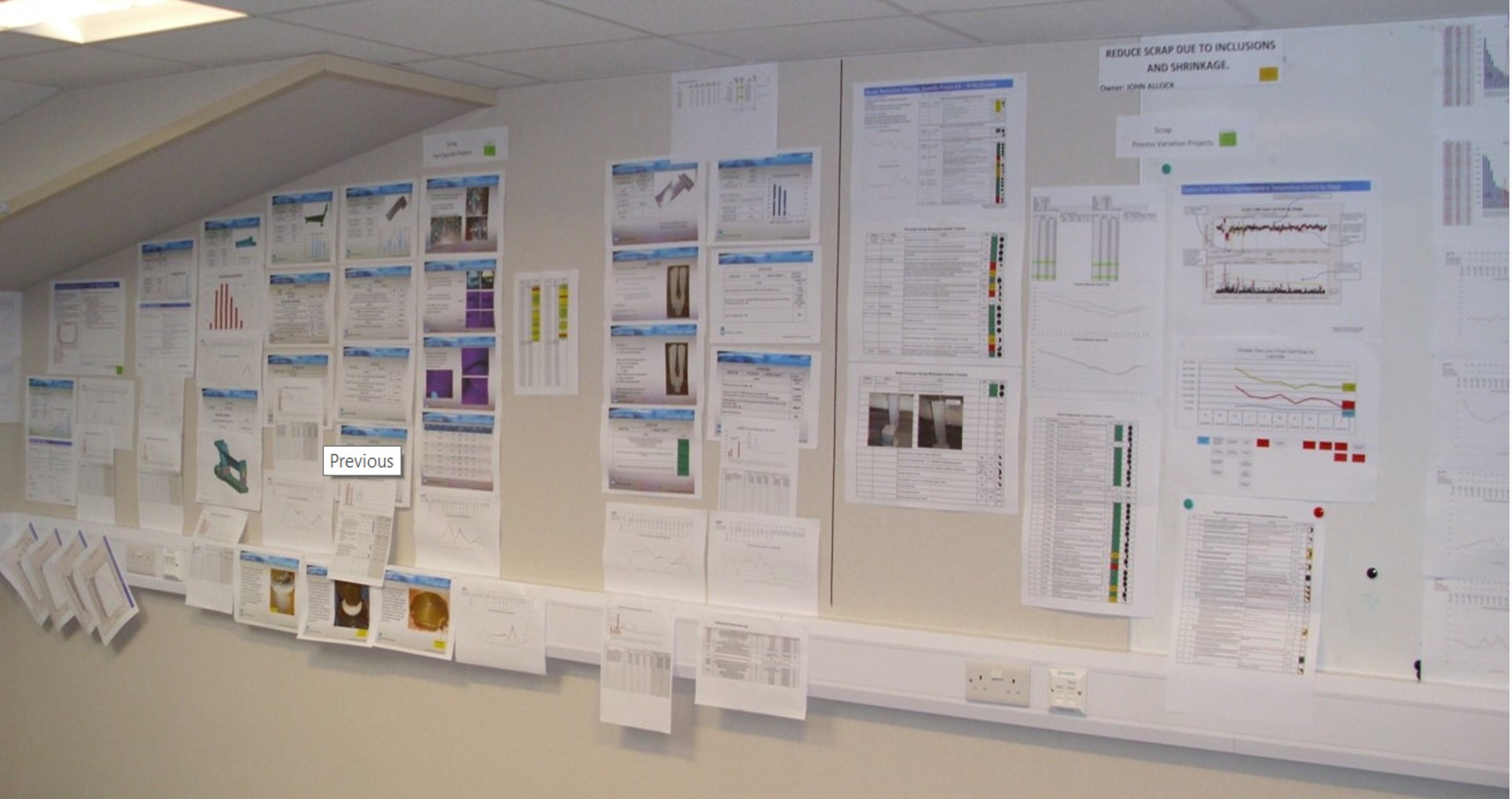
Management Control Rooms were introduced with regular performance reviews held with all owners and stakeholders present. Ongoing coaching and mentoring in Management Behaviour for the process along with business improvement training and our Lean Coaching Programme to ensure execution and sustainability. Operational Excellence and Process Optimisation workshops/projects were completed covering Sales, Purchasing & Logistics, Operations and Planning.

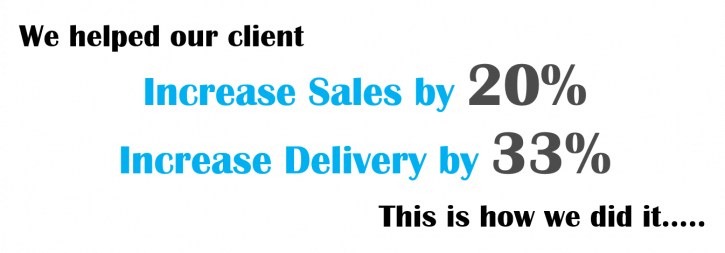
The company significantly impacted it’s financial position over a 9 month period,

  • Increasing Sales by 20%
  • Delivery by 33%
  • Efficiency by 28%.

0330 311 2820

Book a Return Call at a time that Best Suits You “HERE”

The 8 Wastes Costing Your Factory Money Right Now: A Field Guide for UK Manufacturers

Here’s a slightly uncomfortable thought. A good chunk of the money your factory loses this month won’t show up on any invoice.

There’s no bill for the hour a machine sat idle waiting for a first off check. No line on the P&L for the pallet of brackets nobody actually ordered. Nobody sends you a statement for the forty minutes your best setter spent hunting for a torque wrench that “lives” in a drawer it’s never in.

But you pay for all of it. Every single week.

And right now, I think that matters more than it has in a long time. UK manufacturers are paying the highest energy prices in the G7. Nearly nine in ten expect employment costs to keep climbing this year. A Make UK survey back in May found that almost every firm (98%) expects a real hit to profitability, and close to four in ten have already pushed investment back. You can’t do much about the price of gas. You don’t set the National Living Wage. What you can do is stop paying for things your customer never asked for.

That’s really all lean manufacturing is, once you strip away the Japanese vocabulary and the consultant slide decks. It’s a way of looking at your process and asking, for every step, “would the customer pay for this?” If the answer’s no, it’s waste. Taiichi Ohno, the engineer behind the Toyota Production System, grouped that waste into seven types. An eighth, unused talent, was added later as lean spread beyond Japan. Most people remember all eight with one handy word, DOWNTIME: Defects, Overproduction, Waiting, Non utilised talent, Transportation, Inventory, Motion and Extra processing.

I’ll be honest about something. The first time I sat down with a small fabrication business and mentioned lean, the owner laughed. “We’re twelve people in a unit in Walsall,” he said. “That’s for Toyota.” Fair enough, I thought. But by lunchtime we’d found a rack of finished parts that had been sitting there so long the job card had faded. He stopped laughing after that. Not because I’d said anything clever. He just saw it.

So this isn’t a theory piece. It’s a field guide. For each of the eight wastes you’ll get a plain description, a real example from the kind of factory you probably run, and something you can actually do about it. I’ve grouped them into four families, because that’s roughly how you’ll spot them on a normal walk round the floor.

The wastes hiding in your schedule: overproduction, inventory and waiting

These three are close cousins. In my experience, if you find one of them, the other two are usually standing just behind it.

1. Overproduction

Overproduction means making more than the customer needs or making it before they need it. Lean people often call it the worst waste of the lot, and I think they’re right, because it quietly creates most of the others. Extra parts need storing, moving, counting and, sometimes, scrapping.

Field example. A sheet metal shop gets an order for 40 brackets. The press brake is already set up and the materials on the bench, so the supervisor runs 200. “Saves a changeover next time,” he says. Sounds sensible. Except the customer changes the hole spacing four months later, and 160 brackets go in the skip. That’s material, energy, labour and machine time, all paid for twice. Once to make them, and once to throw them away.

What to do about it. Make to the order, not to the machine. If long changeovers are the reason you batch big, that’s the real problem to work on. A simple rule helps: nothing gets made without a customer order or an agreed stock level behind it. Write the rule down. Stick it on the press.

2. Inventory

Inventory is overproduction’s slower, sneakier sibling. Raw material, work in progress, finished goods, it’s all cash sitting on your floor. The usual rule of thumb is that holding stock costs somewhere between 20% and 30% of its value every year, once you add up space, insurance, handling, damage and the cost of the money tied up in it. Some careful benchmarking puts the real figure nearer 10% for well-run firms. Even at the low end, that’s not nothing.

Field example. A food producer I worked with bought a year’s worth of printed film to get a better unit price. Good deal on paper. Then the retailer changed the label design. Most of that film sat in storage… well, it did, until it went to landfill. And for eight months it took up space that could’ve held product.

What to do about it. Walk your stores and ask one question of every pallet: “when will this actually be used?” If nobody knows, that’s your answer. Set sensible maximum levels for your top twenty items and check them monthly. And be a little wary of bulk discounts. A 10% saving can be wiped out by one design change.

3. Waiting

Waiting is any time people, machines or materials are stood still because of something else. It’s the most visible waste on the floor, and oddly the one we get most used to.

The big, dramatic version is unplanned downtime. Research for Fluke found 68% of UK manufacturers had suffered it in the previous year. The headline cost figures in that study come from large plants, but an earlier Oneserve survey put the average UK manufacturer’s loss at around 49 hours a year, roughly 3% of working days. In a small factory, that’s more than a week of output. Just gone.

But honestly? The waiting I see most in smaller firms isn’t the big breakdown. It’s the little stuff.

Field example. A CNC operator finishes setting a job, then waits for the quality engineer to sign off the first part. The engineer’s in a meeting. Forty minutes later the spindle finally turns. That happens two or three times a day, across several machines. Nobody’s done anything wrong, exactly. The process just has a queue built into it.

What to do about it. Track waiting for one week. A tally sheet taped to each machine is plenty: what were you waiting for, and for how long? You’ll probably find two or three causes cover most of it. Train setters to do first off checks against a clear standard. Have the next job’s material and tooling ready before the current one finishes. And get basic preventative maintenance right before you even think about buying clever sensors.

The wastes on the move: transportation and motion

People mix these two up all the time, and to be fair, the line is a bit blurry. Here’s how I think of it. Transportation is moving the product. Motion is moving the person.

4. Transportation

Every time a part goes on a forklift, a trolley or a pallet truck, you’re paying for it. Fuel or charging, labour, the truck itself, and the risk of a dropped crate. And the customer gets nothing for any of it. A part that’s travelled 500 metres isn’t worth a penny more than one that’s travelled five.

Field example. A plastics moulder grew the way lots of UK firms grow, one unit at a time. Moulding ended up in one building, assembly in the next, and packing in a third across the yard. When someone finally traced a single product’s journey with a trundle wheel, it covered just over 400 metres before it was boxed. Outside. In the rain, for half the year. Every crate got handled six times.

The funny thing is, nobody had really noticed. It had just become “how we do it here.”

What to do about it. Draw a spaghetti diagram. Honestly, it’s that simple. Take a plan of your site, pick one product, and draw a line for every move it makes. The tangle tells you everything. You won’t always be able to shuffle buildings around, but you can often move a packing bench, put two linked processes side by side, or finally get rid of that “temporary” storage area halfway across the factory that’s been there since 2019.

5. Motion

Motion is the wasted movement of people. Walking, reaching, bending, searching. It’s tiny in any single moment, which is exactly why it slips past. And it costs you in other ways too: sore backs, tired operators, and more mistakes late in the shift.

Field example. An electronics assembler shares a toolbox with two colleagues at the end of a long bench. When we tallied it over a morning, she was walking to it around sixty times a shift. Call it twenty seconds a trip. That’s twenty minutes a day, per person, just fetching things. Across three people and a working year, you’re well past 200 hours. That’s roughly six weeks of somebody’s time. For a toolbox.

What to do about it. This is where 5S earns its keep: Sort, Set in order, Shine, Standardise, Sustain. Don’t let the name put you off. In practice it just means everyone has what they need, where they need it, and nothing they don’t. Shadow boards, point of use storage, parts presented at a sensible height. I’ve seen a £60 set of duplicate screwdrivers pay for itself inside a fortnight. Not glamorous. Works, though.

The wastes built into the work: defects and extra processing

These two tend to feel like “just part of the job.” Which is precisely why they’re so expensive.

6. Defects

A defect is anything that has to be scrapped, reworked, sorted, checked again or sent back. The obvious cost is the material. The real cost is everything wrapped around it.

The American Society for Quality reckons quality related costs run at 15% to 20% of sales revenue for many manufacturers, and as high as 40% at the worst performers. Maybe you read that and think, “not us, surely.” Maybe you’re right. But the same organisation found that only 31% of firms feel they fully understand what poor quality costs them. Most of it hides in labour, overtime and goodwill, not in a neat column marked “scrap.”

Field example. A joinery firm making bespoke staircases had a habit of fixing problems at the fitting stage. A tread slightly out, a baluster hole drilled off centre, and the fitter would just sort it on site. No scrap recorded, so no problem. Except when they finally added it up, the fitters were spending roughly a day a week on rework, plus extra van trips, plus the odd unhappy customer who noticed. It was costing them more than their whole marketing budget. Nobody had ever written it down as a defect, so in a strange way it didn’t exist.

What to do about it. Start counting. Every reject, every bit of rework, every return, logged with a reason. A whiteboard by the door will do. After a month, sort the reasons. You’ll almost always find a handful of causes behind most of the trouble. Then ask “why?” five times about the biggest one, and fix the cause rather than the symptom. Mistake proofing (a simple jig, a locating pin, a go/no go gauge) often costs pennies compared with the problem it solves.

7. Extra processing

Extra processing is doing more work than the customer actually values. Tighter tolerances than the drawing asks for. A finish on a face nobody will ever see. Paperwork that gets filled in, filed and never read again. It’s the sneakiest waste, I think, because it usually comes from good intentions. People want to do a proper job, and that’s a good thing. Mostly.

Field example. A precision engineering firm was hand deburring and polishing an internal face on a bracket. About six minutes a part. When someone finally rang the customer, it turned out that face sat against a rubber mount and was never seen again. Six minutes, across a few thousand parts a year, for nothing at all. Same story with inspection: one critical dimension was being measured by the operator, again by QC, and again at dispatch. Three checks. One good one would’ve done.

What to do about it. Go back to the drawing, literally, and back to the customer. Ask what really matters to them. Then look at each step and ask, “if we stopped doing this tomorrow, would anyone notice?” Be a bit careful, though. Some extra steps exist for a perfectly good reason that somebody forgot to write down. So check before you cut. But do check.

The waste nobody counts: unused talent

8. Non utilised talent

This is the eighth waste, the one that got added later. And if I’m honest, it’s the one I’d put first.

You already pay for the knowledge in your building. Every operator, setter, storeman and driver knows things about your process that you don’t. Things that never make it onto a drawing or into the ERP system. When that knowledge goes unused, it’s waste, just as surely as a skip full of scrap. Arguably more so, because you can’t easily buy it back.

And right now you really can’t. UK manufacturing is short of skilled people, wages keep rising, and around 60% of manufacturers say skills are the main thing holding back their move into automation. So the talent you’ve already got on the payroll is, quite literally, your scarcest resource.

Field example. A setter at a pressings company had worked out, entirely on his own, a way to cut a changeover from about ninety minutes to under forty. Staging the next tool on a trolley beforehand, swapping a few bolts for quick release clamps, that sort of thing. He’d been doing it on his own shifts for over a year. Nobody else knew, because nobody had ever asked him. When the owner finally found out, she said something I’ve heard a few times now: “Why didn’t he just tell us?” I think the honest answer is that he didn’t think anyone wanted to know.

Remember the shop earlier, running 200 brackets to save a changeover? Shorter changeovers make that temptation disappear. The wastes connect like that, which is sort of the point.

What to do about it. Ask. Properly, and regularly. A ten minute huddle at the start of the shift with one question: “what got in your way yesterday?” Write the answers on a board. Fix one small thing every week and tell people you did it. That last bit matters more than you’d think. Ideas dry up fast when they vanish into a suggestion box nobody empties.

Where to start: your first waste walk

So, eight wastes. You might be feeling slightly overwhelmed right now, or maybe a bit defensive. Both are normal. No factory is free of waste. Toyota still finds plenty in theirs after seventy years of looking.

The trick is not to try to fix everything at once. Start with a waste walk instead. Lean folk call it “going to the gemba,” which just means going to the place where the work actually happens. Here’s a version that fits into a busy week:

  1. Pick one area. One cell, one line, one product. Not the whole site.
  2. Give it one hour. Take a clipboard, a phone for photos and, ideally, the person who works there every day.
  3. Stand still and watch. Resist the urge to fix things on the spot. Just look, and keep asking, “does this step add value the customer would pay for?”
  4. Use DOWNTIME as your checklist. Go through all eight letters and note what you see under each one.
  5. Put a rough cost on the top three. Minutes, metres, pounds. It doesn’t need to be precise. It needs to be honest.
  6. Fix one thing within a week. Then walk the same area again a month later and see what’s changed.

One more thing, and it’s a bit of a soapbox moment, so bear with me. Lots of UK firms are spending serious money on digital tools at the moment. The Kaizen Institute points out that 76% of UK manufacturers are investing in digital, AI and automation, yet our productivity still trails the G7 average by roughly 10%. I’m not against technology. Not at all. But if you automate a process full of waste, you just get the same waste, faster, with a nicer dashboard. Fix the basics first. Then buy the kit.

It’s worth knowing, too, that the government’s DRIVE35 scale up fund now lists lean manufacturing as a named technology track alongside digital transformation. That tells you which way the thinking’s heading.

Bringing it together

Let’s step back for a second. The eight wastes aren’t exotic. Overproduction, inventory and waiting hide in your schedule. Transportation and motion are busy moving around your floor. Defects and extra processing are baked into the work itself. And unused talent is sitting in your canteen every morning with a mug of tea, waiting to be asked.

None of this needs a consultant, a software licence or a black belt to spot. It needs you to look at your own factory as if you’d never seen it before. That’s harder than it sounds, I’ll admit. When you’ve walked past the same rack of parts for three years, it stops looking like waste and starts looking like furniture.

Here’s why I think it matters so much right now. You can’t make energy cheaper. You can’t stop employment costs going up. You can’t make customers pay faster or order more. But every hour of waiting you remove, every pallet of stock you don’t need, every rework job you prevent, drops straight through to your bottom line. It’s margin you win back without selling a single extra part. In a year when Make UK is forecasting barely any growth for the sector, that’s not a small thing.

So don’t try to tackle all eight this month. Pick the one that made you wince a little while you were reading. The example that sounded a bit too familiar. Walk that area this week, put a rough number on it, and fix one thing.

Then do it again next month.

That’s it, really. Lean isn’t a project with a finish line. It’s a habit. And the factories that build that habit, quietly and a bit at a time, tend to be the ones still standing (and still growing) when the next cost squeeze comes round. Which, let’s be honest, it will.

If one or two of these wastes felt a bit too close to home while you were reading, that’s honestly a good sign. It means you can already see them. The harder part is building the habit across your whole team, so it isn’t just you spotting waste on the odd afternoon when you’ve got a spare hour. That’s exactly what our Lean Training is for. It’s practical, shop floor training built for UK small and medium manufacturers, not a slide deck about Toyota. Your team learns to spot the eight wastes, run their own waste walks and fix problems at the source, using your products and your processes as the examples. You can find out more and book a place on our Lean Training.


Leadership Standard Work: Strengthening the Core of Manufacturing Management

Effective leadership is paramount in steering organisations toward success. Leadership Standard Work (LSW) represents a transformative approach that embeds discipline, visibility, and accountability into the daily routines of leaders at all levels. At its core, LSW is a systematic, documented set of behaviours and activities that are fundamental to driving performance improvement and organisational success. Let’s delve deeper into this concept and how it can be actualised in your manufacturing environment.

The Pillars of Leadership Standard Work

Leadership Standard Work revolves around several key behaviours that align with the fundamental lean principles of continuous improvement and respect for people. These include:

  1. Go and See (Gemba): Regular, scheduled visits to the place where work happens to observe processes and engage with frontline workers.
  2. Ask Why: Applying the five-whys technique to uncover the root cause of issues, thus fostering a culture of problem-solving.
  3. Show Respect: Creating an environment in which every team member feels valued and their input is considered critical for continuous improvement.

Standard Work vs. Leadership Standard Work

Standard Work and Leadership Standard Work are twin pillars in high-functioning manufacturing environments, but they cater to different yet complementary aspects of operational excellence. To understand the distinction and the interplay between the two, let’s expand and explore.

Standard Work: The Bedrock of Consistent Quality

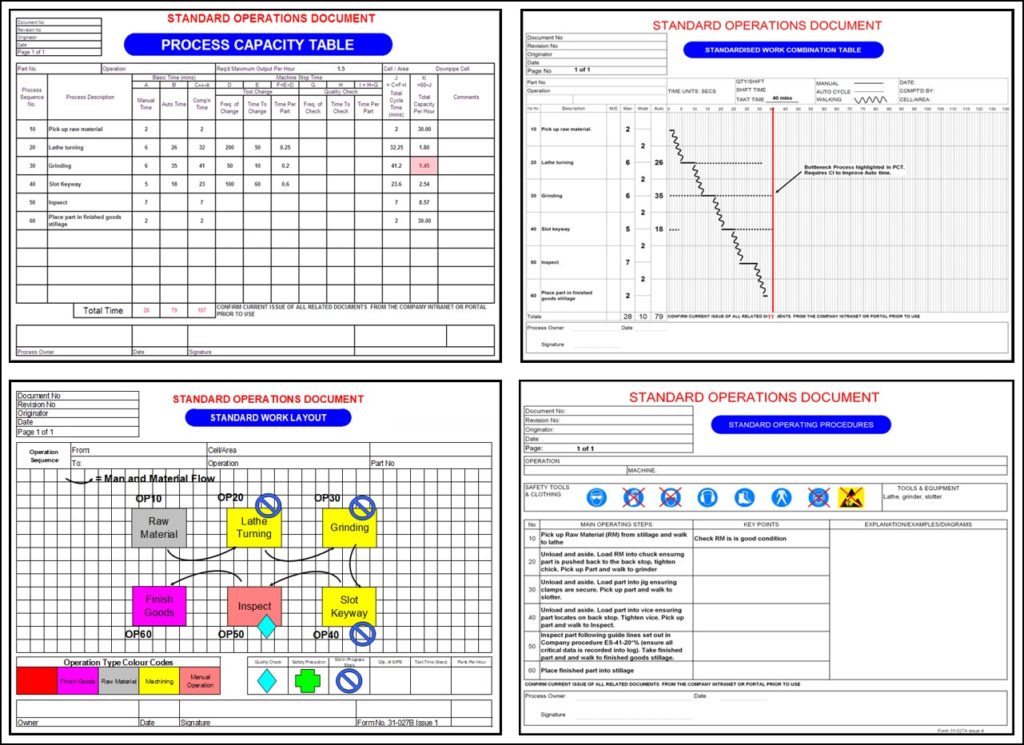
Standard Work is a detailed outline of the optimal current method for performing a particular task or process. It encompasses the best practices identified through continuous improvement efforts and is designed for workers at the operational level to ensure consistency and efficiency. Essentially, it’s the “what” and “how” of the daily tasks:

  • Documented Processes: Clear, concise instructions for performing a task that anyone in the role can follow for consistency.
  • Time Elements: Standard time taken for each task helps in scheduling and balancing workloads in a lean manufacturing system.
  • Sequence of Operations: An optimised sequence for carrying out tasks to reduce waste and ensure efficiency.
  • Quality Checkpoints: Built-in quality inspection points within the workflow to ensure defects are caught and corrected early.
  • Tools and Materials: Identifying and arranging necessary tools and materials to minimise movement and waiting times.

Standard Work is the baseline framework from which continuous improvements are identified and applied. It creates an environment where output quality becomes predictable, and processes become more transparent and efficient. As changes are made through kaizen (continuous improvement) activities, Standard Work documents are updated to reflect the new best practices.

Leadership Standard Work: Enhancing Management Effectiveness

In contrast, Leadership Standard Work turns the spotlight onto the roles of leaders and managers within an organisation. It pertains to the “who,” “when,” and “why” – focusing on leadership behaviours and activities that ensure the Standard Work and all other processes are effective, sustainable, and continuously improving.

  • Routine for Leaders: It includes scheduled checks and observations, regular meetings, and audits ensuring that operations are running according to the documented Standard Work.
  • Performance Monitoring: Involves reviewing key performance indicators (KPIs) to ensure that targets are met, and progress is made toward strategic goals.
  • Problem Escalation: Leaders address issues that frontline employees cannot resolve on their own, bringing a systemic approach to solving workflow interruptions.
  • Mentorship and Development: LSW emphasises developing staff; leaders schedule time to coach and mentor employees, reinforcing a culture of learning and improvement.
  • Change Management: Leaders are tasked with managing and guiding change within the organisation, ensuring that new practices are smoothly integrated and accepted.

LSW provides a blueprint for leaders to follow that ensures they are supporting the Standard Work done at all levels. By managing their time around core leadership tasks and creating a routine aligned with operational processes and goals, leaders ensure that they are not only providing direction but are also supporting and enabling their teams.

Symbiosis and Synergy

Both Standard Work and Leadership Standard Work are vital to sustaining lean manufacturing methodologies. While Standard Work prescribes “the way work is done,” LSW ensures “the way work is led.” In practice, one cannot be successful without the other. Standard Work without supportive Leadership Standard Work may lead to drifts in practice and gradual decline in outcomes as frontline employees may not feel supported or held accountable to maintain improvements. Conversely, Leadership Standard Work without solid Standard Work lacks the baseline consistency required for meaningful leadership activities, leading to disorganised efforts and suboptimal resource allocation.

The synergy between the two establishes a robust system where process efficiency is maintained and continuously improved upon, and where organisational goals are met with consistency through engaged leadership. Leaders reinforce the Standard Work by verifying its application and encouraging continuous improvement, while frontline workers carry out the carefully designed Standard Work, knowing that their efforts are supported and that there’s a framework for escalating and resolving issues. This creates a dynamic loop of performance and productivity that underpins a culture of excellence.

Implementing Leadership Standard Work

To effectively implement LSW, leaders must first understand their roles and establish a set of activities that align with organisational goals. For example:

  • For a Team Leader or Supervisor:
    • Starting the shift with a brief team huddle to discuss the agenda, safety topics, and performance metrics.
    • Routine checks for adherence to 5S standards and progress on action items.
    • Direct, on-the-floor coaching, and problem-solving sessions with team members.
  • For a Senior Manager or General Manager:
    • Weekly or bi-weekly Gemba walks to maintain firsthand knowledge of operations and employee concerns.
    • Participation in cross-departmental meetings to ensure alignment on strategic objectives.
    • Reviewing KPIs and ensuring that audit protocols are being followed to maintain high standards of quality and safety.

Each level of leadership standard work varies in scope and frequency, but the underlying principles remain the same.

Leadership Standard Work Audit

The Impacts of Effective Leadership Standard Work

By embracing LSW, manufacturing organisations can expect several key benefits:

  • Problem-Solving: Frontline associates, empowered to raise issues, drive a culture of immediate problem-solving rather than reactive fire-fighting.
  • Continuous Improvement: Regular practice of LSW ensures that improvement becomes habitual, not just a one-off event.
  • Developing Leaders: Provides a framework for nurturing future leaders by exposing them to strategic thinking and decision-making processes.
  • Performance Gains: Continuous focus on goals and metrics tends to accelerate performance improvements.
  • Team Culture: Promotes a sense of ownership at all levels, leading to stronger team bonding and collaboration.

Case Studies and Evidence

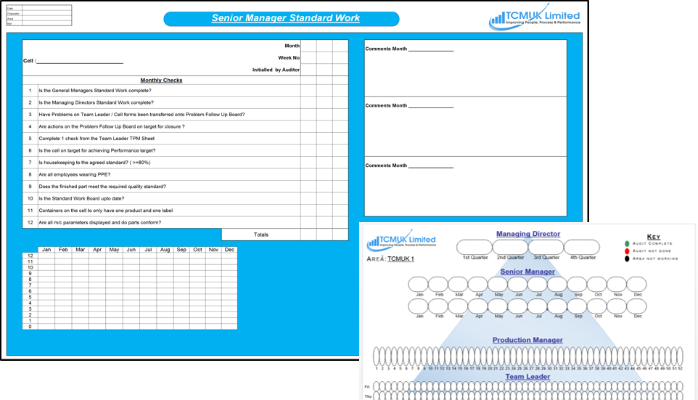
The practice of LSW isn’t theoretical; it has been successfully integrated into numerous organisations. As we implemented and embedded this within Unipart in the late 90’s early 20’s it highlighted its effectiveness. LSW was introduced across the organisational hierarchy, from team leaders to the managing director, driving substantive improvements and embedding a proactive and positive culture. Just one of the many implementations we have done throughout the years since.

The Leadership Pyramid

Visualising LSW through a leadership pyramid can provide clarity on the distribution of responsibilities and activities at all levels. It emphasises the importance of foundation work by team leaders, the managerial oversight, and strategic vision at the upper tiers of the pyramid.

Key-Takeaway

Leadership Standard Work is the engine that propels the continuous improvement vehicle forward. It provides predictability, structure, and a means by which leaders can methodically contribute to the organisation’s overall well-being while developing their teams. In embracing LSW, manufacturing organisations are not merely investing in a set of tasks; they are nurturing a culture of excellence, responsibility, and innovation that echoes through every layer of the company’s fabric.

For manufacturing leaders seeking sustainable improvement and cohesive teams, leadership standard work isn’t a choice—it’s an essential strategy in the modern manufacturing playbook.

If you need support or want to know more about Leadership Standard Work please do contact us

 0330 311 2820

World Class Traits

Committed LEADERSHIP is essential to success

Maintaining a strong CUSTOMER FOCUS assures we’re fixing the right things and going in the right direction

Effective PROCESS MANAGEMENT accelerates improvement & helps us keep ahead of our competitors

Drive improvement goals through the enterprise using effective STRATEGY DEVELOPMENT & REVIEW

Careful attention to ORGANISATIONAL DEVELOPMENT builds important foundations for continued success

Carefully chosen METRICS help us monitor our rate of improvement & make course corrections when needed

Rigorous & Structured USE OF CI TOOLS is the engine that propels improvement

0330 311 2820

Book a Return Call at a time that Best Suits You “HERE”

Why Standardised Work Isn’t Boring (And Why It’s The Secret Weapon You’re Ignoring)

Right, let’s talk about something that, on the surface, sounds about as exciting as watching paint dry. Standardised work. I know, I know. The phrase itself probably conjures up images of old black and white factory footage, rows of identical workers doing identical tasks with robotic precision. It feels rigid, a bit soul crushing, and completely at odds with the dynamic, creative, and, let’s be honest, slightly chaotic way most of our businesses actually run.

And that’s the problem right there. It’s one of the most powerful, transformative tools in the entire lean manufacturing playbook, yet it remains one of the least understood and least used. Why? Because we’ve completely misunderstood what it’s for.

From my own experience working with countless teams, I can tell you this with absolute certainty: without standards, you do not have continuous improvement. What you have is chaos. You have firefighting. You have good days and bad days that you can’t quite explain. You have a constant, draining variability that makes progress feel like guesswork.

I’ve heard all the rebuttals, and I’m sure you have too. They usually come from very smart, passionate people who genuinely believe their work is different.

“We don’t make cars, you know.”

“You see, our process is creative. It can’t be standardised.”

“We’re unique… this isn’t an assembly line!”

And I get it, I really do. The objection comes from a good place, a desire to protect the craft, the human element, the spark of ingenuity that makes their work special. But here’s the thing I always say in response. Everyone, and I mean everyone, works a process. That process, whether you’re designing a marketing campaign, admitting a patient to a hospital, writing code, or yes, building a car, can only be doing one of two things. It’s either creating value for your customer, or it’s destroying it. Which would you rather it be?

It doesn’t matter if you’re delivering lifesaving patient care or assembling a gearbox. The end result relies on a sequence of highly coordinated tasks and processes. When you find a way to standardise the best-known method for that sequence, you’re not killing creativity. You’re clearing the path for it. You are beginning the journey of fundamentally improving your work and eliminating the significant, often hidden, sources of waste that frustrate your team and disappoint your customers.

The Great Misunderstanding: “But Our Work is Special”

Let’s dig into that pushback a little more, because it’s the single biggest barrier to getting started. The idea that standardisation is only for the factory floor is a myth, but it’s a persistent one.

Imagine the head of a busy A&E department. Their environment is the definition of unpredictable. Every case is different, every patient unique. The idea of a “standard” way of working seems almost insulting to the skill and judgement of the doctors and nurses. But think about the process of triage. Is there a standard set of questions to ask to assess urgency? Is there a standard procedure for checking vital signs? A standard location for the crash cart? Of course there is. These standards don’t restrict a doctor’s ability to make a complex diagnosis. They do the opposite. They handle the repeatable, critical basics flawlessly every single time, freeing up the doctor’s mental energy to focus on the difficult, unique aspects of the patient’s condition. Without those standards, you get chaos, missed steps, and potentially tragic errors.

Or what about a team of software developers? They’re the epitome of modern knowledge work. Their job is to solve complex problems with elegant code. You can’t standardise creativity, right? Well, no, you can’t standardise the moment of inspiration. But you can absolutely standardise the process around it. How does the team handle bug reports? Is there a standard way to test new code before it’s deployed? A standard checklist for releasing an update to prevent servers from crashing at 2 a.m.? These standards don’t tell a developer how to write a brilliant algorithm. They create a stable, predictable framework so that their brilliant algorithm can be delivered to users reliably and without causing new problems. They prevent the team from constantly reinventing the wheel on routine tasks.

The truth is, every job has elements that are repeatable. Standardised work isn’t about the whole job; it’s about those repeatable parts. It’s about agreeing, as a team, on the best way we currently know how to do a specific task. By doing this, we create a baseline. A stable foundation. And you cannot improve something that isn’t stable. Trying to improve a chaotic process is like trying to measure a moving object with a ruler made of elastic. The data you get is meaningless.

So, the next time you hear “we’re different,” the answer isn’t to argue. It’s to ask a different question. “What parts of our work are repeatable? And for those parts, have we agreed on the best way to do them?” The conversation that follows is often the first real step toward meaningful improvement.

So, What Is It, Really?

At its heart, standardised work is incredibly simple. It’s the documented, current, best practice for completing a task. It’s a living document that captures the most efficient and effective way we know right now to get a job done to the highest quality. The goal is to ensure that the same results are achieved, in roughly the same amount of time, with the same level of safety and quality, regardless of who on the team completes the task.

The key word in that definition is current. This is not about carving a process into stone tablets to be handed down from on high. It’s not a rigid, top-down procedure manual that gets written once and then gathers dust in a forgotten folder on the company server. To be honest, that kind of documentation is worse than useless; it breeds cynicism.

Standardised work is the opposite of that. It’s a tool for the people actually doing the work. It’s a dynamic agreement, a hypothesis that says, “Based on everything we know today, this is the best way to do this.” And tomorrow, we might find a better way. When we do, we test it, prove it, and then we update the standard. It’s the engine of kaizen, or continuous improvement.

Think of it like a professional chef’s recipe. A Michelin starred chef has a precise, documented recipe for their signature dish. Every ingredient is measured, every step timed, every technique specified. This doesn’t stifle their creativity. It ensures that every customer who orders that dish gets the same brilliant experience. The standard recipe is the foundation. It’s what allows the kitchen brigade to perform flawlessly under pressure. The creativity happened when the chef was developing the recipe, experimenting with ingredients and techniques. And if they discover a better way to sear the scallops or a new spice for the sauce, they don’t just do it randomly. They test it, perfect it, and then they update the master recipe. They change the standard.

That is what we’re aiming for. A clear, agreed upon method that removes ambiguity and inconsistency from our routine tasks, freeing up our minds to focus on the real problems and the next improvement.

The Building Blocks of a Good Standard H2

While the specific document might look different in an office versus on a factory floor, the core principles and key elements remain remarkably consistent. To build effective standardised work, you generally need to understand three key components.

Standard Work Elements

1. Takt Time

This is a concept that often gets confused with cycle time, but they are very different things. “Takt” is a German word, and it means beat, or rhythm, like the baton of a conductor keeping an orchestra in time. In a business context, Takt time is the rhythm of your customer demand. It’s the rate at which you need to complete a product or a service to keep up with what your customers are asking for.

The calculation is simple:
Takt Time = Your Available Production Time per Day / Your Customer Demand per Day

Let’s use a non-manufacturing example. Imagine a mortgage processing team that has 420 minutes of available work time in a day (after breaks and meetings). The company receives, on average, 70 mortgage applications per day that need to be processed.

Takt Time = 420 minutes / 70 applications = 6 minutes per application.

This number is profound. It’s the heartbeat of the operation. It tells the team that to meet customer demand, one completed application needs to roll off their production line, so to speak, every six minutes. It’s not about how long it actually takes to do the work (that’s cycle time). It’s about the pace required to satisfy the market. Understanding Takt time helps you design your processes. If the team’s current process takes 10 minutes, you immediately know you have a problem. You can see the gap between your capability and your customer’s expectation, and that’s where your improvement efforts should focus. It prevents overproduction (working faster than needed, which builds up inventory and waste) and underproduction (working too slow, which leads to backlogs and unhappy customers).

2. Work Sequence

This is the most straightforward part. As the great Taiichi Ohno of Toyota put it, it is “The time for an employee to do a prescribed task and return to his original stance.” It is the actual step by step sequence of actions that a person performs to complete one cycle of their work within the Takt time.

A good work sequence is clear, logical, and focuses on the most efficient path of action. It’s not a dense paragraph of text. It’s usually a numbered list, often accompanied by pictures or diagrams, that breaks the task down into its core elements. What is the first thing you do? What is the second? Where do you get your materials from? What tool do you use? It captures the how of the job in a way that is easy for anyone to follow. This ensures that everyone is following the same best practice, which is the key to reducing variation and defects.

3. Standard Inventory

This third element is often overlooked, especially in service or office environments. In manufacturing, it’s easy to understand. It refers to the minimum number of parts or materials needed at a workstation to complete the work smoothly without interruption. You need enough to keep working, but not so much that you’re creating clutter and excess inventory.

In other sectors, the “inventory” might be different, but the principle is the same. For a software developer, it could be the number of open tasks in their “to do” column. Too few and they risk being idle; too many and they suffer from context switching and an overwhelming workload. For a call centre agent, it might be the number of reference documents they need open on their screen to answer customer queries effectively. For a doctor, it could be the standard number of patient files to have ready for their next appointments.

Standard inventory is about defining the minimum resources necessary to perform the job according to the standard work sequence and within the Takt time. It’s about ensuring the process flows without hiccups or delays caused by searching for information, tools, or materials.

Putting It All Into Practice: A Few Ground Rules

Knowing the theory is one thing, but actually creating and sustaining a culture of standardised work is another. It requires a thoughtful, human centred approach. Here are a few things to bear in mind.

First, and most importantly, involve the employees. The people who do the work every day are the experts. A manager sitting in an office trying to write a standard for a task they haven’t performed in years is a recipe for disaster. The standard will be wrong, and the team will resent it and ignore it. The best standards are created when a leader facilitates a conversation with the team, at the place where the work is done. You observe the process together, you time the different steps, and you collectively agree on what the current best practice is. This builds ownership and engagement. When the team creates the standard, they are far more likely to adhere to it and, even better, to improve it.

Focus on the gritty details. A standard that is too high level is useless. Its purpose is to reduce variation, and variation lives in the details. You need to capture the little nuances, the “tricks of the trade.” I remember working with one process where an associate had to physically lean on one part to get another part to fit correctly. A slight tolerance stack up in the components meant it was the only way. This “knack” had to be written into the standard work. Now, was that the long-term solution? Of course not. But documenting it made the problem visible to everyone, including the engineers. It quantified the issue. Imagine the lost time and production if a new person started, wasn’t told about the trick, and spent hours struggling. By documenting the knack, we created a temporary standard while a permanent engineering solution was developed to fix the root cause. Without that detail, the problem remains hidden in tribal knowledge.

Use visuals whenever you can. Our brains are wired to process images far more quickly and effectively than text. A single photograph with a few key annotations can convey more than a full page of written instructions. Use diagrams, photos, examples, and even colour coding to bring your standard work to life. A picture really is worth a thousand words, and it helps overcome language barriers and differences in reading comprehension. The goal is instant clarity.

Make it accessible. This seems obvious, but it’s a common failure point. The documentation is no good if it’s locked in a filing cabinet or buried in a complex server directory. The standard work needs to be available at the point and time that the work is actually being performed. Laminated sheets at the workstation, a monitor displaying the steps, a tablet with the instructions readily available. If a team member has to walk away from their work area to find out how to do their job, the system has failed.

Finally, build a system to innovate. This is the crucial point that prevents standardisation from becoming stagnation. While you don’t want employees deviating from the standard work on a whim, you absolutely must have a clear and simple process for them to suggest improvements. When someone has a new idea, a better way, there needs to be a method to consider it. This is often handled through a governance process or a kaizen suggestion system. It allows the new idea to be tested, analysed, and, if it proves to be better, for it to be approved and rolled out as the new standard for everyone. This creates a positive feedback loop. It tells the team, “We value your expertise, and we want your ideas.” The standard isn’t a cage; it’s simply the starting line for the next improvement.

Standardised work isn’t the most glamorous tool. It doesn’t have the futuristic appeal of AI or automation. But it is, without a doubt, the bedrock of operational excellence. It’s about creating stability in a chaotic world. It’s about respecting the people who do the work by capturing their collective knowledge. And most of all, it’s about building a solid foundation, a floor from which your entire team can rise, together, to new levels of performance. It’s time we stopped dismissing it and started seeing it for what it truly is: the starting point of all meaningful improvement.

Ready to Go Beyond the Basics?
Body: Standard Work is a cornerstone of Lean, but it’s just one tool in the toolbox. Our Lean Green Belt training gives you the complete framework to lead impactful improvement projects from start to finish.
Learn More About Green Belt Certification


>

0330 311 2820

Book a Return Call at a time that Best Suits You “HERE”

“Performance Rooms” a powerful Visual Management Tool.

Over the last few months I had a number of discussions regarding what I call “Performance Rooms” others call “War Rooms” (never really been keen on that expression but as long as the process is followed what does it matter) or the Japanese term “Obeya Rooms”. I will use Obeya in this article.

These rooms and the disciplined approach to the process behind them helps businesses to reach their strategic/tactical goals and promotes the creation of solutions and actions that can be developed and implemented quickly. The aspect of Managing Performance Improvement for any business undertaking Growth or Lean.

Strategy Room

The following is an overview to understand the theory behind it.

Obeya is based on a simple idea that we dedicate: time, space, the coordination to root cause analysis and problem solving so that organisational barriers are minimised. This ability to maintain a disciplined approach to real-time problem awareness, listening to team members concerns, making discoveries, resolving problems, collaborating and above all developing/mentoring our people is critical to the success of a business.

They promote the coordination and implementation of Strategic and Tactical issues by mobilising and pulling together the intellectual resources of all employees in the service of the firm.

The following are different types of Obeya Rooms (not limited to):

Product Launch; when developing a new product, managers responsible for decision making in design, production engineering, and manufacturing gather in one place to shorten the lead-time through real-time problem resolution.

Business Process Layout: Centralised data collection, prioritising and action planning.

Focused: Project Performance Rooms, SQPDC, A3 Problem Solving, Continuous Improvement rooms.

Observations to consider when looking at Obeya Rooms :

  • Use two colors when tracking status, Red and Green. This avoids ambiguities; the status is ON TARGET or NOT.
  • Define SMART metrics (Specific, Measurable, Attainable, Realistic, Timely), no more than 3-5 focused metrics as more would be impractical for every day review.
  • Problem, Follow-Up and Countermeasure Boards are mandatory, the team must be prompted to solve issues immediately. The deferment/stalling to solving the problem is not allowed.
  • Meeting Discipline – Punctuality, Question and Challenge with dignity and Respect and the meeting should last no more than 30mins.
  • The flow for review takes the shape of Check, Plan, Do, Check, Act instead of the normal PDCA.

0330 311 2820

Book a Return Call at a time that Best Suits You “HERE”

A3 Problem-Solving – How To Tell the Story On One Sheet of Paper.

I was chatting with a few contacts recently, and the topic of A3 Problem Solving came up. It got me thinking, and I figured it was worth doing a quick overview of what it is and, more importantly, why it’s so surprisingly effective.

We’ve all been there, haven’t we? Staring at a 40-page report that’s landed in our inbox, complete with dense paragraphs, endless charts, and a conclusion that, if we’re honest, we’ll probably just skip to. Or maybe we’re the ones writing it, spending days crafting the perfect document, only to suspect it will be skimmed at best and ignored at worst. There’s a kind of corporate theatre to it all. We create these huge, comprehensive documents to prove we’ve done the work, but do they actually help anyone think better or make better decisions? Most of the time, I’d argue they don’t. They bury the essential story under a mountain of information.

This is where a beautifully counter intuitive idea comes into play. The idea that you can achieve more clarity, better thinking, and stronger alignment with less. Specifically, with a single sheet of A3 paper.

Problem solving, at its heart, is a thinking-intensive activity. But the act of writing things down, of structuring our thoughts, can massively amplify the quality of that thinking. It forces us to move from a jumble of ideas in our heads to a logical, coherent narrative. The A3 process is a framework designed to do exactly that. It guides us to document key information and decisions at each step of a problem-solving journey. This document then becomes a living thing, something that can be shared with others to get their input, to challenge our assumptions, and to build a shared understanding before any final decisions are made.

It sounds simple, and in many ways it is. But its power lies in a discipline that most of our modern reporting has lost.

So, Why A3? A Quick History Lesson

Let’s get the most obvious question out of the way first. Why the name A3? It’s almost comically practical. The methodology was pioneered at Toyota, a company famous for its relentless focus on efficiency and continuous improvement. Back in the day, much of their communication across different sites, and even different countries, was done by fax. And A3, which is roughly 29 by 42 centimetres, just happened to be the largest size of paper that could reliably fit through a fax machine.

It’s an amazing little detail, I think. A world changing management philosophy constrained and shaped by the technology of the time. It’s a perfect reminder that innovation doesn’t always come from some grand, abstract vision. Sometimes it’s born from very real, very mundane limitations. The size constraint wasn’t an afterthought; it was a foundational element that forced a particular kind of discipline. You couldn’t just keep adding pages. You had to be concise. You had to make every word and every chart count.

This little piece of history is crucial because it gets to the very soul of the A3 report. The key fundamental is not the rigid format, the specific boxes you have to fill in, or the finesse with which you create fancy drawings and charts. To be honest, a beautifully designed A3 that reflects shallow thinking is completely useless. The real point, the thing that makes it all work, is the communication process it enables.

The A3 is the physical manifestation of a problem solving journey. It’s a tool that underpins a deeper process of critical thinking and collaborative decision making. It allows the most critical information about a problem, from its background to the proposed solution, to be distilled onto a single page. This can then be shared across the business, allowing others to quickly evaluate the thought process behind it. It becomes a formal means for requesting support and advice, which in turn aligns everyone in the organisation on how the problem will be tackled and moved forward. It transforms problem solving from a solo activity into a team sport.

Anatomy of an A3 Report

If you look at a typical A3 template, you’ll see it’s laid out to tell a story, flowing logically from left to right and top to bottom. While the exact layout isn’t set in stone, as I mentioned, the format is not the main point, most successful A3s follow a structure that mirrors the Plan Do Check Act, or PDCA, cycle. It guides you through a systematic process, ensuring no critical steps are skipped.

A3 Problem-Solving Template

Let’s break down the typical sections.

  1. Title or Theme: This is the headline. It should concisely define the problem you’re trying to solve. Something like, “Reducing Customer Wait Times in the Support Queue” or “Improving the Accuracy of Monthly Financial Forecasts.” It needs to be clear and specific, framing the entire document.
  2. Background / Current Condition: This is where you set the scene. Why is this problem important? Who does it affect? What is the business impact? This section isn’t about opinions; it’s about facts. You need to go and see the process for yourself, what lean practitioners call genchi genbutsu. You should include data, charts, or simple diagrams to show the current state. What does the process look like right now? What is the performance? This section grounds the problem in reality.
  3. Goal / Target Condition: If the last section was about where we are, this is about where we want to be. What does success look like? The key here is to be incredibly specific and measurable. “Make things better” is not a goal. “Reduce average customer wait time from 4 minutes to 90 seconds by the end of Q3” is a goal. It should be a clear, unambiguous statement that leaves no room for interpretation. This target becomes the benchmark against which you’ll measure your success.
  4. Root Cause Analysis: To me, this is the absolute heart of the A3. It’s where the real thinking happens. It’s also the step that is most often rushed or skipped entirely in traditional problem solving. We see a problem, we jump to a solution. The A3 process forces you to slow down and ask one simple, powerful question, over and over again: Why? This is the famous “5 Whys” technique. You state the problem and ask why it’s happening. Then you take that answer and ask why that is happening. You continue drilling down until you move past the symptoms and uncover the true root cause. Often, the cause you end up with is completely different from what you initially suspected. This section might include a fishbone diagram or a simple bulleted list, but its purpose is to show a clear, logical chain of reasoning from the problem to its source.
  5. Countermeasures / Proposed Actions: Only after a thorough root cause analysis can you begin to think about solutions. Notice the word “countermeasures,” not “solutions.” It’s a subtle but important distinction. A countermeasure is a specific action designed to address a specific root cause. This section should directly link back to your analysis. If a root cause was “Inadequate training on the new software,” a countermeasure would be “Develop and deliver a mandatory 2 hour training module for all team members.” You’re not just throwing ideas at the wall; you’re proposing targeted interventions.
  6. Implementation Plan: This is where the plan becomes real. An idea without a plan is just a wish. For each countermeasure, you need to define who is responsible, what specific tasks need to be completed, and when they need to be done by. It’s a simple table: What, Who, When. This creates accountability and turns a good idea into a concrete project.
  7. Follow Up / Verification: How will we know if our countermeasures actually worked? This section closes the loop. It defines the metrics you will track, which should be directly related to the goal you set at the beginning. It also specifies when and how you will check the results. Are you going to review the data weekly? Monthly? This step ensures that the A3 isn’t just a one time exercise but the start of a continuous improvement cycle.
  8. Results and Learning: Finally, once the plan has been implemented and enough time has passed, you document what actually happened. Did you hit your target? If so, great. What did you learn that you can apply elsewhere? If not, why not? This is just as valuable. An A3 that shows a failed experiment is not a failure; it’s a source of incredible learning. This final section captures that knowledge for the rest of the organisation.

The Real Magic: A Tool for Thinking and Talking

So, that’s the structure. But if you just download a template and fill in the boxes, you’re missing the point entirely. The document is just an artefact; the real value is in the thought process and the conversations it creates.

First, it’s a tool for clarifying your own thinking. The constraint of the single page is a powerful focusing agent. You can’t waffle. You can’t hide behind jargon or bury weak arguments in long paragraphs. You have to be brutally economical with your words. The process of trying to fit a complex problem onto one sheet forces you to simplify, to prioritise, and to make sure your logic is sound. You can literally see the connections between the problem, its root cause, and the proposed fix. It makes your thinking visible, not just to others, but to yourself.

Second, and perhaps more importantly, the A3 is a catalyst for communication and collaboration. In a typical corporate setting, a proposal or report is often worked on in isolation and then presented in a big meeting, a “big reveal” moment. This often puts people on the defensive. They poke holes in it, ask questions the presenter isn’t prepared for, and the whole thing can descend into conflict or get bogged down in debate.

The A3 process flips this on its head. The A3 is meant to be a draft, a conversation starter. The idea is to take your messy, pencil drawn A3 and walk it around to the key stakeholders. This process is sometimes called nemawashi in Japanese, which translates literally to “turning the roots.” It’s about carefully building consensus from the ground up. You show it to your manager, to the people who work in the process, to colleagues in other departments. You don’t present it; you ask for their help. “Here’s what I’m thinking, what am I missing?” “Does this data look right to you?” “What are your thoughts on these countermeasures?”

This approach does a few wonderful things. It enriches the A3 with diverse perspectives, making the final outcome much stronger. It builds buy in from the very beginning, because people feel they have been part of the solution finding process. And it fosters a culture of coaching. A good manager doesn’t just approve or reject an A3. They ask probing questions. “Why did you stop your root cause analysis there?” “How confident are you that this countermeasure will achieve the full target?” They coach the author to think more deeply, turning every problem into a development opportunity.

How to Start Your First A3

If any of this sounds interesting, my advice is simple: just try it. Pick a small, nagging problem that you’re familiar with. It doesn’t have to be a multi million pound production issue. It could be something as simple as “Team meetings consistently run over time” or “The process for submitting expense reports is confusing.”

And please, for your first few attempts, follow the original author’s advice and use a pencil and a physical piece of paper. I know it sounds old fashioned, but there’s a reason for it. A PowerPoint or a fancy software template can create a false sense of finality. It looks polished, so we become reluctant to change it. A pencil and paper, on the other hand, feels temporary and iterative. It gives you permission to be messy, to erase things, to scribble in the margins, and to focus purely on the quality of your thinking, not on your graphic design skills.

Walk through the sections one by one. Go and observe the current condition. Talk to the people involved. Spend a good amount of time on the root cause analysis. Don’t just accept the first answer that comes to mind. Keep asking why. Then, once you have a rough draft, go and talk to someone about it. See what they think. Your first one won’t be perfect, and that’s completely fine. The goal is to practice the thinking discipline, not to create a masterpiece.

Over time, you’ll find that the structure becomes second nature. It becomes an internal mental model for how you approach any problem, whether you’re formally writing an A3 or not.

A Way of Thinking for Everyone

While the A3 report was born on the factory floors of Toyota, its application is truly universal. It’s a mistake to see it as just a manufacturing tool. At its core, A3 thinking is simply a structured, collaborative, data driven approach to problem solving. And what part of a business couldn’t benefit from that?

Think about it.

A marketing team could use it to analyse why a particular campaign underperformed, digging into root causes related to audience targeting, messaging, or channel selection, rather than just shrugging and moving on to the next thing.

An HR department could use it to tackle a problem like high employee turnover in a specific team. Instead of jumping to solutions like a pay rise, they could use the A3 process to uncover deeper issues related to management style, workload, or career development opportunities.

An IT team could use it to finally solve a recurring network outage, systematically investigating the root cause instead of just rebooting the server every time it happens.

Even at a strategic level, a simplified A3 format can be used to propose a new business initiative, outlining the current market condition, the proposed goal, the analysis behind the proposal, and a high-level implementation plan, all on one page for senior leaders to review.

The principles are always the same: Go see for yourself. Grasp the current situation. Analyse down to the root cause. Build consensus around effective countermeasures. And follow through to ensure they work.

In the end, the A3 process is a powerful antidote to the complexity and information overload that plagues so many of our organisations. It’s a call to return to a more disciplined, more thoughtful, and more human way of solving problems. It reminds us that clarity doesn’t come from adding more information, but from stripping away everything that isn’t essential.

It proves that sometimes, the most powerful and persuasive story you can tell is the one that fits on a single sheet of paper.

We’re different it won’t work here

It’s been an interesting month, great meetings, new contacts and one of the most interesting presentations I‘ve given regarding Operational Excellence and Problem Solving.

The presentation was given to the Manufacturing and Construction sectors as part of a Seminar/Workshop.

The comments at the end we’re ones I have heard over and over again, “We’re Different, it won’t work here!”

Is “we’re different” an excuse not try to improve?

This got me thinking in one of my reflective moments, what is it that naturally creates this push back? Do we think that Business Excellence, Operational Excellence, Lean or Six Sigma is a technical tool and technique, only applied to manufacturing, high volume processes, etc? Is it we naturally assume that it’s for the automotive industry?

There are a number of answers you can come up with that can be assigned to this emotion and push back.

So we have to ask ourselves

Do business improvement principles (as that is all they are) apply to pretty much every process? Yes, I’d say so. Does that mean its easy to put in place? Absolutely not. But that, along with being different, should be no reason to not try.

Which leads me on from last month’s article REFLECTION! and into OPERATIONAL EXCELLENCE TRANSFORMATION

We must first seek to understand what is it we are trying to solve, what problem? This could be as an organisation, function, sub-process.

Then we must ask,

What process improvement needs to be done? What do I need to design, re-design, improve to solve our problem and achieve our objective?

Next,

Do I have the capability in house? Do I have the skillset within my team?

We then come to,

What mindset do I need to have? Growth? (One of learning as we do not have the capability in house), Implementation (I have the capability so execute, or get support if you don’t), Experimental (try and test)

Remembering that Leadership behaviour and Programme Management are the key. The governance process you apply.

Final thought – it’s often said that “Operational Excellence doesn’t succeed or fail… it’s just a set of principles. What succeeds or fails is the organisation or the leaders who try.” Success isn’t guaranteed — it requires hard work and creativity to figure out how will work in your setting, because you are different!

0330 311 2820

Book a Return Call at a time that Best Suits You “HERE”

Reindustrialising Britain.

Just reading though an article (again) in the UK Manufacturing Review and felt compelled to quote James Selka (CEO of The Manufacturing Technologies Association).

I have to say James is spot on with his comments.

“We are living through an explosion in the potential of technology, and it provides a most wonderful opportunity to reinvigorate the manufacturing sector in the 21st century.”

“Manufacturing is remarkable because of the multiplier effect that the sector has. It is so complex, and touches so many other sectors, that activity in it acts as a stimulus to the economy as a whole.”

“As technology becomes more central to the process of manufacturing, the cost of labour – the rationale for much of the offshoring that took place – is a smaller and smaller proportion of the cost of manufacturing activity. Labour cost becomes less of a driver…”

“This is not just about what others can do for us, but what we – UK Manufacturing – can do to help ourselves”

Extracts taken from the UK Manufacturing Review 2015 -16 (Stirling Media).

0330 311 2820

Book a Return Call at a time that Best Suits You “HERE”

How Good is Your Factory? Are there Opportunities?

It’s easy to feel like a factory tour is something that happens once every couple of years, but in reality, it’s something that should happen every day. Conducting regular factory tours and assessments is crucial for maintaining operational efficiency, safety, and overall productivity. This regular review helps factory managers and supervisors identify areas of improvement and ensure that their operations are lean and effective.

Walking your factory floors is not just a managerial activity; it’s an opportunity to observe, learn, and communicate with your workforce. There are nine key items to consider when assessing the lean nature of your factory. These elements provide a comprehensive framework for evaluating your factory’s effectiveness and identifying opportunities for improvement.

1. Work Stations

The first item to consider is the state of your workstations. A clean, organised workstation is a hallmark of a well-run factory. Are the workstations free from unnecessary material and equipment? Are tools organised, identified, and easy to find? The 5S methodology (Sort, Set in order, Shine, Standardise, Sustain) is a great tool to ensure that workstations are kept in optimal condition.

Visual labelling, proper lighting, and cleanliness are crucial. Workstations should be well-lit to prevent accidents and ensure that employees can work efficiently. Equipment needs to be clean and in good working order. Supervision and support personnel should be present on the shop floor to provide immediate assistance and oversight. Metal-on-metal contact, safety hazards, and debris on the floors are signs of poor workstation management. Even the cleanliness of the bathrooms can provide insights into the overall maintenance of the facility.

2. Monuments

Monuments refer to large, immovable machines that are anchored to the floor. These machines often require materials to be delivered to them, which can disrupt the flow of production and reduce flexibility. It’s important to evaluate whether these monuments are still in use and if they are contributing to inefficiencies in your production process.

Not all older machines are inefficient; some are purpose-built and offer flexibility in cellular manufacturing. The key is to assess whether machinery, material locations, and drop-off points can be easily rearranged to improve workflow and reduce bottlenecks.

3. Work in Process (WIP)

Excessive Work in Process (WIP) is a clear indication of inefficiencies in the production process. Are there piles of WIP accumulating on the factory floor? Has some of it been there so long that it has grown roots or celebrated multiple birthdays? Each piece of WIP should have associated paperwork, and there should be a clear process for managing and prioritising hot items.

In an ideal factory, WIP should be minimised, and the only WIP present should be classified as Standard in Process Stock (SIPS), meaning it is controlled and part of the regular workflow. Reducing WIP can lead to significant improvements in efficiency and productivity.

4. Visibility of Targets and Schedules

Can everyone in your factory see if they are on target or behind schedule? Hour-by-hour monitoring or close-to-real-time tracking is essential for maintaining productivity and identifying issues as they arise. Using visual indicators like red and green colours can help distinguish between normal and abnormal conditions.

When abnormalities are identified, they should be recorded and analysed to determine the root cause and implement corrective actions. This proactive approach helps prevent recurring issues and ensures that production stays on track.

5. Team Metrics

What metrics do your teams have to measure their performance? Charts, graphs, and objectives should be posted in the work area, and these should be standard documents that are revision controlled, time and date stamped. Metrics need to be up-to-date, regularly reviewed, and actionable.

Having clear metrics allows teams to see if they are meeting their targets and identify areas that need improvement. It also helps distinguish between normal and abnormal conditions, enabling quick responses to emerging issues.

6. Materials at Point of Use

Efficient material delivery is crucial for maintaining a smooth production flow. Are materials delivered to or stacked at the point of use? If a worker loses a component like a screw, nut, or rivet, do they have to go to the stockroom to retrieve another one? This can cause significant delays and disrupt the workflow.

Assess how items are replenished and whether the process depends on cranes or forklifts. Implementing a just-in-time (JIT) system where materials are delivered exactly when needed can reduce inventory costs and improve efficiency.

7. Product Flow

How does the product flow through your factory? Is it through a cell, moving line, or in large batches or lots? Associates should be positioned close together so they can communicate easily, see each other’s WIP, and assist if something goes wrong.

A smooth product flow reduces bottlenecks and ensures that production processes are efficient. It also fosters a collaborative environment where workers can support each other and address issues promptly.

8. Testing and Inspection

Where is the product inspected and tested? Are inspections conducted by the associates themselves, or does the product move to a separate area for inspection? Having large numbers of inspectors can indicate inefficiencies, and a backlog in inspections can delay the production process.

Defects should be recorded, reviewed, and actioned. Tracking defects and implementing corrective actions can help reduce their occurrence and improve product quality over time.

9. Communication and Engagement

The most important aspect of assessing your factory is communication. Show dignity and respect at all times, question and challenge, talk to the people on the front line, and ask why. Understanding the perspectives of those directly involved in production is invaluable for identifying issues and opportunities for improvement.

Engage with your workforce, use your senses to observe, and foster an environment where open communication is encouraged. This approach not only improves operations but also boosts morale and job satisfaction.

In-Depth Exploration

Now that we have outlined the nine key points to consider when assessing your factory, let’s delve deeper into each aspect to provide additional background context, examples, and expert opinions.

1. Workstations: The Foundation of Productivity

Workstations are the foundation of productivity in any factory. A well-organised workstation minimises the time workers spend searching for tools and materials, reduces the risk of accidents, and enhances overall efficiency. The 5S methodology is widely recognised as a best practice for maintaining organised workstations.

  • Sort: Remove unnecessary items from the workspace.
  • Set in Order: Arrange tools and materials for easy access.
  • Shine: Keep the workspace clean.
  • Standardise: Establish consistent cleaning and organisation procedures.
  • Sustain: Maintain and review standards regularly.

For example, Toyota, a pioneer in lean manufacturing, has implemented the 5S methodology across its production facilities. This approach has significantly improved their operational efficiency and reduced waste.

2. Monuments: Balancing Flexibility and Efficiency

Monuments, or large immovable machines, can be a significant barrier to flexibility in a production environment. While they are often necessary for specific manufacturing processes, it’s essential to evaluate their impact on workflow and efficiency.

In some cases, investing in more flexible machinery that can be easily rearranged can lead to substantial improvements. For instance, a study by the Lean Enterprise Institute found that companies that replaced monuments with more adaptable equipment saw a 30% increase in production efficiency.

3. Work in Process (WIP): Controlling Inventory Levels

Excessive WIP can tie up valuable resources and space, leading to inefficiencies. Implementing a pull system, where production is driven by actual demand rather than forecasts, can help control WIP levels.

Kanban, a scheduling system that visualises work and inventory levels, is an effective tool for managing WIP. By using Kanban cards to signal when new materials are needed, factories can reduce excess inventory and improve flow.

4. Visibility of Targets and Schedules: Real-Time Monitoring

Real-time monitoring of targets and schedules is crucial for maintaining productivity. Digital dashboards and visual management tools can provide instant insights into production status and help identify issues quickly.

For example, General Electric (GE) uses real-time monitoring systems across its production facilities. These systems provide up-to-the-minute data on production performance, enabling quick responses to any deviations from the plan.

5. Team Metrics: Data-Driven Decision Making

Having clear and actionable metrics allows teams to make data-driven decisions. Metrics should be aligned with overall business goals and regularly reviewed to ensure they remain relevant.

Key performance indicators (KPIs) such as cycle time, throughput, and defect rates provide valuable insights into production performance. Regularly reviewing these metrics helps identify trends and areas for improvement.

6. Materials at Point of Use: Just-In-Time Delivery

Just-in-time (JIT) delivery is a cornerstone of lean manufacturing. By delivering materials exactly when they are needed, factories can reduce inventory costs and minimise waste.

For example, Honda has implemented JIT delivery across its production facilities, resulting in significant cost savings and improved efficiency.

7. Product Flow: Streamlining Processes

A streamlined product flow reduces bottlenecks and ensures that production processes are efficient. Techniques such as value stream mapping can help identify and eliminate waste in the production process.

By mapping out the entire production process, factories can identify areas where delays and inefficiencies occur and implement improvements to enhance flow.

8. Testing and Inspection: Ensuring Quality

Effective testing and inspection processes are essential for maintaining product quality. Implementing in-line inspection, where quality checks are integrated into the production process, can help identify defects early and reduce rework.

For example, Boeing has implemented in-line inspection in its aircraft manufacturing process, resulting in higher quality products and reduced production time.

9. Communication and Engagement: Fostering a Collaborative Environment

Open communication and engagement with the workforce are crucial for identifying issues and opportunities for improvement. Regular team meetings, suggestion programs, and employee feedback mechanisms can help create a collaborative environment where continuous improvement is encouraged.

For instance, Toyota’s approach to continuous improvement, known as Kaizen, involves all employees in identifying and implementing improvements. This approach has been instrumental in Toyota’s success and is widely regarded as a best practice in lean manufacturing.

Key Takeaways

Assessing the effectiveness of your factory is an ongoing process that requires regular reviews and a commitment to continuous improvement. By focusing on the nine key areas outlined above, factory managers can identify opportunities for improvement and implement changes that enhance efficiency, productivity, and overall performance.

Regular factory tours and assessments provide valuable insights into the state of your operations and help ensure that your factory remains competitive in an ever-evolving market. By fostering a culture of continuous improvement and engaging with your workforce, you can create a productive and efficient factory that meets the demands of today’s dynamic business environment.

Remember, the journey to lean manufacturing is never complete. It requires ongoing effort, regular reviews, and a commitment to excellence. Now, armed with these insights and best practices, go look, see, and improve your factory’s operations.


0330 311 2820

Book a Return Call at a time that Best Suits You “HERE”